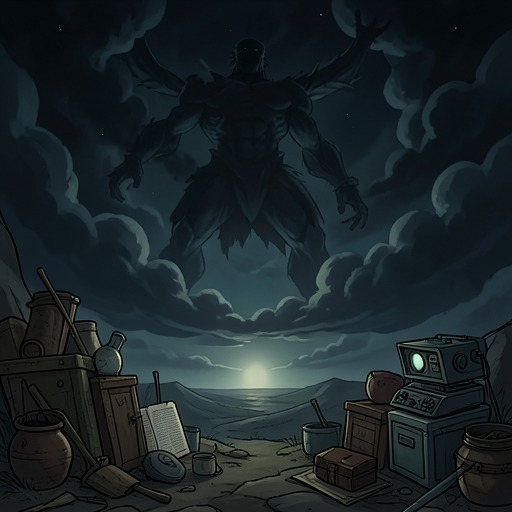
Creation of the New Heaven and New Earth
Book of RevelationCreation of the New Heaven and New Earth is the culminating change in the chronology presented by the book: after the final judgment, the former heaven and earth pass away, and God makes all things new. The vision joins a transformed creation to a changed relationship between God and humanity, promising not only a new home but the end of death, sorrow, crying, and pain.
Place in the Book’s Chronology
The book treats this event as the next great stage after the final judgment of humanity. Its commentary describes the old heavens as rolling up like a scroll and says that God will create new heavens and a new earth. Revelation’s vision supplies the concrete sequence: the first heaven and first earth have passed away, and the holy city descends from God out of heaven. Creation is therefore presented not as an isolated image but as the resolution that follows judgment.
That placement reflects the author’s broader insistence that Revelation must be read in chronological order, even though its material is not always presented sequentially. The book argues that rearranged passages have contributed to competing interpretations of end-time events, particularly the timing of the rapture. In its closing commentary, it says that reading Revelation chronologically strengthens the case for a mid-tribulation rapture. The new creation belongs to the end of this proposed sequence, beyond the judgments and the final accounting of the dead; it is the promised outcome toward which that reading directs the reader.
The Passing of the Former World
The vision marks the transition through a stark contrast: the first heaven and first earth are gone, and there is no more sea. The author’s commentary likewise emphasizes that the former creation will pass away before God establishes the new one. The text does not elaborate on the mechanics of this transformation. Its force lies in the clear division between what has ended and what God now makes new.
The disappearance of the former world is paired with the descent of the New Jerusalem. John the Apostle sees the holy city coming down from God out of heaven, prepared like a bride adorned for her husband. The image gives the new creation a destination and a focal point: the city is not described as humanity ascending to God, but as a holy dwelling descending from God. The bride comparison conveys preparation and arrival, while the city’s origin identifies it as part of the divine gift rather than a human achievement.
God Dwells with Humanity
A great voice from heaven interprets the city’s arrival as the establishment of God’s dwelling among people. God will be with them; they will be his people, and he will be their God. The promise changes the relation between the divine and human realms: the new creation is defined not only by what has disappeared, but by God’s presence among its inhabitants.
That presence is expressed through the ending of human suffering. God wipes away every tear, and death, sorrow, crying, and pain are no more because the former things have passed away. The passage links consolation directly to the transformation of the world: grief is not merely answered with comfort while the old conditions remain in place; those conditions themselves belong to what has ended. The author presents these promises as the sure hope of an eternal home, and urges readers to examine themselves and remain faithful to the end.
Promise, Judgment, and Significance
The announcement that God makes all things new is accompanied by a command to write because the words are true and faithful. The vision thus presents the new creation as both a promised future and a testimony to be preserved. It also sets inheritance within a moral distinction: those who overcome are promised inheritance and a filial relationship with God, while a separate warning assigns the unbelieving and other named wrongdoers to the Lake of Fire, identified as the second death. The new world is not portrayed as erasing the preceding judgment; it follows that judgment and stands in contrast to its final consequence.
The book ends its commentary at this point while acknowledging that the last two chapters continue to describe the new earth and the New Jerusalem, including what the new home will be like. That decision leaves the event as a threshold rather than an exhaustive account of the future: the central assurances are given, but the promised life beyond them is not fully detailed in the commentary. Its closing emphasis is practical as well as eschatological. The expectation of a world without death or pain is offered as reason to endure suffering for Christ in this life and to remain faithful until the end.