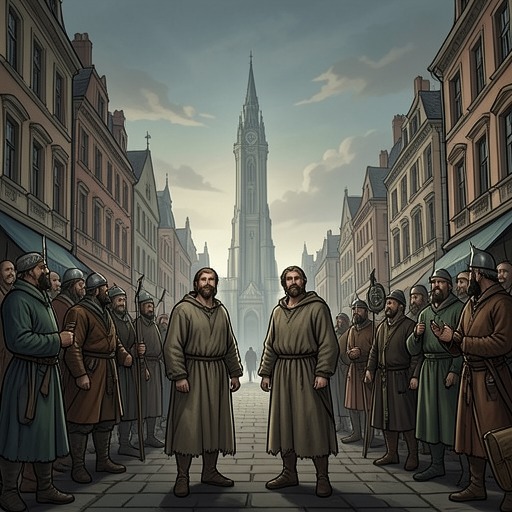
Death and Resurrection of the Two Witnesses
Book of RevelationThe Death and Resurrection of the Two Witnesses is the turning point at the end of their 1,260-day prophetic ministry: the beast kills them, their bodies remain in the great city, and after three and a half days they stand again and ascend to heaven. The event is both a reversal of apparent defeat and a chronological clue in the book’s proposed reading of Revelation. The author links the earthquake that follows their ascent to the seventh bowl of God’s wrath, using that connection to place the witnesses’ death in the latter half of a seven-year tribulation.
The witnesses’ ministry and its end
Revelation 11 presents the Two Witnesses as prophets commissioned to speak for 1,260 days, clothed in sackcloth. They are also described as two olive trees and two lampstands standing before God. Their ministry is marked by extraordinary protection and authority: anyone who tries to harm them is met with fire from their mouths, and they can withhold rain, turn waters to blood, and strike the earth with plagues as often as they choose. These powers establish that their public work is not simply a human contest with the beast; the narrative gives them a divinely granted capacity to act throughout their appointed testimony.
The transition comes only when their testimony is finished. The beast that rises from the Abyss then makes war against them, overcomes them, and kills them. In the book’s account, this is the first decisive change in their condition: the pair who had been able to repel harm are no longer protected from the beast once their period of testimony has run its course. Their deaths therefore mark both the end of their ministry and a limit on the beast’s apparent victory: it acts against them only after their commission is complete.
Public response and reversal
Their bodies lie in the street of the great city, identified spiritually as Sodom and Egypt and as the place where Jesus Christ was crucified. People from different peoples, tribes, languages, and nations see them there. The account says their bodies remain unburied for three and a half days, making their defeat visible beyond the city itself. The public response is not mourning: people on earth celebrate, make merry, and exchange gifts because the prophets had tormented those who lived there. Their rejoicing turns the scene into a public repudiation of the witnesses and their message.
That celebration is abruptly reversed. After three and a half days, the Spirit of life from God enters the Two Witnesses; they stand on their feet, and great fear falls on those who see them. A voice from heaven calls them to come up, and they ascend in a cloud while their enemies watch. The sequence answers the public spectacle of their unburied bodies with an equally public restoration and departure. Their enemies witness the very outcome that overturns their celebration: the witnesses whom the beast killed are alive again and taken up to heaven.
The earthquake and the proposed chronology
The same hour as the witnesses’ ascent, a great earthquake strikes. A tenth of the city falls, seven thousand people are killed, and the survivors are afraid and give glory to the God of heaven. The earthquake thus follows directly upon the witnesses’ return to life and ascension, extending the consequences of the scene from their personal reversal to a disaster affecting the city. Revelation then announces that the second woe has passed and the third is coming quickly.
The author uses this earthquake to argue for where the episode belongs in Revelation’s chronology. He observes that the book describes two especially severe earthquakes: one at the sixth seal and another at the seventh bowl of God’s wrath. He rejects the sixth-seal placement for the witnesses’ death because counting back three and a half years from that point would put their arrival before the Antichrist’s arrival, a sequence he considers inconsistent with the judgments associated with the witnesses. Instead, he sees the earthquake following their ascent as corresponding to the seventh bowl, which he says describes an earthquake that topples the world’s cities. On this reading, the witnesses die and rise again at the time of that final bowl, and their arrival must be placed three and a half years earlier.
Place in the seven-year tribulation reading
This placement depends on the author’s broader interpretation of Daniel’s seventieth week. He treats the final week of years as a still-future seven-year period and understands it as the span of the Great Tribulation. In his account, the first 3.5 years end with the rapture, while the period after the rapture includes the outpouring of God’s wrath. The Two Witnesses’ ministry covers 1,260 days, or three and a half years; their death and resurrection are therefore a marker for the transition toward the latter part of that seven-year framework, not an isolated episode assigned solely by its position in the printed chapters.
The author acknowledges that some teachers call only the first 42 months the Great Tribulation and label the following 42 months the period of God’s wrath. He regards the difference in terminology as less important than recognizing the two successive halves and their seven-year total. He also argues that Revelation’s passages are not all presented in chronological order and that reading them sequentially as printed can produce competing accounts of the timing of the rapture. For him, the earthquake supplies a link between the witnesses’ ending and the final bowl, while the 1,260-day ministry supplies the interval needed to place their beginning. In his closing commentary, he presents this chronological reconstruction as support for a mid-tribulation rapture, while framing the larger timing claim as his interpretation of Revelation rather than as an uncontested conclusion.