Euphrates River
Book of RevelationThe Euphrates River is the setting for two distinct turning points in the book’s interpretation of Revelation: the release of four angels at the sixth trumpet and the drying of the river at the sixth bowl. In the first episode, the angels’ release precedes a vast military force and the death of a third of humanity; in the second, the vanished waters prepare the way for eastern kings who are gathered toward Armageddon. The river thus marks a passage from a judgment described through immense loss of life to a final assembly for battle.
The River in the Sixth Trumpet
At the sixth trumpet, a voice from the golden altar directs the angel with the trumpet to release four angels bound at the great river. The text describes these angels as prepared for a specific time: an hour, a day, a month, and a year. Their purpose is to kill a third of humanity. The river is not presented merely as a name in the landscape; it is the stated place of the angels’ confinement, and their release initiates the judgment.
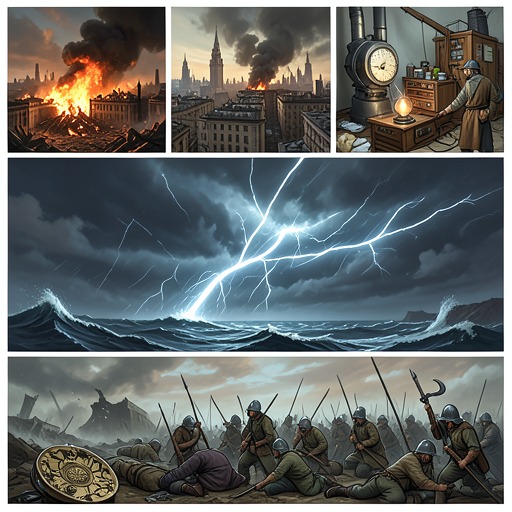
The vision then gives the scale of the force associated with this episode: an army of two hundred million horsemen. Its horses and riders are described in unusual, visionary terms, including breastplates of fire, jacinth, and brimstone, horses with lion-like heads, and fire, smoke, and brimstone issuing from their mouths. The account links the army’s action to the death of a third of humanity. In the author’s reading, these details signify a powerful military campaign, rather than total destruction of the kind he associates with nuclear war.
The duration of the angels’ preparation is important to the author’s interpretation. He reads the phrase specifying an hour, a day, a month, and a year as giving the judgment a possible duration of one year. This is presented as his inference from the wording, not as a separate, explicit statement that the battle itself lasts exactly that long. He considers a year-long campaign consistent with the scale of the army and the reported mortality, while stressing that the vision describes the death of one third of humanity rather than the destruction of everyone.
The River in the Sixth Bowl
The river appears again in a different judgment sequence when the sixth angel pours out a bowl. This time, the Euphrates River is dried up so that a way may be prepared for the kings of the east. The action changes the river’s role: at the trumpet, it is the place where the four angels are bound; at the bowl, its waters are removed to prepare passage for rulers and their forces.
The drying is followed by the appearance of three unclean spirits, likened to frogs, from the mouths of the dragon, the beast, and the False Prophet. The text identifies them as demonic spirits that perform signs and go out to the kings of the earth and the whole world. Their purpose is to gather those rulers for the battle of the great day of God Almighty. The gathering culminates at a place called Armageddon. The passage therefore connects the river’s altered condition to a worldwide mobilization, rather than describing the drying as an isolated geographical event.
Relationship Between the Two Episodes
The two appearances should not be collapsed into one event. The sixth-trumpet passage centers on the release of four bound angels and a campaign associated with an army of two hundred million and the death of a third of humanity. The sixth-bowl passage centers on the drying of the river and the gathering of kings for Armageddon. The shared location ties the episodes together, but their agents, actions, and consequences differ.
This distinction matters within the book’s broader argument about sequence. The author says Revelation is not wholly chronological and that reading its visions as though they all followed one uninterrupted timeline has contributed to divergent interpretations. He treats the arrangement of events as a problem that must be worked out, rather than assuming that the order in which every vision appears automatically supplies the order of its fulfillment. The river’s appearances offer a concrete example of why scenes must be distinguished: both are associated with major judgments, but one concerns a release and a devastating military force, while the other concerns a route for kings and their assembly for battle.
Interpretive Significance and Limits
In the author’s exposition, the sixth trumpet’s time phrase supplies a basis for estimating the episode’s possible duration, while the army’s stated number and the death of a third of humanity define its scale. Those details support his reading of a formidable military action; they do not identify the army’s modern nationality or provide a physical description of the river’s geography. Likewise, the sixth bowl passage names the kings of the east and their destination but does not, in the cited discussion, specify their identities.
The Euphrates River consequently functions as a recurring landmark within the book’s prophetic framework, but the meanings assigned to its two appearances depend on the surrounding visions and on the author’s reading of their order. The trumpet account emphasizes release, warfare, and mortality; the bowl account emphasizes the removal of a barrier and the gathering of rulers. Keeping those functions separate preserves the contrast the exposition draws and avoids treating the river itself as an explanation for events that the text attributes to angels, spirits, and kings.