Fall and Destruction of Babylon
Book of RevelationThe Fall and Destruction of Babylon is a vision of sudden judgment against a city portrayed as a source of influence, wealth, and corruption among nations. In the book’s proposed chronological reading, its destruction occurs before the rapture, during a period when saints must endure persecution. The account moves from the city’s commanding reach to its isolation and ruin; the author then extends that biblical imagery into a debated modern possibility, suggesting that Mystery Babylon might be the United States while acknowledging the uncertainty of the identification.
The Vision and Its Place in the Sequence
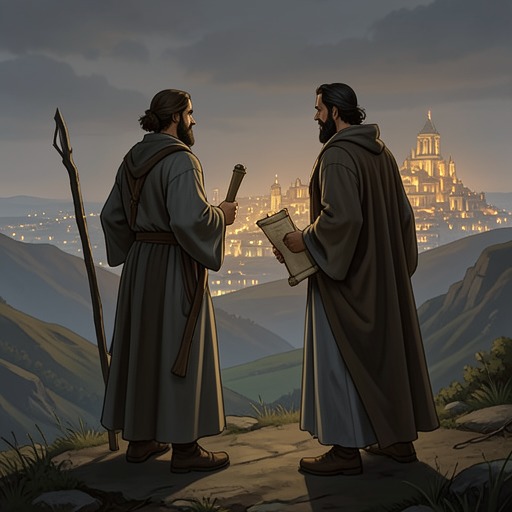
The event is presented through John the Apostle’s prophetic vision. One of the angels associated with the bowls shows him the judgment of the woman seated upon many waters, and the vision identifies those waters with peoples, multitudes, nations, and languages. The image therefore joins a single city to a broad human and political sphere: its reach is not confined to its walls, and its influence is measured by the rulers and populations connected to it.
The book treats the chapters concerning Babylon as a continuous chronological unit rather than as a sequence that should be read in the order in which every vision appears. Its account connects Revelation 17–19:10 and argues that this passage belongs before the rapture. The author’s larger premise is that Revelation is not entirely chronological and that recognizing its rearranged passages can correct mistaken conclusions about the timing of end-time events. In this scheme, Babylon’s fall is a landmark within the tribulation narrative, not merely a later description of a catastrophe already placed elsewhere.
That placement matters to the book’s interpretation of the saints’ situation. The author says that saints remain on earth during the period surrounding Babylon’s destruction and must patiently endure trials, including the Beast government’s war against them. The rapture, in this reading, follows the fall and ends that persecution. The sequence thus makes the city’s judgment part of a wider transition: earthly power is being overturned while believers are still called to endurance, before the narrative reaches the heavenly celebration associated with the Lamb’s marriage supper.
The City’s Reach and the Powers That Turn Against It
The vision first presents the city through its relationships. Kings have joined themselves to its corrupting influence, while the inhabitants of the earth have been made drunk with it. Merchants, too, have prospered from the abundance of its luxury. The city’s power is consequently both political and economic: rulers are implicated in its influence, and commercial actors gain wealth from its consumption and abundance.
The woman’s position upon many waters supplies a symbolic explanation of this reach. The waters are not simply a geographic feature; the vision interprets them as peoples, multitudes, nations, and languages. The book’s author uses that detail in considering a modern referent, but the image itself does not name a contemporary country. Likewise, the vision calls the woman a great city that rules over the kings of the earth, making political dominance part of the portrait without, on its own, settling which city the symbol represents.
The relationship between the city and the beast changes sharply. The ten kings who share power with the beast first give their authority and strength to it. They then turn against the woman: they leave her desolate, strip away her splendor, consume what had been hers, and burn her with fire. The vision presents this reversal as serving God’s purpose, even though the kings’ hostility is the immediate instrument of the city’s destruction. The city’s former associations with rulers do not protect it; the political powers aligned with the beast become the agents of its downfall.
The Sudden Ruin and Its Human and Commercial Cost
A heavenly angel announces that Babylon has fallen and describes it as a dwelling place for unclean spirits. The pronouncement is followed by a warning for God’s people to leave, so that they do not share in the city’s sins or receive its plagues. The appeal makes separation an urgent consequence of the judgment: the city’s fate is not only a spectacle to observe but a danger from which the faithful are told to withdraw.
The stated causes are moral as well as political. The city has drawn nations into its wrongdoing, its rulers have participated in that corruption, and merchants have grown rich through its abundance. Its sins are described as having reached heaven, and the judgment answers its conduct. The vision contrasts the city’s self-assurance—its confidence that it lives like a queen and will not suffer—with the reversal that follows. Its plagues arrive in one day: death, mourning, famine, and destruction by fire. The account emphasizes the mismatch between the city’s confidence and the speed with which its security disappears.
The response from abroad is marked by distance. Kings who had shared in its prosperity mourn when they see the smoke of its burning, but they stand far away out of fear of its torment. Merchants likewise remain at a distance and lament because their market has vanished. Their losses are made concrete through the range of goods associated with the city: precious metals and stones, fine cloth, luxury materials, spices, perfumes, food and oil, livestock, horses, chariots, and enslaved people. The inventory depicts an extensive economy whose reach encompasses costly objects, everyday provisions, transport, and human beings. When the city falls, the fruits that buyers desired and the goods that sustained trade are no longer available.
The seaborne economy shares in the shock. Shipmasters, crews, sailors, and others who trade by sea watch from afar as the city burns; the merchants’ wealth and the prosperity of those with ships are linked to its commerce. They cast dust on their heads in grief, while the suddenness of the loss is underscored by the repeated image of great riches reduced to nothing within an hour. This is not only the downfall of a ruler or a city. It is the collapse of a trading center on which distant commercial interests had depended.
The vision closes the city’s ruin with images of irreversible absence. A mighty angel throws a stone like a great millstone into the sea to signify that Babylon will be violently cast down and found no more. Music and skilled craft will cease there; the sound of a millstone, the light of a candle, and the voices of a bridegroom and bride will no longer be heard. These details extend the loss beyond political control and trade: work, celebration, domestic life, and ordinary light all disappear from the city. The account also charges Babylon with the blood of prophets, saints, and people slain on earth, making the judgment a reckoning for violence as well as luxury and corruption.
The United States as a Proposed Identification
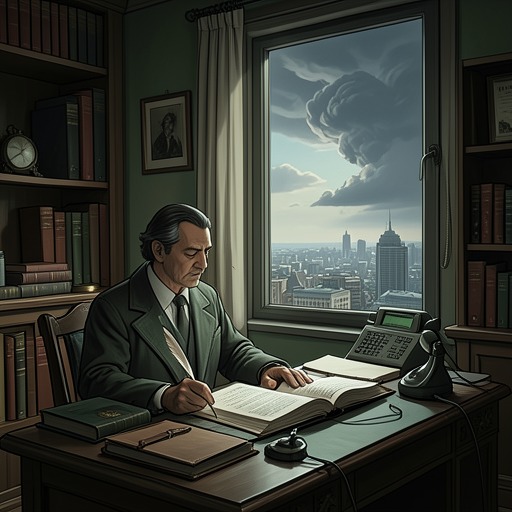
The book distinguishes its reading of the vision from the author’s proposed identification of its modern counterpart. The author considers whether Mystery Babylon could be the United States, noting that the biblical description of a city of power, authority over kings, and a seat among many peoples and languages seems to him to fit the country better than Iraq. He also points to the vision’s account of a wealthy city whose merchants and maritime traders are devastated by its sudden destruction. These are the author’s interpretive comparisons, not an explicit identification made by the vision itself.
He acknowledges reasons for caution. Other Bible teachers, he says, commonly identify the passage with Iraq, and he describes his own proposal as uncertain. He also finds the account of Babylon bearing responsibility for the blood of prophets and saints difficult to reconcile straightforwardly with the United States. From that difficulty he raises, as a possibility rather than a settled fact, that the country might turn against Christians in the last days. His treatment therefore combines a proposed match with an unresolved feature that complicates it.
The author further allows that Mystery Babylon could refer to New York City, described in the book as a center of wealth in the United States and the world. Even that narrower possibility carries national consequences in his reasoning: he argues that the city’s destruction would bring down the rest of the country as it is known today. Elsewhere, he links the prospect of Babylon’s fall to the possibility of widespread economic collapse, while presenting the larger claim as a reading of prophecy rather than a known future event.
Significance in the Book’s End-Time Argument
Babylon’s destruction serves as both a judgment scene and a hinge in the book’s chronology. Its imagery gathers political power, international influence, material abundance, maritime commerce, and moral accountability into one catastrophe. The merchants’ grief and the silenced sounds of city life show what is lost when a center of wealth disappears; the warning to leave and the indictment of violence give that economic collapse a spiritual and ethical dimension.
The event also supports the book’s argument for a mid-tribulation rapture. The author reads the fall as occurring while saints are still enduring persecution, before their gathering to God. He connects the later marriage supper of the Lamb with the presence of the bride in heaven and takes that sequence as evidence that the rapture has taken place by the end of the passage. In his account, therefore, Babylon’s fall is followed not simply by further ruin but by a change in the saints’ position within the end-time sequence.
The interpretation depends on two steps that the book asks readers to keep in view: first, that passages in Revelation can be rearranged into chronological order; and second, that the symbolic city may have a modern political and economic counterpart. The destruction imagery is explicit within the vision, while the proposed identification with the United States remains the author’s argued possibility. That distinction is central to the event’s significance in the book: Babylon’s fall anchors a chronological claim, but its possible contemporary referent remains open to debate.