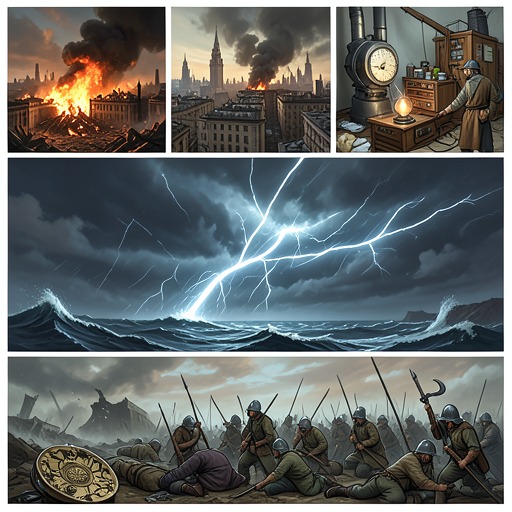
False Prophet
Book of RevelationThe False Prophet is the second beast in Revelation 13, a figure whose signs and authority serve the first beast’s rule. In the book’s interpretation, he is the Antichrist’s right-hand man: not merely a second adversary, but the organizer of worship and compliance that make the first beast’s power operative across the earth. His story runs from a lamb-like appearance and dragon-like speech to the enforcement of the beast’s image and mark, and ends with his capture and judgment.
Identity and Introduction
Revelation presents the figure as another beast, rising from the earth after the first beast has come into view. He has two horns like a lamb, yet speaks like a dragon. The contrast between the lamb-like appearance and the dragon-like voice introduces the central tension in his portrayal: an outward sign of gentleness accompanies speech and conduct aligned with the first beast. The account does not give him a personal name or a history before his appearance; his identity is defined by his relation to the first beast and by the work he performs on its behalf.
The book identifies this second beast as the False Prophet and describes him as the Antichrist’s right-hand man. That identification makes his function more specific than simply being an associate or fellow opponent. He acts as the public religious and persuasive counterpart to the first beast’s political authority, directing the earth’s inhabitants toward worship of the ruler whose deadly wound has been healed. His own authority is consequential, but the text repeatedly shows it being exercised in the first beast’s service.
Authority, Signs, and Persuasion
The False Prophet exercises the first beast’s power in its presence. The account therefore connects his influence to an authority that is delegated or shared, rather than describing him as an independent ruler. His activity is directed toward a clear outcome: causing the earth and its inhabitants to worship the first beast. The healed wound is part of the account’s explanation for that worship, while the second beast’s actions reinforce it.
His signs are the means by which he deceives those living on earth. Revelation describes great wonders, including fire coming down from heaven in the sight of people. The book’s commentary treats these displays not as isolated marvels but as instruments of persuasion that prepare the population to accept the beast’s system. Their narrative purpose is made explicit by what follows: the False Prophet urges people to make an image of the first beast, whose wound by a sword had healed.
The image extends the first beast’s presence into a further demand for public worship. The False Prophet is given power to give life to the image, which then speaks and becomes part of the machinery of punishment: those who refuse to worship it are put to death. Thus the signs, the image, and the threat against refusal form a progression. Persuasion establishes the demand; the speaking image gives it an instrument; punishment makes noncompliance perilous. The False Prophet’s role is consequently both propagandistic and administrative, joining spectacle to enforcement.
Worship, the Mark, and Daily Life
The same system reaches beyond worship into economic life. The False Prophet causes people of every standing—small and great, rich and poor, free and bond—to receive a mark on the right hand or forehead. Buying and selling are restricted to those who have the mark, the beast’s name, or the number of its name. The account thereby presents allegiance not as a private conviction alone but as a condition imposed on participation in ordinary exchange.
This economic restriction complements the demand to worship the image. Those who refuse face the stated threat of death, while those without the mark are barred from commerce. Revelation’s sequence links religious conformity, political power, and access to the market in one system. The commentary emphasizes the breadth of the demand: the beast’s authority reaches across kindreds, tongues, and nations, and the False Prophet helps make that reach effective. His role is not simply to announce a ruler’s claims; he helps establish the practices and penalties through which those claims govern daily life.
The book draws a direct practical conclusion for its readers: the mark must not be accepted. That warning follows from the False Prophet’s actions, which make the mark a test of submission and attach economic exclusion to refusal. The account also depicts a countervailing response during this period: angels proclaim the everlasting gospel to every nation, kindred, tongue, and people. The contrast places the False Prophet’s worldwide demand for worship beside a worldwide proclamation calling people to worship God.
Place in the End-Time Sequence
The commentary situates the False Prophet’s rise within its chronological reading of Revelation. It says the second beast appears after the Antichrist is revealed at the opening of the first seal, during the seven-year Great Tribulation. It also distinguishes a first forty-two-month period, in which the Antichrist makes war on the saints, from the later period associated with God’s wrath. Within that framework, the False Prophet’s enforcement of worship and the mark belongs to a larger sequence of global rule, opposition to the saints, and divine judgment.
This placement matters to the book’s argument about the structure of Revelation. Its author maintains that some passages are not presented in chronological order and that recognizing this prevents misinterpretations of events such as the rapture. The False Prophet’s account is thus both a portrayal of an end-time antagonist and a piece in the author’s proposed timeline. The figure’s emergence, activity, and defeat help connect the beast’s rule to the later gathering of its forces and their defeat.
Capture and Narrative Significance
At the final confrontation, the beast, the kings of the earth, and their armies gather to make war against the one seated on the horse and his army. The False Prophet is captured alongside the beast. The narrative recalls his defining actions at the moment of judgment: he had performed signs before the beast and deceived those who received the mark and worshipped the image. Both figures are cast alive into the Lake of Fire, while the remaining forces are defeated.
His ending reverses the authority he exercised. The signs that had served deception do not protect him; the system he helped impose does not secure his survival. The account gives no intervening repentance or change of allegiance, and it presents his judgment as final within this episode. As a character, the False Prophet is defined less by an individual history than by the functions he performs: he legitimizes the first beast through spectacle, directs worship toward its image, enforces the mark, and connects political submission to economic access. His capture brings those functions to an end and closes the arc from persuasive power to judgment.