Four Living Creatures around the Throne
Book of RevelationThe Four Living Creatures around the Throne are four extraordinary beings positioned at the center of Revelation’s heavenly visions. Their composite appearance is sharply specified, but their narrative identity is conveyed chiefly through what they do: they praise God without ceasing, honor the Lamb, and join the elders and angels in worship. Their presence links the throne-room vision to later scenes of praise, making them recurring participants in the book’s heavenly order rather than decorative features of its setting.
Identity and Appearance
The creatures are situated in and around the throne, before a sea of glass like crystal. Each has eyes before and behind; each also has six wings and is full of eyes within. Their forms are distinct: one resembles a lion, another a calf, the third has a human face, and the fourth resembles a flying eagle. The description makes their difference from one another part of their collective identity: they are four beings, not four interchangeable appearances of a single figure.
Their many eyes and wings are concrete elements of the vision, not details the account explains in a separate biography. The text does not give them individual names or describe their origins. It presents them instead in relation to the throne and to the worship taking place there. The seven lamps before the throne are identified as the seven Spirits of God, while the creatures themselves are described separately as living beings surrounding the throne. The vision thus distinguishes the throne’s radiant surroundings from the four figures whose activity gives the scene its recurring voice and movement.
Unceasing Worship
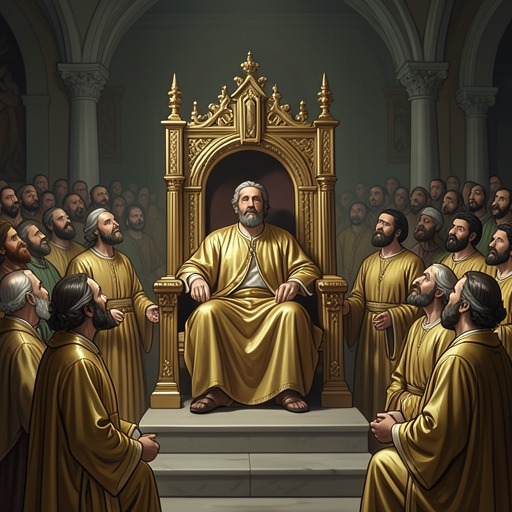
The creatures’ defining action is continual praise. They do not rest day or night, repeatedly ascribing holiness to the Lord God Almighty, who was, is, and is to come. Their worship is not an isolated response to a single dramatic event: it establishes the enduring rhythm of the throne room. The scene places their voices before the response of the Twenty-Four Elders, who fall down, worship, and cast their golden crowns before the throne.
That sequence gives the creatures a distinct role within a larger company. When they give glory, honor, and thanks to the one seated on the throne, the elders answer with their own act of surrender and praise. The creatures do not merely appear as part of the heavenly scenery; the account shows them initiating or accompanying worship to which others respond. In the throne-room vision, their ceaseless praise frames the declaration that all things were created by God and exist by divine will.
The Lamb and the Sealed Book
The creatures are also present when the Lamb takes the book from the right hand of the one seated on the throne. The book cannot be opened by anyone initially found worthy, and the narrator weeps until an elder announces that the Lion of the tribe of Judah has prevailed. The vision then presents the Lamb, bearing the appearance of one slain, standing amid the throne, the creatures, and the elders. The creatures’ position places them at the heart of this change from lament over the unopened book to the Lamb’s taking it.
When the Lamb takes the book, the creatures and the Twenty-Four Elders fall down before him. Each is associated with a harp and a golden bowl full of incense, identified as the prayers of the saints. They join in a new song that declares the Lamb worthy to open the seals because he was slain and redeemed people from every kindred, tongue, people, and nation. The song also looks toward the redeemed as a kingdom of priests who will reign on earth. The creatures thus participate in worship that interprets the Lamb’s act: his worthiness is grounded in his death and in the redemption attributed to him.
The praise expands beyond the creatures and elders. Countless angels surround the throne, the creatures, and the elders, proclaiming the worthiness of the slain Lamb; then every creature in heaven, on earth, under the earth, and in the sea joins the acclamation of the one on the throne and the Lamb. At the close, the four creatures say Amen, while the elders fall down and worship. Their response marks the end of the sequence and affirms the praise surrounding the Lamb’s taking of the book.
Recurrence and Narrative Significance
The creatures return in later throne-centered scenes, where their presence helps make worship a recurring structure in the visions. When the great multitude from every nation stands before the throne and the Lamb, the angels gather around the throne, the elders, and the creatures; they fall on their faces and worship God. The multitude’s public acclamation is therefore set within a heavenly assembly that includes the creatures already seen in the earlier vision.
They appear again as the Twenty-Four Elders fall down and worship God after the heavenly announcement of judgment against the great whore and the avenging of the blood of God’s servants. Later, when the voice from the throne calls on God’s servants to praise him and the multitude proclaims that the Lord God omnipotent reigns, the creatures and elders again fall down in worship. Across these scenes, the creatures’ actions remain consistent: they surround the throne, give or join in praise, and answer the events of the vision through worship. The text gives them no separate earthly journey or personal change. Their narrative significance lies in that constancy: they make the throne’s sovereignty audible and visible, and their repeated participation binds the Lamb’s redemption, the saints’ vindication, and the final acclamations of praise into one continuing heavenly order.