John the Apostle
Book of RevelationJohn the Apostle is the witness and recorder through whom the book of Revelation reaches its churches. On Patmos, in the Spirit on the Lord’s Day, he hears a commanding voice and sees a figure like a son of man among seven golden lampstands. The book presents his testimony as both personal and commissioned: what he sees is to be written and sent to seven churches, while the opening passage describes the revelation as coming from God through Jesus Christ and an angel to John. The study’s commentator makes John’s act of recording central to an explanation of the book’s unusual order, while distinguishing the visions’ sequence from the order in which they were written down.
Identity and Setting
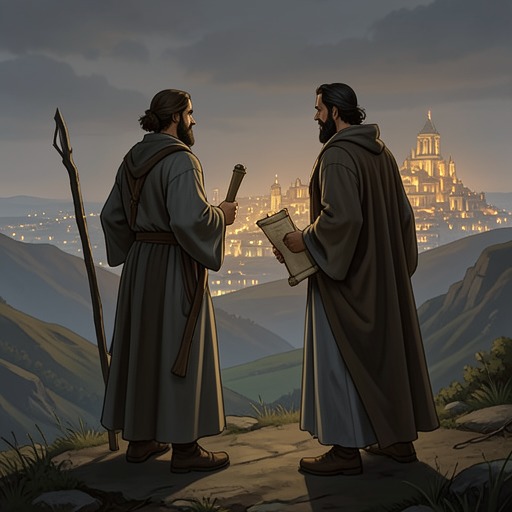
John identifies himself as a brother and companion in tribulation, in the kingdom, and in the patience of Jesus Christ. He is on Patmos because of the word of God and the testimony of Jesus Christ. These details place him not outside the suffering described in the revelation, but among those who share its pressures and commitments. Patmos is the setting from which he receives and records a message addressed beyond himself.
The vision’s destination is specified as seven churches in Asia: the Church of Ephesus, the Church of Smyrna, the Church of Pergamum, the Church of Thyatira, the Church of Sardis, the Church of Philadelphia, and the Church of Laodicea. John is therefore both a participant in the circumstances of tribulation and a commissioned messenger to a wider Christian audience. The opening frame links his experience on the island to the needs of these congregations, making the written message an act of transmission rather than a private account alone.
Call and Vision
On the Lord’s Day John is in the Spirit when he hears behind him a loud voice like a trumpet. The voice orders him to write what he sees and send it to the seven churches. John turns toward the speaker and sees seven golden lampstands, with a figure like a son of man standing among them, dressed in a robe reaching to his feet and wearing a golden sash across his chest. The study identifies this figure as Jesus Christ, who appears to John in the vision.
The scene joins a sensory sequence to a writing commission: John hears the voice, turns, sees the lampstands and the figure among them, and is told to make a record. The commentator also points to the book’s first verses, which describe the revelation as communicated through an angel and say that John testifies to what he saw. In this account, his role is not that of an independent interpreter inventing the message, but of a witness responsible for preserving and delivering what was shown to him.
The limits of the experience remain open in the commentator’s reconstruction. John may have been taken to the heavenly throne, or he may have seen the event in a vision while in the Spirit on the Lord’s Day; the study says that either possibility fits its account. It does not establish a physical journey as a fact. What it emphasizes is the vision’s authority and John’s obligation to write it down.
Recording the Revelation
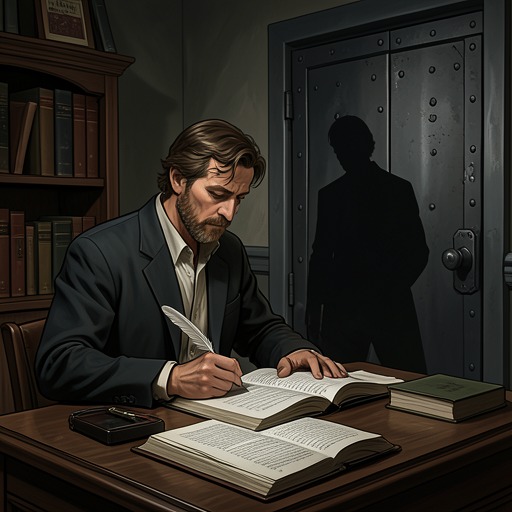
The book itself presents John as the recipient and witness, but the commentator imagines the practical circumstances of composition in more detail. In that reconstruction, John returns from the vision to ordinary reality still on Patmos, holding a revelation intended for the seven churches and, more broadly, the body of Christ. The commentator supposes that John lacked parchment and a pen, made contact with friends who smuggled writing materials to him, and later had his completed writings smuggled out. These particulars are proposed as a way to picture the work of recording, not reported as explicit details of the vision account.
This imagined process gives physical shape to the transition from revelation to text. John must preserve a large message under constrained circumstances, and the imagined arrival of writing supplies helps explain how the vision could become a document for circulation. The reconstruction also places emphasis on the difference between receiving a revelation and composing its written form: the commentator suggests that John wrote as the material came to him, rather than rearranging every section into the chronology of the events described.
Interruptions and Written Order
The commentator uses John’s writing process to explain why parts of Revelation, in his reading, are not arranged chronologically. He imagines John already well into what is now chapter 10 when an angel appears with further revelation. John adds this material to his assignment in the order it is given, then returns to the writing he had left unfinished. The proposed sequence treats the angelic passage as an interruption in the act of composition, not as proof that the events it describes must occur at that point in the end-times timeline.
A second interruption is placed after John has written through chapter 16, which contains the final bowls of God’s wrath. At Revelation 17:1, the commentator says, another angel brings additional revelation. John inserts this material and then resumes, completing the book. The explanation distinguishes the order of reception and writing from the chronological order of the events: material added later may appear before the narrative resumes, even when its events belong elsewhere in the proposed timeline.
This account connects John’s role as recorder to the study’s larger interpretive method. The commentator argues that reading Revelation as though every section followed a single chronological sequence has contributed to competing interpretations, including disagreement over the timing of the rapture. John’s imagined interruptions become a structural explanation for those shifts in sequence. The explanation is the commentator’s reconstruction of how the book was composed, rather than a detail stated directly in the account of John’s vision.
Narrative Role and Significance
John serves as the link between revelation and its readers: he receives, witnesses, testifies, writes, and sends. The opening vision grounds that chain in his presence on Patmos, the voice’s direct commission, and the appearance of Jesus Christ among the lampstands. The book’s angelic mediation further places John within a sequence of communication that begins with God and reaches the churches through the revelation entrusted to him.
In the commentator’s larger argument, John’s significance also lies in the form of his record. The claim that he writes additional angelic revelations as they arrive makes the text’s discontinuities part of its history of transmission, rather than evidence that the book lacks an intelligible structure. The commentator describes these additions as explanatory pieces that illuminate events in the last days and argues that their placement must be separated from their chronological location. John thus occupies two related roles in the study: the first-person witness of the vision and, in the commentator’s proposed reconstruction, the working recorder whose sequence of composition helps readers understand the book’s sequence of discourse.