Lake of Fire
Book of RevelationThe Lake of Fire is the final place of punishment in the book’s account of the end times. It receives the beast and the False Prophet after their defeat, Satan after his last rebellion, and Death and Hades after the judgment of the dead. Those whose names are not found in the Book of Life are also cast there. Its appearances gather the story’s conflicts and judgments into a final outcome: opposition is ended, the dead are judged, and the second death is declared.
Place in the End-Times Sequence
The Lake of Fire appears near the end of the sequence the author reconstructs from Revelation. The book is not treated as wholly chronological: the author argues that some sections interrupt the order of events and must be repositioned. His proposed reading distinguishes the judgments and conflicts that precede the final judgment from the outcomes that follow it. In that arrangement, the Lake of Fire belongs to the closing stages of the narrative, rather than to the earlier disasters of the seals, trumpets, or bowls.
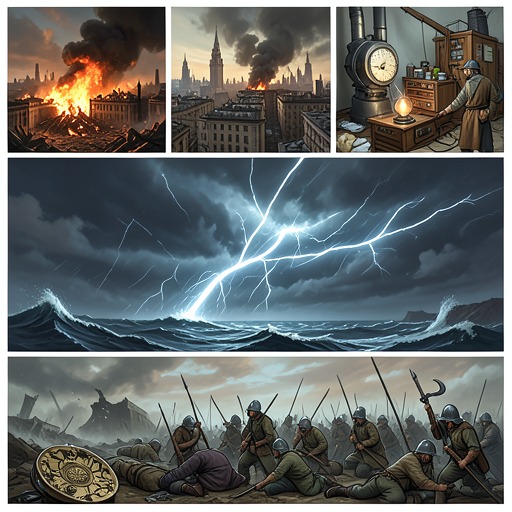
The distinction matters because the book describes successive acts of judgment without treating them as the same event. The opening of the sixth seal brings cosmic signs and a declaration that the day of wrath has come; the trumpet judgments include destruction on earth; and the final bowl is followed by an unprecedented earthquake and the remembrance of Babylon for judgment. These are part of the unfolding end-times crisis, but the Lake of Fire is presented later as a lasting destination, not simply another disaster within that crisis. The author’s emphasis on chronology places its significance in the final resolution of the sequence.
The Beast and the False Prophet
The first explicit placement in the supplied account follows the battle in which the beast, the kings of the earth, and their armies gather against the rider and his army. The beast is captured along with the False Prophet, whose miracles had deceived people who received the mark of the beast and worshipped its image. Both are cast alive into the Lake of Fire. The account then says that the remaining forces are slain, separating their fate in the battle from the distinct fate assigned to the two captured figures.
This outcome connects the Lake of Fire to the earlier system of deception and enforced allegiance. The False Prophet’s miracles, the mark, and the worship of the image are specified as part of the circumstances surrounding the deception; the beast and the False Prophet are then removed from the conflict together. The text does not describe the Lake’s geography or offer a route to it. Its narrative function is established by what happens there: the leaders associated with the beast’s power are assigned a final destination after their defeat.
Satan and the Final Rebellion
The Lake of Fire receives Satan only after a later, separate episode. Following a thousand years of peace, Satan is released and deceives nations across the earth, gathering them for battle against the camp of the saints and the beloved city. Their assault ends when fire comes down from God and devours them. Satan, identified as the deceiver, is then cast into the Lake of Fire, where the beast and the False Prophet already are; the account describes their punishment as continuing day and night forever.
This sequence makes the Lake of Fire the endpoint not only of the beast’s military defeat but also of Satan’s final attempt to deceive and gather opposition. The intervening thousand years separates these events: Satan’s first defeat does not, in this account, immediately conclude his part in the narrative. His release permits one last rebellion, and his casting into the Lake of Fire closes that arc. The author connects this episode to the possibility that mortal people living during the peaceful thousand years will face a final choice of allegiance, although the passage does not elaborate on individual participants.
The Great White Throne and the Second Death
After Satan is cast into the Lake of Fire, the narrative turns to the judgment of the dead before the Great White Throne. The dead, both great and small, stand before God; books are opened, including the Book of Life, and they are judged according to their works. The sea gives up its dead, and Death and Hades surrender those held by them. Death and Hades are then cast into the Lake of Fire, which the text identifies as the second death.
The judgment also determines the fate of anyone not found written in the Book of Life: that person is cast into the Lake of Fire. The author relates this outcome to the need for forgiveness through Jesus Christ, presenting inclusion in the Book of Life as decisive. The sequence thus gives the Lake of Fire a broader role than the punishment of the beast, the False Prophet, or Satan alone. It is the destination named at the conclusion of the judgment of the dead, and even Death and Hades themselves are removed into it.
The Lake of Fire stands at a threshold between the end of the old order and what follows. After the judgment, the first heaven and earth pass away and a new heaven and a new earth appear, followed by the descent of the New Jerusalem. The contrast is structural: the Lake of Fire belongs to the book’s account of final judgment, while the new creation describes the succeeding eternal home. In the author’s chronological interpretation, the Lake is therefore both a punishment and a marker of completion—the last destination assigned in judgment before the narrative turns to a renewed creation.