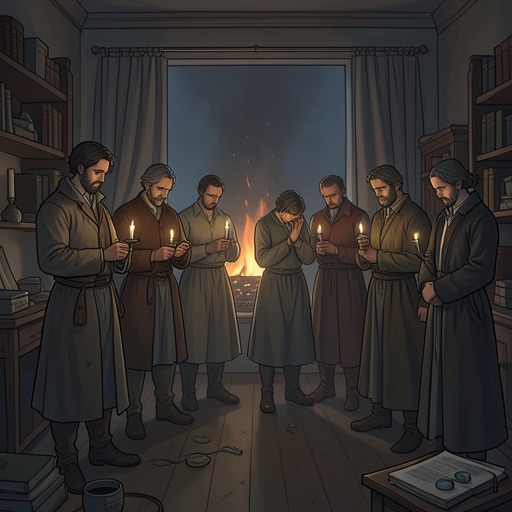
Martyrs Cry Out for Justice at the Opening of the Fifth Seal
Book of RevelationThe fifth seal turns the sequence of Revelation’s judgments toward the dead who bear witness. Beneath the altar, the souls of those slain for God’s word and their testimony call for justice; the answer gives them white robes, but not immediate vindication. They must wait while further deaths remain part of the unfolding account.
The Vision and Its Appeal
When the Lamb opens the fifth seal, John sees the slain gathered beneath the altar. Their deaths are linked to the word of God and the testimony they had maintained, marking them not simply as casualties of the preceding disasters but as witnesses whose deaths have a stated cause. They raise a collective appeal to the sovereign, holy, and true Lord, asking how long judgment on the earth’s inhabitants and the avenging of their blood will be delayed.
The scene places a demand for justice inside the heavenly vision. The martyrs are not depicted as silent or forgotten: they address God directly, and their appeal names both the wrong done to them and the judgment they await. Yet the answer does not describe an immediate reversal. Each receives a white robe, a sign given to them in the vision, while they are instructed to wait a little longer.
Waiting and Further Deaths
The delay is given a specific condition: the full number of their fellow servants, identified also as their brothers and sisters, must be killed in the same way. The vision therefore connects the martyrs’ vindication to deaths still to come. Their waiting is not presented as evidence that their testimony has been dismissed; rather, the reply acknowledges them while placing justice within a larger sequence that has not yet reached completion.
The author’s commentary treats the fifth seal as confirmation that the period ahead will be difficult for the saints. At the same time, he offers a Christian assurance that death has lost its sting for those in Jesus Christ and that God will bring believers through whatever they must endure. This pastoral reading does not remove the vision’s account of further deaths; it sets that prospect alongside the promise that death is not the final word for believers.
Relation to the Later Seals
The fifth seal’s appeal for judgment leads into the sixth seal’s signs in the heavens. In the study’s reading, the darkened sun, altered moon, and falling stars are the signs believers have been waiting for, associated with the coming of Jesus Christ to gather his saints. The author connects these signs with the Day of the Lord: a day of expectation for believers, but a terrible recognition for the unrepentant that God’s wrath is beginning.
This ordering gives the fifth seal a distinct place between persecution and public signs of approaching judgment. The martyrs ask when the inhabitants of the earth will be judged; the sixth seal then shows earthly powers and people hiding among caves and rocks as they recognize the day of wrath. The sequence does not say that the martyrs themselves cause that judgment, but it places their unanswered appeal within the larger movement toward it.
The Author’s Speculation About Persecution
Elsewhere, the author considers whether Mystery Babylon might refer not to geographic Iraq but to the United States. He bases the proposed identification on descriptions of a powerful country associated with many peoples and languages, influence over other nations, and wealth connected to trade by sea. He presents this as a possibility he has questioned for years, not as a settled identification.
One difficulty he identifies is the passage’s association of Mystery Babylon with the blood of prophets and saints. That language leads him to wonder whether America could turn against Christians in the last days. The book does not establish that this imagined persecution is the cause of the fifth-seal martyrs’ deaths; it is a separate, explicitly tentative application that gives the vision of slain witnesses a possible contemporary setting in the author’s interpretation.