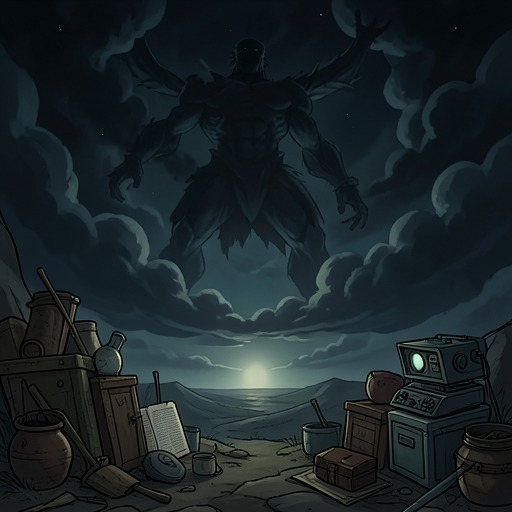
Satan Is Bound for a Thousand Years
Book of RevelationSatan Is Bound for a Thousand Years is the decisive restraint of Satan between the defeat of the beast’s forces and the final rebellion. In the sequence presented by the book, an angel confines him in the Abyss and seals him there for a thousand years. The act suspends his deception of the nations, but does not end his story: the appointed interval expires, and he is released for a short time.
Place in the Sequence
The binding follows the vision of the beast, the kings of the earth, and their armies gathering to make war against the rider on the horse and his army. The beast and the False Prophet are captured and cast alive into the Lake of Fire; the remaining fighters are slain. Revelation then turns from that defeat to an angel descending from heaven with the key to the Abyss and a great chain. The change in scale is sharp: the armies’ defeat is followed not by an immediate account of Satan’s final fate, but by his confinement for a defined period.
The book’s author treats the binding as part of the chronology following the Battle of Armageddon. He also describes the meeting of Jesus Christ with the 144,000 on Mount Zion as a transition in the sequence, before the account moves to the thrones and the thousand-year reign. This arrangement places Satan’s restraint within a larger progression of judgment, reward, and rule, rather than treating the thousand years as an isolated image.
The Act of Binding
The angel’s equipment and actions are specified: he holds the key of the Abyss and a great chain, seizes the dragon—identified in the passage as the ancient serpent, the Devil, and Satan—and binds him for a thousand years. He casts Satan into the Abyss, shuts it, and sets a seal over him. The sequence emphasizes that the confinement is secured: seizure, binding, enclosure, closure, and sealing mark successive stages of the restraint.
The stated purpose is to prevent Satan from deceiving the nations during that interval. The text does not describe the binding as Satan’s destruction or as the end of all future conflict. Instead, the seal establishes a limit on his activity: he cannot deceive the nations until the thousand years have been completed. The passage further specifies that after this period he must be released for a little while. The restraint is therefore both forceful and temporary, with its duration and its eventual end built into the account.
The Thousand-Year Reign and Its People
The binding is directly connected to the thousand-year reign of Jesus Christ. In the subsequent vision, thrones are occupied by those given judgment, alongside the souls of people beheaded for their witness to Jesus Christ and for the word of God. These are identified by what they refused: they had not worshipped the beast or its image and had not received its mark on their foreheads or hands. They live and reign with Jesus Christ for a thousand years.
The passage distinguishes this group from the rest of the dead, who do not live again until the thousand years are finished; it identifies the described resurrection as the first resurrection. Those who share in it are called blessed and holy, beyond the power of the second death, and are to serve as priests of God and of Jesus Christ and reign with him. The binding thus forms the temporal frame for a promised reign and for the vindication of people who remained faithful under the beast’s persecution. The author reads this moment as one of judgment and reward for those who endured the tribulation, including those who did not yield even in death.
Release and the End of the Restraint
When the thousand years expire, Satan is released from his prison. The later account says that he goes out to deceive the nations in the four quarters of the earth and gathers them for battle. The book’s author adds that the earth will have been repopulated by mortals during the thousand years, and presents the final uprising as a last occasion for them to stand with God or with the devil. This interpretation underscores the contrast between the long period of peace and the renewed possibility of rebellion; the duration of Satan’s confinement does not, in this account, make the later deception impossible.
The rebellion ends when fire comes down from God and devours those gathered against the camp of the saints and the beloved city. The devil is then cast into the Lake of Fire and brimstone, where the beast and the False Prophet are. The author places the judgment of all who have died after this final defeat, connecting the end of Satan’s deception to the concluding judgment. The binding is therefore a timed restraint within the larger end-times sequence: it makes possible the thousand-year reign, delays Satan’s final punishment until after a last release, and leads toward the final judgment.