Seven Bowls of God’s Wrath
Book of RevelationThe Seven Bowls of God’s Wrath are the vessels through which seven angels pour out the last plagues upon the earth. The book presents them not as an isolated set of disasters but as the completion of a sequence of divine judgments: the bowls injure those marked by allegiance to the beast, transform seas and waters, gather earthly rulers toward Armageddon, and end with an earthquake and hail. Their force in the narrative comes both from what they do and from their place in the book’s disputed chronology.
Identity and Heavenly Setting
The bowls appear after a sign in heaven: seven angels have seven last plagues, in which God’s wrath is brought to completion. Before the plagues begin, a sea of glass mixed with fire is seen, and those who have overcome the beast, its image, its mark, and the number of its name stand beside it holding harps. The scene sets the bowls against an image of endurance and victory; judgment on earth is paired with the presence of those who have resisted the beast.
The heavenly temple then opens. Seven angels emerge carrying the plagues, dressed in pure white linen with golden belts around their chests. One of the four beasts gives them seven golden bowls full of God’s wrath. Smoke from God’s glory and power fills the temple, and no one can enter until the seven plagues are completed. The vessels are therefore presented as entrusted instruments in a controlled, bounded sequence: they are given by a heavenly figure, carried by appointed angels, and their work marks the condition for the temple to become accessible again.
Place in the Book’s Sequence
The author emphasizes that Revelation does not proceed in strict chronological order throughout. He argues that passages describing different events may be arranged out of sequence, a feature he believes has contributed to conflicting interpretations, including disagreements about the timing of the rapture. That reading matters for the bowls because their designation as the “seven last plagues” does not, in his account, mean that they constitute all of God’s wrath. He reasons that calling them last implies that other judgments have already occurred.
The surrounding visions offer contrasts that make this sequence visible. At the sixth seal, a great earthquake accompanies changes in the sun, moon, stars, heavens, mountains, and islands; people across social ranks seek shelter and recognize the arrival of the day of wrath. At the first trumpet, hail and fire mixed with blood burn a third of the trees and all green grass. These are distinct scenes, not descriptions of the bowls themselves. The author’s emphasis on nonchronological arrangement cautions against treating their order on the page alone as proof that the seals, trumpets, and bowls form one uninterrupted timeline. The bowls are identified specifically as the final plagues within the book’s larger series of judgments.
The Plagues and Their Targets
The command to begin comes from a great voice out of the temple, which tells the seven angels to pour their bowls upon the earth. The first angel pours his bowl on the land, and painful sores fall upon people who bear the mark of the beast and those who worship its image. The text thus identifies the recipients by their allegiance: this plague falls on the people associated with the beast’s mark and image, rather than being described as affecting everyone indiscriminately.
The next recorded bowls turn to the waters. The second is poured into the sea, which becomes like the blood of a dead person, and every living creature in it dies. The third angel pours his bowl on rivers and springs, and they become blood. An angel of the waters declares God righteous in judging in this way. These scenes move from the land to the sea and then to freshwater sources, presenting an expanding disruption of the places on which life depends. The declaration of righteousness frames the calamities as judgment, not as accidents without a stated moral meaning.
Gathering and Completion
Later in the sequence, unclean spirits like frogs emerge from the mouths of the dragon, the beast, and the False Prophet. They are described as demonic spirits that perform signs and go to the kings of the whole world, gathering them for the battle of the great day of God Almighty. A warning to remain watchful interrupts this account; the text then names the gathering place Armageddon. The bowls’ function is thus not limited to physical plagues: in the final movement, the vision also depicts the mobilization of earthly rulers toward a decisive confrontation.
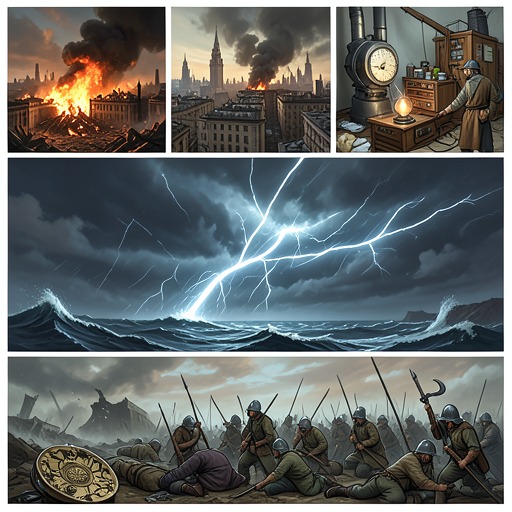
The seventh angel pours his bowl into the air, and a great voice from the heavenly temple and throne declares that it is done. Voices, thunder, lightning, and an earthquake follow; the earthquake is described as unprecedented in magnitude. The great city divides into three parts, the cities of the nations fall, and Babylon is remembered before God to receive the cup of the fierceness of his wrath. Islands disappear and mountains are no longer found. Finally, enormous hail falls from heaven, yet people blaspheme God because of the plague. The ending joins a declaration of completion to continued defiance: the bowls finish their assigned sequence, but the account closes not with repentance, only with the scale of the judgment and the persistence of opposition.