The Battle of Armageddon
Book of RevelationThe Battle of Armageddon is presented as the decisive confrontation between the Beast’s earthly coalition and Jesus Christ with the heavenly army. In the book’s reading of Revelation, deceptive spirits gather the rulers of the world for this conflict; the Beast and the False Prophet are defeated, and the assembled forces are destroyed. The author also links the battle to Revelation’s image of the earth’s harvest, placing the conflict within a larger sequence of judgment rather than treating it as an isolated military encounter.
Background and Gathering
The immediate preparation occurs during the sixth bowl judgment. The Euphrates River dries up, making way for the kings of the east, while unclean spirits emerge from Satan, the Beast, and the False Prophet. The author describes these spirits as performing signs and going out to the rulers of the earth and the whole world to assemble them for the great day of God Almighty. In this account, the gathering is not presented as a spontaneous alliance: it is the result of supernatural deception acting through the leaders of the world.
The passage also interrupts its account of gathering with a warning to remain watchful and ready. The author retains that warning as part of the scene’s significance: the assembly of rulers is not only a forecast of conflict, but a moment in which vigilance is urged. The account then names the gathering place as Armageddon. It provides no further description of the location or of the armies’ movements before the confrontation.
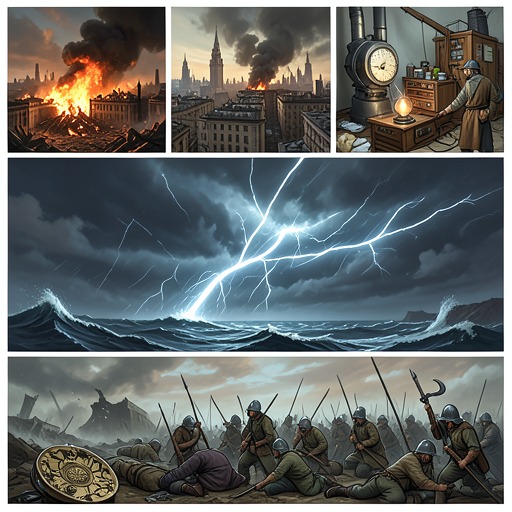
The seventh bowl follows. A voice from the heavenly temple declares the completion of the judgment, and the scene is accompanied by voices, thunder, lightning, and an earthquake described as unprecedented in magnitude. The great city is divided into three parts, the cities of the nations fall, and Babylon is brought before God for the cup of divine wrath. The text thus places the assembly at Armageddon amid a broader convulsion affecting cities and nations, and joins the battle’s setting to the judgment of Babylon.
The Confrontation
The battle is presented more fully in the book’s treatment of Revelation 19. Jesus Christ appears as the rider on a white horse, accompanied by armies from heaven. The account identifies him as faithful and true and depicts his judgment and warfare as righteous. His authority is signified by many crowns and by the title King of Kings and Lord of Lords; the sword proceeding from his mouth represents the means by which he strikes the nations and rules them.
Opposing him are the Beast, the kings of the earth, and their armies, assembled to make war against the rider and his army. The author identifies this as the final battle and connects it to the prior gathering at Armageddon. The scene’s decisive reversal is not an evenly matched contest: the assembled political and military power is overcome, and the Beast is taken along with the False Prophet, who had performed signs and deceived those who received the Beast’s mark and worshipped its image.
The defeat also completes the account of the Beast’s coercive religious and political system. Earlier in the book’s exposition, the False Prophet is described as enforcing worship of the Beast and its mark, with severe consequences for refusal. At the battle’s conclusion, the two figures who led and sustained that order are removed from the conflict. Both are cast alive into the Lake of Fire. The remaining forces are slain by the sword from the rider’s mouth, and the scene ends with birds gathering over the dead. The outcome is therefore both military defeat and the termination of the leaders associated with enforced worship and deception.
The Harvest and Its Imagery
The author links the battle to Revelation 14:17–20, where angels gather the earth’s grapes and cast them into the winepress of the wrath of God. One angel comes from the heavenly temple carrying a sharp sickle; another comes from the altar and directs him to harvest the ripe clusters. The author reads this passage as the harvest of the unrepentant and as part of the destruction of the armies assembled for Armageddon, placing it alongside the more explicit battle scene in Revelation 19.
The winepress is trodden outside the city, and the passage measures the resulting blood imagery as reaching the horses’ bridles across 1,600 furlongs. The author specifically identifies this detail as a reference to Armageddon. The number and image communicate the extraordinary scale assigned to the judgment, while the book’s commentary interprets the harvest as a divine action against the unrepentant. This connection makes the battle more than a clash between opposing armies: it is also represented as a judgment on the earth.
Chronology and Aftermath
A central concern of the book is that Revelation is not wholly arranged in chronological order. The author argues that recognizing this prevents passages that describe related events from being mistaken for events in their printed sequence. Within that method, the harvest passage in chapter 14 and the gathering and battle scenes in chapters 16 and 19 are read together as parts of the end-time sequence. The battle is consequently placed after Jesus Christ’s return, not treated as an event that precedes it.
The author also connects the aftermath to the appearance of the Lamb on Mount Zion with the 144,000 sealed from Israel. He reads their meeting with the Lamb as occurring after Christ’s return and the end of the battle, followed by their presence before God’s throne in worship. This proposed sequence reinforces the book’s larger chronological argument: events that appear earlier in Revelation may, in the author’s view, describe moments that belong later in the timeline.
More broadly, the battle supports the book’s interpretation of a seven-year period of tribulation, including a first period of conflict against the saints and a subsequent period of divine wrath. The author’s chronology and mid-tribulation rapture argument depend on distinguishing these periods and relocating passages that he considers interruptions or thematic overlays. Armageddon therefore serves as both the culmination of the earthly conflict and a test case for his method of reading Revelation: the decisive outcome becomes clear, he argues, when related visions are arranged by their chronological place rather than simply followed in chapter order.