The Beast Wars against the Saints and Enforces Worship
Book of RevelationThe Beast’s war against the saints is presented as both political domination and a test of religious allegiance. In the book’s interpretation of Revelation, the Beast receives authority for forty-two months, exercises power across nations, and wages war on the saints. A second beast, identified as the False Prophet, supports that rule by directing worship toward the first Beast and enforcing a system in which refusal carries severe consequences.
Background and Emergence
The book places this persecution within a larger end-times sequence. It connects Satan’s expulsion from heaven with the dragon’s anger against God’s people, then reads the rising Beast as the political power that gives that hostility worldwide reach. The Beast’s war against the saints is therefore not treated as an isolated conflict: it follows the account of the dragon turning against the woman’s remaining children, and accompanies the formation of the Beast government.
The author further interprets the first seal as revealing the Antichrist, who will emerge from among ten global leaders. In this account, the leader’s identity becomes apparent when one of the heads is fatally wounded and recovers; the recovered wound draws the world’s attention to the Beast. This proposed sequence links the Beast’s public authority to a dramatic change in one leader’s status, rather than presenting the persecuting ruler as identifiable from the outset.
The Beast’s Rule and the War on the Saints
Revelation describes the Beast as receiving a mouth for proud and blasphemous speech and authority to continue for forty-two months. The book emphasizes that this period is also the duration of the Beast’s war against the saints. His jurisdiction extends over every kindred, tongue, and nation, making the conflict global rather than confined to one people or territory. The author connects the Beast’s authority to the account of a ten-headed government, interpreting its reach as encompassing all nations.
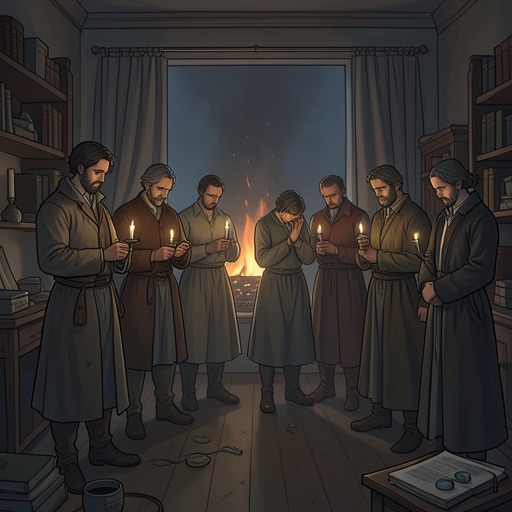
The war changes the conditions under which believers live. The passage warns of captivity and death, and presents patience and faith as the response required of the saints. The author stresses that this will not be an easy period for Christians: the Beast is permitted to overcome them, so steadfastness does not mean that they escape persecution. The conflict thus places endurance under pressure, while the Beast’s apparent power is set against the persistence of religious fidelity.
The False Prophet and Enforced Worship
The second beast rises from the earth and acts with the authority of the first. The book identifies this figure as the False Prophet and describes him as the Antichrist’s close ally. His role is not merely to endorse the Beast: he uses signs and wonders to deceive people and direct them toward worship of the first Beast, whose wound has healed.
This religious campaign is reinforced by the Image of the Beast. The False Prophet calls for its creation, gives it the capacity to speak, and makes refusal to worship it punishable by death. The mechanism turns allegiance into a public demand: worship of the image is not treated as a private conviction but as a condition imposed on people under the Beast’s rule. The book’s warning about the image therefore makes the conflict one of compulsory worship as well as political subjection.
The mark extends that system into ordinary economic life. It is imposed on people across social divisions, including small and great, rich and poor, free and enslaved. Without the mark, the Beast’s name, or the number of his name, a person cannot buy or sell. The author accordingly treats the mark as more than an identifying sign: its connection to economic access makes compliance a daily material pressure, while the threat against those who refuse worship makes the same demand explicitly religious and punitive.
Consequences and Significance
The book reads the forty-two-month authority of the Beast as evidence for a mid-tribulation rapture. In its chronology, the Beast’s rule and war against the saints occupy three and a half years, within the larger seven-year Great Tribulation. The timing matters to the author’s larger argument: believers may pass through part of this period before the rapture, rather than being removed before events become severe. This is an interpretation advanced by the book, not a neutral claim that all readers of Revelation share.
The author also draws a practical warning from the predicted scope of the rule. If the Beast will govern every nation, no country is outside the prophecy merely because it presently possesses independence. The threat is described as a worldwide political order joined to religious demands, not simply a local crisis. In this account, the saints face two linked pressures: the use of force against those who resist and the restriction of economic participation for those who refuse the Beast’s system.
Against that pressure, the book places two responses side by side. The saints are called to patience and faith, while an angel proclaims the everlasting gospel to every nation, kindred, tongue, and people. The announcement directs people to fear God and give glory to him as the hour of judgment approaches. The Beast’s campaign may reach across nations and shape worship and commerce, but the narrative also presents a counter-message addressed to the same worldwide audience. The conflict’s central stakes are therefore allegiance and endurance: whether people submit to the Beast’s rule or remain faithful amid its demands.