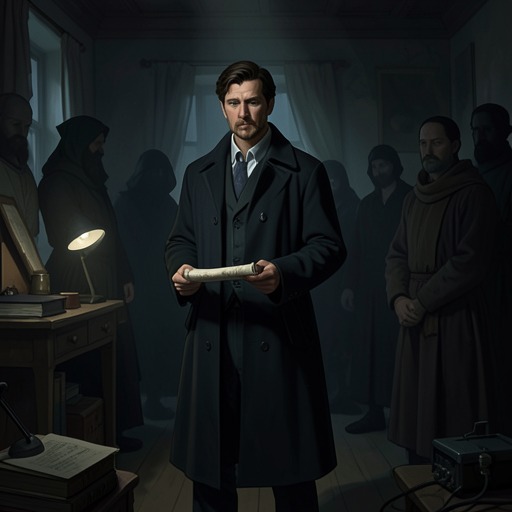
The First Seal and the Rise of the Beast
Book of RevelationThe First Seal and the Rise of the Beast presents the opening of the first seal as the unveiling of a conqueror and, in the book’s interpretation, the first appearance of the Antichrist. The vision gives only a white horse, a rider with a bow, and a crown granted to him; the later account of the beast supplies the political identity and worldwide reach that the first scene leaves implicit. That connection turns the seal from an isolated image of conquest into the beginning of a sequence in which power, apparent death, recovery, and war against the saints converge.
The First Seal and Its Rider
The scene begins when the Lamb opens the first of the seven seals. One of the Four living creatures calls out, and John the Apostle sees a white horse. Its rider holds a bow, receives a crown, and rides out as a conqueror intent on further conquest. The account establishes motion and authority, but does not identify the rider by name or explain the bow’s use. The crown is given to him, making his authority something conferred rather than simply possessed from the outset.
The book reads this opening as the revealing of the Antichrist. Its argument depends on reading the first seal alongside Revelation 13, where a beast rises from the sea and one of its heads bears a fatal wound that is healed. The white horse scene therefore functions as an initial disclosure whose meaning becomes clearer through a later vision: the rider’s conquering role is associated with the leader who will emerge from the beast’s political structure.
The Beast’s Political Identity
The account of the beast describes it through a composite appearance: it resembles a leopard, has feet like a bear’s, and a mouth like a lion’s. It has seven heads and ten horns, with crowns on the horns and blasphemous names on its heads. The text also says that the dragon gives the beast power, a seat, and great authority. These details place its rise within a structure of delegated power and mark its rule as both politically organized and blasphemous.
The author interprets the ten heads as ten heads of state, each representing one of ten regions of the earth. In this reading, the system will initially be formed to include every nation. This is the author’s proposed explanation of the imagery, not an identification supplied by the cited verses themselves. It makes the beast’s rise a development in global governance: the Antichrist, on this account, does not become identifiable before the political arrangement exists, but comes from one of its ten leadership positions.
The Wound and Recognition
The decisive change comes when one of the beast’s heads is wounded as if to death, but the deadly wound is healed. The book treats this recovery as the point at which the identity of the Antichrist can be recognized. Before it, the leader is one among the ten; afterward, the recovered head becomes the focus of astonishment, and the whole world wonders after the beast. The apparent return from death thus functions both as a public sign and as a transfer of attention toward the beast’s power.
The account adds that people worship the dragon that gave power to the beast, and worship the beast itself, declaring its apparent invulnerability to challenge. The author interprets this as Satan taking possession of a human host: one of the ten leaders becomes the Antichrist and begins to make war against God’s people. The healed wound is therefore not merely a striking recovery in the narrative. In the book’s reading, it marks the turn from an indistinct political figure to an openly hostile ruler whose authority is bound to satanic power.
Conquest, Duration, and Consequences
The beast is given a mouth for great and blasphemous claims, along with authority to act for forty-two months. The book equates that span with three and a half years and connects it to the period in which Satan is permitted to make war on the saints. Revelation 13 further describes the beast as making war against the saints and receiving authority over every kindred, tongue, and nation. Together, these details give the rise of the beast a defined duration and a scope that reaches beyond any single people or territory.
The book also draws a connection between that persecution and the dragon’s anger against the woman and the remnant of her offspring, identified as those who keep God’s commandments and hold the testimony of Jesus Christ. This connection broadens the first seal’s consequences: the initial image of a rider going out to conquer leads, in the author’s chronology, toward a global power that persecutes believers. The proposed midtribulation rapture follows from the forty-two-month period of the beast’s authority; it is presented as the author’s interpretation of that duration, rather than as a detail directly stated in the first-seal vision.
The event’s narrative force lies in the delayed recognition. The first seal shows a crowned conqueror without naming him; the beast vision supplies a political framework; the wound and recovery then identify the leader around whom worldwide wonder and worship gather. Read this way, the sequence makes conquest the beginning of a revelation, not its conclusion: the rider’s authority becomes the sign of a later confrontation between the beast’s rule and the saints it makes war against.