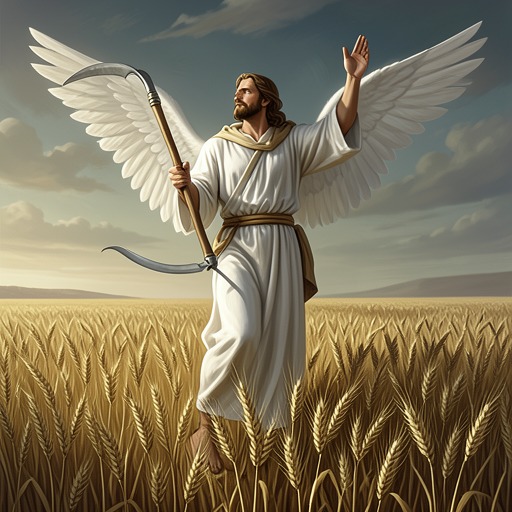
The Lamb Reaps the Earth’s Harvest
Book of RevelationThe Lamb Reaps the Earth’s Harvest is a brief but consequential vision in which a crowned figure on a white cloud reaps the earth at an angel’s command. The book treats the scene not as an isolated image but as part of its proposed chronological reconstruction of Revelation: placed after the destruction of Mystery Babylon, the harvest becomes further confirmation, in the author’s interpretation, that the rapture follows Babylon’s fall.
The Vision and Its Action
The account opens with a figure seated on a white cloud, described as being like the Son of Man. He wears a golden crown and holds a sharp sickle. The image joins authority and readiness: the crown marks the figure’s status, while the sickle is the instrument by which the harvest will be carried out. The passage does not describe the figure’s identity beyond that likeness, nor does it provide additional details about the setting or the people being reaped.
An angel comes out of the temple and calls loudly to the figure. The angel announces that the time to reap has arrived because the harvest of the earth is ripe, then commands him to use the sickle. The figure thrusts it onto the earth, and the earth is reaped. The scene’s action is compact and sequential: the angel announces the appointed time, gives the command, and the crowned figure performs the harvest. The text presents completion without describing how the harvest unfolds or what follows for those gathered.
Placement After Babylon’s Destruction
The book’s placement of this vision depends on its distinction between the order of Revelation’s presentation and the chronological order it proposes for the events. The author argues that angelic interruptions can revisit or expand material already presented, so passages need not be read in the order in which they appear. Revelation 14:14–16 is treated as one such passage whose position in the book’s reconstruction clarifies its relation to other end-time events.
In that reconstruction, the harvest follows the account of Mystery Babylon’s destruction. The author reads Revelation 17:1 through 19:10 as a continuous unit concerning judgment on a nation symbolized as a prostitute. He proposes that the United States may be the country represented by Mystery Babylon, while acknowledging that this identification is his interpretation and that readers may disagree. The vision of the harvest is then taken up after the Babylon material as the next relevant passage in the argument.
The proposed sequence gives the reaping a specific chronological function. It is not merely another picture of judgment: its position after Babylon’s fall is used to establish what the author believes happens next. This order is central to the book’s claim, rather than an incidental detail of its reading of the imagery.
The Harvest and the Rapture
The author explicitly presents the reaping as further confirmation that the rapture occurs after the destruction of Mystery Babylon. The reasoning links the harvest image to the gathering of believers: the earth is reaped after the time for harvest is declared, and the author places that action after the preceding judgment. The passage itself describes the reaping but does not name it as the rapture; that identification belongs to the book’s interpretive framework.
The book also connects the surrounding Revelation passages to the rapture. In its reading, the marriage supper described near the end of the Mystery Babylon unit indicates that the bride is already in heaven. The harvest passage is brought forward as additional support for the same sequence. Thus the argument relies on two related images—the marriage supper and the ripe harvest—to place the gathering of the faithful after Babylon’s destruction, rather than before it.
This ordering matters because the author regards the timing of the rapture as a disputed question with practical consequences. He warns that Christians who expect an early rapture may neglect preparation for severe future events. In that context, the harvest is not only a symbolic scene but a chronological marker within a teaching meant to shape expectations and readiness. The account does not give practical instructions within the vision itself; its force comes from the position the author assigns it in the larger sequence.
Interpretation and Reception
The book presents its chronological reading as the result of a process of confusion, study, and reconsideration. The author recalls being troubled by the placement of the Mount Zion vision in Revelation 14, which seemed to show Jesus visiting the 144,000 before his return to the Mount of Olives. On a later reading, he says, he recognized that Revelation includes material outside chronological sequence. That discovery informs the method by which he relocates the harvest and related passages.
Readers’ letters describe the proposed ordering as making Revelation easier to understand. One reader says the book had previously seemed disjointed, while another praises the placement of six chapters and connects Revelation 14 with the Church’s rapture. These responses document the reception of the author’s chronology; they do not independently establish the interpretation. The harvest’s significance therefore lies both in its spare biblical action and in the explanatory role the book assigns it: a ripe earth, a command from the temple, and a completed reaping become part of an argument about when the faithful are gathered.