The Saints Are Raptured and Gathered before God’s Throne
Book of RevelationThe Saints Are Raptured and Gathered before God’s Throne is the author’s reading of the great multitude in white robes in Revelation 7:9–17. He treats their sudden appearance before the throne as the Rapture of the saints, occurring after the Great Tribulation and between the sixth and seventh seals. In his chronology, this gathering is not an isolated heavenly image: it helps locate the Rapture in relation to the destruction of Mystery Babylon, the harvest of the earth, the silence following the seventh seal, and the beginning of God’s wrath.
The Multitude and Its Appearance
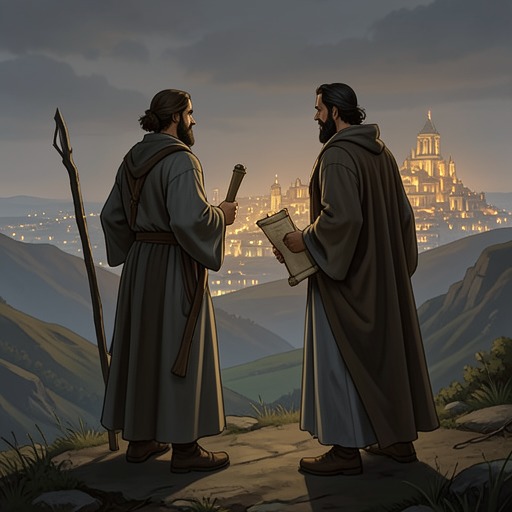
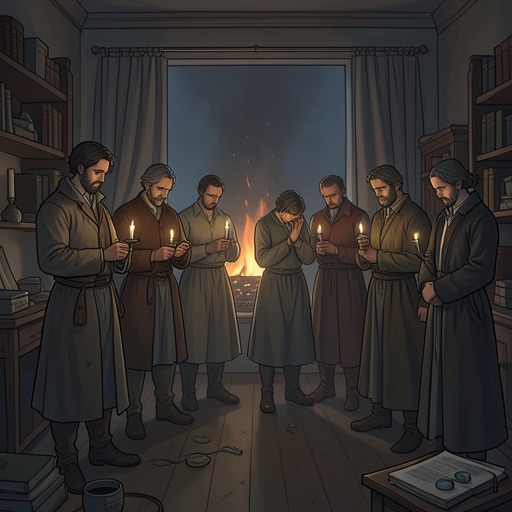
The vision presents a multitude too numerous to count, drawn from all nations, peoples, and languages. They stand before the throne and before the Lamb, wearing white robes and holding palm branches. Their collective presence is the scene’s defining fact: the gathered group is international and innumerable, rather than a small or readily identifiable company. The author emphasizes that the multitude seems to have arrived together, making its appearance a clue to the timing of the event.
The people praise God and the Lamb for salvation. Angels stand around the throne with the elders and the four living creatures, fall before the throne, and worship. The gathering therefore appears within a larger scene of heavenly praise, not as a description of earthly preparations or of the process by which individuals leave the earth. The passage shows the saints already present before the throne and depicts their place among the worshippers there.
The Elder’s Question and the Multitude’s Identity
One of the elders asks who the white-robed people are and where they came from. John replies that the elder knows; the elder identifies them as those who came out of the Great Tribulation and whose robes have been made white in the blood of the Lamb. The author gives special weight to the question about their origin. In his interpretation, it signals that a newly arrived company has become visible to those already assembled around the throne.
The elder’s explanation also gives the multitude a history and a religious identity. They have passed through the Great Tribulation, and their white robes signify, in the passage’s account, cleansing through the Lamb. Their future is described in terms of service before God: they remain in the divine presence, are no longer subject to hunger or thirst, and are led by the Lamb to living fountains of waters. God wipes away every tear from their eyes. The scene thus joins arrival with consolation: the gathered saints are not only counted among the worshippers but are promised enduring care and relief.
The Author’s Chronological Placement
The book argues that Revelation contains passages that are not arranged in chronological order, and that reading every chapter as a continuous sequence can obscure the timing of events. The author places the multitude in Revelation 7:9–17 after the sixth seal and before the opening of the seventh. He regards the multitude’s apparent sudden arrival, together with the elder’s question about where its members came from, as evidence for a Rapture at that point. This is the author’s interpretive conclusion, not a detail explicitly narrated as a departure from earth in the quoted passage.
The seventh seal follows the vision of the multitude. When it is opened, heaven is silent for about half an hour. The author interprets this silence as the gathered saints standing in awe before the throne, and imagines it as a pause before the Father welcomes the Son’s bride to her new home. The passage itself states the silence and its duration; the explanation of the silence as the multitude’s arrival and response belongs to the author’s reading of the sequence.
In the wider arrangement, the author places the elders’ scene in Revelation 11:16–19 between the seventh seal’s silence and the trumpet judgments. He sees the movement from the silence to the distribution of the trumpets as a transition into God’s wrath. This placement supports his larger claim that the heavenly gathering occurs before the judgments associated with the trumpets, while following the tribulation from which the multitude has emerged.
Relation to Babylon and the Harvest
The author also connects the timing of the Rapture with his rearrangement of other passages. He treats Revelation 17:1–19:10 as a continuous unit that belongs together chronologically, although it appears elsewhere in the book’s chapter order. In that section, he identifies Mystery Babylon with the United States, while acknowledging that this identification is his proposal and that other readers may disagree. He points to the country’s power, its association with many peoples and languages, and the description of its destruction amid great wealth and maritime trade. He also notes a difficulty in his own interpretation: the passage’s reference to the blood of prophets and saints leads him to consider whether the United States might turn against Christians. These claims form the author’s proposed setting for the destruction of Babylon, not an independently established identification.
The author reads the end of this Babylon passage, Revelation 19:1–10, as occurring after the Rapture, because it announces the time for the Marriage Supper of the Lamb, which he understands to require the bride’s presence in heaven. He also reads the harvest in Revelation 14:14–16, where a figure like the Son of Man on a white cloud reaps the earth at an angel’s command, as further confirmation that the Rapture follows Babylon’s destruction. These cross-references place the gathering within a broader interpretive sequence rather than treating the white-robed multitude as a self-contained episode.
Consequences for the Book’s End-Times Argument
The proposed timing matters to the book’s disagreement with an early-Rapture expectation. The author says that many Christians expect to be removed before conditions worsen and therefore do not prepare for the Great Tribulation. He warns that a crisis severe enough to cause panic could arrive too late for adequate preparation, and that churches might not be able to feed people without resources. The white-robed multitude functions in this argument as evidence that the saints pass through the Great Tribulation before appearing before the throne, rather than having all departed beforehand.
Readers’ letters included in the book describe the chronological arrangement as making Revelation easier to understand, and one reader specifically praises the placement of the Rapture in Revelation 14. Such responses show how the proposed sequence shaped the book’s reception, but they do not themselves establish the interpretation. At the close of the vision as the author reads it, the saints stand before the throne, their tribulation behind them and the seventh seal’s silence immediately ahead. Their gathering becomes both a promised scene of refuge and a disputed hinge in the book’s timetable of end-time events.