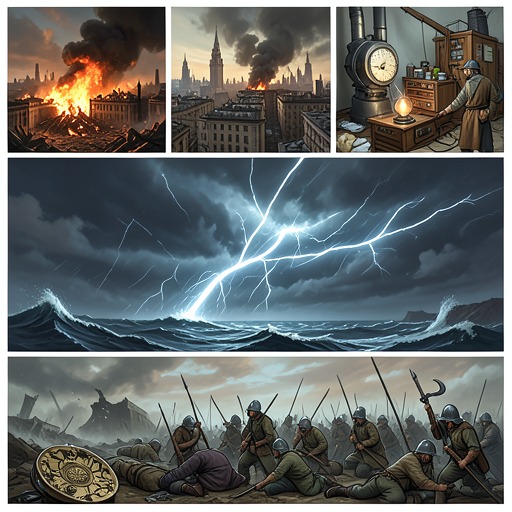
The Seven Bowl Judgments
Book of RevelationThe Seven Bowl Judgments are the final plagues in the book’s account of divine wrath, a sequence that devastates the earth and gathers its rulers toward Armageddon. Their force lies not only in the calamities themselves but in the way the author uses them to make a chronological argument: the bowls reach a declared completion, while the chapters that follow them in the text are, in his interpretation, an interruption before the narrative resumes with Jesus Christ’s return.
Setting and place in the sequence
The account begins with seven angels bearing what the book calls the seven last plagues, in which the wrath of God is completed. Before they are sent, the vision shows those who have gained victory over the beast, its image, and its mark standing on a sea of glass mingled with fire. They hold harps and sing the song of Moses and the song of the Lamb, praising God’s works and judgments. The scene places worship and judgment side by side: the victorious stand before the impending plagues, while the song declares the justice of the judgments to come.
The heavenly temple then opens, and seven angels receive seven golden bowls full of the wrath of God. Smoke from God’s glory and power fills the temple, and no one can enter until the plagues are completed. A voice from the temple commands the angels to pour the bowls upon the earth. This framing makes their sequence bounded and purposeful: the plagues begin under a direct command, and access to the temple remains closed until their completion.
The author emphasizes the phrase “seven last plagues.” He argues that if these are the last, other plagues must have preceded them, and challenges interpretations that treat the bowls as the entirety of God’s wrath while excluding the trumpets. Earlier in the book, the first trumpet brings hail and fire mixed with blood, burning a third of the trees and all green grass. The bowl sequence therefore appears within a broader pattern of judgments rather than standing alone.
The first five bowls
The first bowl brings painful sores upon those who bear the mark of the beast and worship its image. The judgment is directed at people identified by their allegiance, connecting the physical consequence to the book’s conflict over worship and the beast’s mark. The second bowl strikes the sea, which becomes like the blood of a dead person, and every living thing in it dies. The third turns rivers and springs to blood. An angel of the waters declares God righteous, explaining that those who shed the blood of saints and prophets have been given blood to drink; another voice from the altar affirms that the judgments are true and righteous.
The fourth bowl is poured upon the sun, whose power scorches people with fire. Their response is to blaspheme God, who has power over the plagues, rather than give him glory. The fifth bowl falls upon the throne of the beast, plunging its kingdom into darkness. The people suffer pain, blaspheme the God of heaven, and do not repent of their deeds. In these two judgments, the narrative stresses not only the escalation of disaster but also the persistence of defiance: suffering does not lead those described to repentance.
The sixth and seventh bowls
The sixth angel pours his bowl upon the Euphrates River, drying its water to prepare a way for the kings of the east. John then sees unclean spirits like frogs emerging from the mouths of the dragon, the beast, and the False Prophet. The vision identifies them as demonic spirits that perform signs and go out to the kings of the earth and the whole world, gathering them for the battle of the great day of God Almighty. The gathering is named Armageddon. At this point the account also includes a warning that the coming will be like a thief and that the watchful person who keeps his garments is blessed.
The seventh bowl is poured into the air. A great voice from the heavenly temple and throne announces that it is done. Voices, thunder, lightning, and an earthquake follow; the narrator describes the earthquake as unlike any since people were upon the earth. The great city divides into three parts, the cities of the nations fall, and Babylon comes before God to receive the cup of the fierceness of his wrath. Islands flee and mountains disappear. Great hail falls from heaven, with stones described as weighing about a talent, yet people blaspheme God because of the plague. The sequence thus ends with both a declaration of completion and continued rejection of God by those afflicted.
Chronology and aftermath
The author reads the end of Revelation 16 as the point at which the bowls have completed God’s wrath. In the chronological order he proposes, the next event should be Jesus Christ riding a white horse, with the armies of heaven following him to the final battle. Revelation 17 instead begins with an angel showing John the punishment of the great prostitute, and chapters 17–18 continue with the account of Mystery Babylon, its destruction, and the martyrdom of the saints. The author treats this passage as a second angelic interruption, not as the chronological continuation of the bowls. He reasons that the call for God’s people to come out of Babylon would not fit after the wrath had already been completed if the passage were simply the next event in sequence.
On this reading, the chronological account resumes at Revelation 19:11, where heaven opens and the rider called Faithful and True appears on a white horse. The armies of heaven follow, dressed in clean white linen. The bowls therefore serve two related roles in the author’s account: they mark the completion of the final plagues, and they establish a turning point after which the text’s order must be distinguished from the proposed order of events. Their ending is not the end of the larger conflict; it leads toward the battle at Armageddon and the return of Jesus Christ.