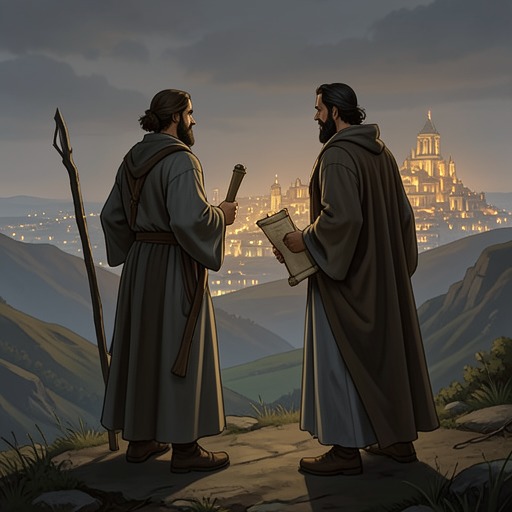
The Seventh Trumpet Announces Christ’s Kingdom
Book of RevelationThe Seventh Trumpet Announces Christ’s Kingdom is both a turning point in the book of Revelation’s visionary sequence and, in the author’s reading, a heavenly announcement made after the rapture, at the midpoint of God’s wrath. When the seventh angel sounds, voices in heaven declare that the kingdoms of the world have become the kingdom of God and Jesus Christ, whose reign will continue forever. The author reads this proclamation not simply as another earthly calamity, but as a disclosure of the coming divine order and of events unfolding in heaven.
Place in the Chronology
The author’s interpretation begins from the claim that Revelation is not wholly arranged in chronological order. In his view, reading every passage as a continuous timeline has contributed to competing interpretations, including at least five different proposals for when the rapture occurs. The seventh trumpet therefore has significance beyond its immediate announcement: locating it within the right sequence is part of the book’s broader effort to clarify the order of end-time events.
In the proposed sequence, the material in Revelation 12–13 describes Satan’s attack against the children of Israel and Satan’s being cast down to earth. The account then proceeds through further visions and judgments. This placement matters because the trumpet’s announcement is not treated as an isolated sentence detached from the surrounding timeline. It belongs to an arrangement in which earthly conflict and judgment occur alongside events concerning God’s people in heaven.
The Sounding and Its Announcement
The event itself is brief in the cited passage: the seventh angel sounds, and great voices are heard in heaven. Their proclamation changes the frame from the world’s divided kingdoms to a kingdom belonging to God and Jesus Christ. It also declares the duration of that reign: forever. The announcement therefore presents the trumpet as a statement of sovereignty, not merely as a signal that another disaster is about to follow.
The author emphasizes this heavenly setting. His reading of Revelation 11:15 is that the seventh trumpet appears to signal an event in heaven, possibly connected with the Lamb’s marriage supper. He also relates this possibility to Revelation 10:7, where the days of the seventh angel’s voice are associated with the completion of the mystery of God. The text, as he notes, does not specify all that the seventh-trumpet judgment entails; his proposal is that its emphasis may include what is happening to God’s elect in heaven, rather than describing only a further earthly judgment.
Relation to the Judgments
The trumpet sounds within a sequence of escalating judgments. Earlier, at the sixth seal, a great earthquake is followed by signs in the sky: the sun becomes dark, the moon appears blood-red, stars fall, and mountains and islands are displaced. The people described in that passage hide and recognize that the great day of wrath has come. The author places the seventh trumpet within this larger movement, while distinguishing its announcement from the visible upheavals associated with the seals.
The first trumpet provides a contrasting example of the judgments’ earthly effects: hail and fire mixed with blood burn a third of the trees and all the green grass. Later, the seventh bowl brings an earthquake described as unprecedented, divides the great city into three parts, and brings Babylon to remembrance before God. These episodes help define the broader setting of the seventh trumpet without making them the trumpet’s own contents. The author explicitly associates the trumpet with the middle of God’s wrath and says the rapture has already happened by this point; he then describes the seven bowls as the last plagues, following earlier judgments rather than comprising the entirety of God’s wrath.
Interpretive Significance
The trumpet’s announcement holds two scales of the author’s timeline together. On earth, the sequence includes catastrophic judgments and continuing opposition; in heaven, voices announce the transfer of the world’s kingdoms to God and Jesus Christ. The juxtaposition makes the trumpet a hinge in the interpretation: it declares the ultimate outcome while the judgments are still being described as unfolding.
The author’s proposed connection to the marriage supper remains qualified: he says the announcement may be tied to that heavenly event, rather than presenting the connection as explicit in the verse. Even so, this reading supports his larger chronological claim that the rapture has already occurred and that heavenly activity accompanies the release of God’s wrath. The seventh trumpet thus functions both as a declaration of the kingdom’s lasting sovereignty and as a marker in the author’s disputed reconstruction of Revelation’s sequence.