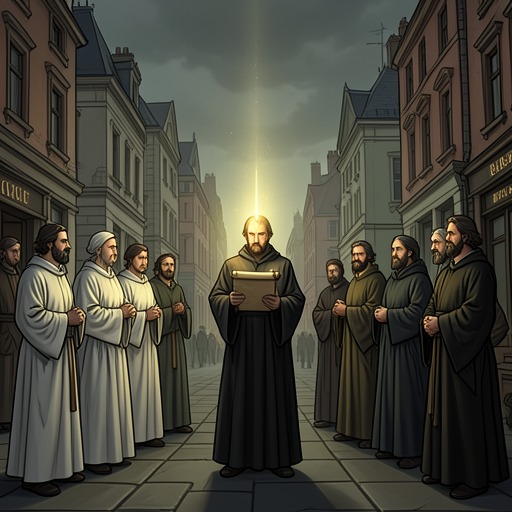
The ten kings
Book of RevelationThe ten kings are a coalition of rulers in the book’s reading of Revelation: they receive authority alongside the Beast, give it their power, and later help destroy Mystery Babylon. Their allegiance is consequential but not final. The same rulers who empower the Beast are also depicted as making war against the Lamb, whose victory establishes the limits of their political power.
Identity and Formation
In Revelation 17, the ten horns are interpreted as ten kings who have not yet received kingdoms when they appear in the vision. They receive authority with the Beast for a brief period, described in the passage as one hour. The text associates their rule with a shared purpose: they have one mind and give their power and strength to the Beast. The book presents this transfer as a defining act of the group, rather than describing the kings as an independent ruling bloc.
The author develops the image into a future political structure. In his account, the Beast’s global government is initially organized around ten heads of state representing ten regions of the earth, with the system extending to every nation. He links this formation to the Beast’s rise and argues that one of the ten leaders will be fatally wounded and recover; that leader then becomes the Antichrist. This is the author’s interpretation of the prophetic imagery, not a description of an already existing organization.
The kings’ authority belongs to a larger sequence of end-times events in the book. The author reads Revelation as not wholly chronological and argues that putting its episodes into sequence can correct mistaken conclusions about the timing of the rapture. In his timeline, the Beast’s authority over the saints lasts forty-two months, and the rapture ends that period of persecution; God’s wrath follows. The forty-two-month period is assigned to the Beast’s authority, not explicitly to the ten kings’ joint rule.
Alliance with the Beast and War against the Lamb
The kings’ transfer of power makes them allies of the Beast, but the alliance places them in opposition to the Lamb. Revelation 17 says that they make war with the Lamb and that the Lamb overcomes them. The passage describes those with the Lamb as called, chosen, and faithful. In the book’s account, therefore, the coalition’s combined political strength does not decide the final conflict: the Lamb’s authority does.
The author places this confrontation within a wider period of global rule and pressure on believers. He connects the Beast’s dominion over peoples, languages, and nations with a war against the saints, and cites the passage’s call for the saints to endure with patience and faith. He does not identify the ten kings individually as the agents of every act of persecution. Instead, he situates them within the political order that gives the Beast power, while treating the Beast’s war on the saints as a distinct part of that order’s consequences.
The Kings and Mystery Babylon
The kings’ relationship with Mystery Babylon changes sharply. In Revelation 17, the waters associated with the woman are interpreted as peoples, multitudes, nations, and languages; the ten kings then hate the woman, strip her of protection, and burn her city. The passage also says that God puts it into their hearts to carry out this purpose and to give their kingdom to the Beast until God’s words are fulfilled. The kings’ destruction of the woman is thus presented both as a political reversal and as an action within divine providence.
The author identifies Mystery Babylon with the United States, while acknowledging that readers may disagree. He argues that the description in Revelation 17 fits the country and points to its status as a superpower that did not exist when the Bible was written. He also reads Revelation 18’s account of merchants and shipmasters mourning the sudden loss of the city’s wealth and its destruction as further support for his identification. This national identification is the author’s proposed interpretation; the account of the ten kings’ attack is the prophetic passage on which it rests.
The destruction of Mystery Babylon also matters to the author’s chronology. He reads passages in Revelation 14 and 17 as placing Babylon’s fall before the rapture. In his sequence, saints remain on earth after the fall and are still warned against worshipping the Beast or accepting its mark. Their patience and the deaths of believers during this period make the kings’ destruction of the city one episode in a longer crisis, rather than the end of the conflict between the Beast’s system and the faithful.
Role in the Book’s Interpretation
The ten kings embody a political alliance whose power serves the Beast but whose actions also fulfill a judgment against Mystery Babylon. Their allegiance is not depicted as an enduring or self-directed partnership: they hand authority to the Beast, turn against the woman, and join the conflict with the Lamb. The sequence makes their role one of delegated power and shifting targets, while the outcome remains governed by the Lamb’s victory.
Their portrayal also supports the book’s wider argument that Revelation must be read with attention to sequence. The author says that the book’s non-chronological passages have contributed to divergent interpretations, including multiple accounts of the rapture’s timing. His chronological arrangement places the Beast’s rule, the saints’ endurance, Babylon’s fall, and the rapture in a particular order. Within that framework, the ten kings connect the formation of global rule to Babylon’s destruction and to the final opposition overcome by the Lamb.