Two Witnesses
Book of RevelationThe Two Witnesses are prophetic figures in Revelation 11 whose ministry and return to life become a key chronological marker in the book’s reordered reading of Revelation. They prophesy for 1,260 days, exercise authority over rain and plagues, and are killed by the beast after completing their testimony. Their bodies remain visible for three and a half days; then they stand, ascend to heaven, and are followed immediately by an earthquake. The author uses that final earthquake to place their death near the end of the period of God’s wrath, while locating their arrival roughly three and a half years earlier, shortly before the rapture in the proposed timeline.
Identity and Prophetic Setting
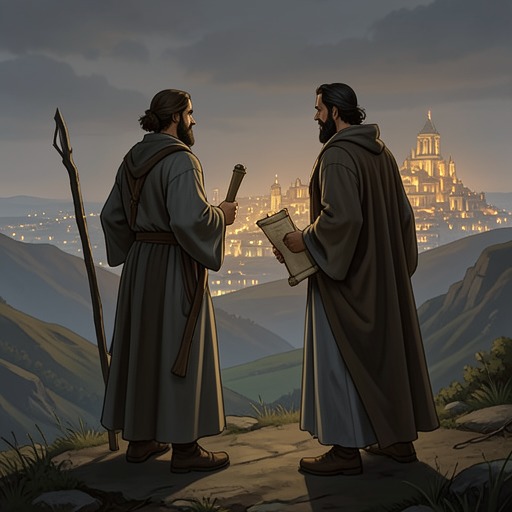
The account presents the Two Witnesses as a pair commissioned to prophesy, not as individually named characters with separate biographies. Revelation 11 introduces them within a passage that also describes the temple, the altar, and worshippers being measured. The outer court is left unmeasured and given to the Gentiles, while the holy city is trampled for forty-two months. Their own period of prophecy is given as 1,260 days, and the book treats these time references as parts of the same broad end-times setting.
The text describes the pair as two olive trees and two lampstands standing before God. They are clothed in sackcloth, a sign that distinguishes their public prophetic role from the authority they wield. The passage does not supply their names or personal histories. Instead, it defines them through their testimony, their powers, the opposition they face, and the sequence of events that follows their death.
Ministry and Powers
The Two Witnesses’ ministry lasts for 1,260 days. During this period, they can shut the heavens so that rain does not fall, turn waters to blood, and strike the earth with plagues as often as they will. The passage also describes fire proceeding from their mouths to consume anyone who tries to harm them, and says that an attacker must die in this manner. These powers make their testimony more than speech: the witnesses’ presence is accompanied by judgments that affect the earth and deter direct attacks against them.
The author interprets their powers within a larger sequence of divine judgment. In his account, the Two Witnesses arrive around the time the 144,000 are sealed and the rapture approaches. Their authority to withhold rain and call down plagues makes them instruments through whom God’s wrath is directed during the latter part of the tribulation. This is the author’s placement and theological explanation of the passage; the text itself gives the duration of their ministry and lists their powers, while the broader timeline is assembled by comparing those details with other events in Revelation.
Opposition and Death
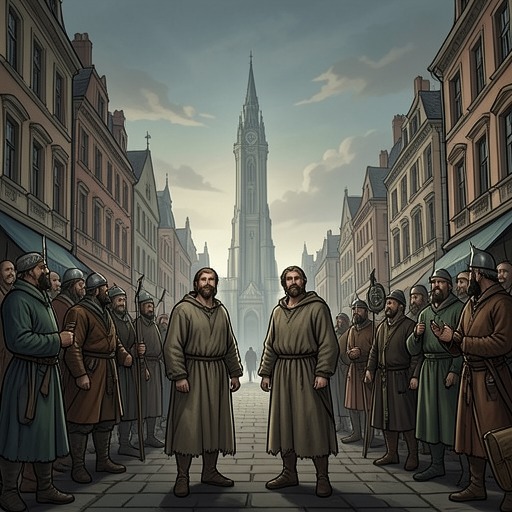
The beast does not overcome the Two Witnesses until they have finished their testimony. At that point, it makes war against them, overcomes them, and kills them. Their bodies lie in the street of the great city, described spiritually as Sodom and Egypt and identified as the place where the Lord was crucified. People from peoples, kindreds, tongues, and nations see the bodies for three and a half days, and the bodies are not placed in graves during that time.
The response of the earth’s inhabitants reverses the witnesses’ earlier power over their lives. Those who dwell on earth rejoice and celebrate their deaths, exchanging gifts because the prophets had tormented them. The account thus sets public hostility against the witnesses’ completed testimony: the celebration follows their killing, but it does not end their story. The author also places their deaths within the beast’s broader war against the saints, which he understands as lasting for forty-two months and ending with the rapture.
Resurrection and Ascent
After three and a half days, the Spirit of life from God enters the Two Witnesses, and they stand on their feet. The spectators respond with great fear. A voice from heaven then calls them to come up, and they ascend to heaven in a cloud while their enemies watch. Their ascent is both a reversal of the public celebration and a visible conclusion to the period in which their bodies had been left exposed.
An earthquake occurs in the same hour. A tenth of the city falls, seven thousand people are killed, and the survivors are afraid and give glory to the God of heaven. The earthquake provides the decisive link in the author’s chronology. He identifies only two severe earthquakes in Revelation as candidates for the event: one associated with the sixth seal and another with the seventh bowl. He rejects the sixth-seal placement because counting back three and a half years would put the witnesses’ arrival before the Antichrist’s arrival, which he considers inconsistent with the timing and character of their judgments. He therefore connects their resurrection and ascent with the earthquake at the seventh bowl.
Chronological and Narrative Role
The author reads Revelation 11:1–14 as an account that spans the entire 3.5 years of the witnesses’ ministry, rather than as a sequence in which every detail occurs at the moment the passage is placed in his timeline. The prophecy looks ahead from the witnesses’ arrival to their death, resurrection, and ascent. He therefore warns readers that the passage includes events separated by three and a half years and must be read with that duration in view.
This structure makes the Two Witnesses a chronological hinge in the book’s argument. Their 1,260 days provide a period that can be set beside the forty-two months associated with the trampling of the holy city and the beast’s authority. Their death and the earthquake that follows their ascent, in turn, help the author locate the end of their ministry near the seventh bowl. He places their arrival shortly before the midpoint of the seven-year tribulation, possibly a short time before the rapture, and their death just before the seventh bowl of God’s wrath. In this interpretation, their story connects prophetic testimony, the beast’s opposition, the rapture, and the final judgments without treating Revelation’s written order as a fully chronological sequence.