Blademate
Bound by DarknessBlademate is a Kalith warrior relationship whose meaning extends beyond personal attachment: it establishes a place within Kalith society, binds the warrior to a Sworn Guardian, and turns protection into a lifelong duty. Larem q’Jones’s experience shows the bond under pressure, as its code remains powerful even after he crosses into the human world, loses his former status, and must decide what loyalty means when his own people become his enemies.
Definition and Social Meaning
Larem remembers being a Blademate to a Sworn Guardian as a life in which he knew his place and served his people with honor. The bond gave him an intelligible identity within Kalith society, in contrast to his uncertain existence among the Paladins, where he survives partly through charity and a small paycheck for teaching weapons practice. His exile therefore is not merely geographical. It removes him from the social order that once confirmed his worth, leaving him to learn how to make independent choices without the structure of the role he had inherited and fulfilled.
The relationship also carries explicit protective obligations. When Larem identifies himself as Blademate to Lusahn q’Arc, he immediately connects that status to a wider vow: he is sworn to protect anyone unable to defend themselves, whether human or Kalith. The title is thus both relational and ethical. It names his connection to a particular Sworn Guardian, but it also measures his conduct in moments when obedience, compassion, and violence collide.
Duty Under Exile
Larem’s attachment to the Blademate role persists despite his distrust of the Paladins. He has been betrayed too often by his own kind to accept easily that former enemies will treat him differently, and he sometimes considers returning to Kalithia even though doing so could expose him to a death sentence. Yet he resists that course, continuing to live in the new world while trying to become free enough to make his own decisions. The bond remains part of what he is, even when the society that gave it meaning is inaccessible.
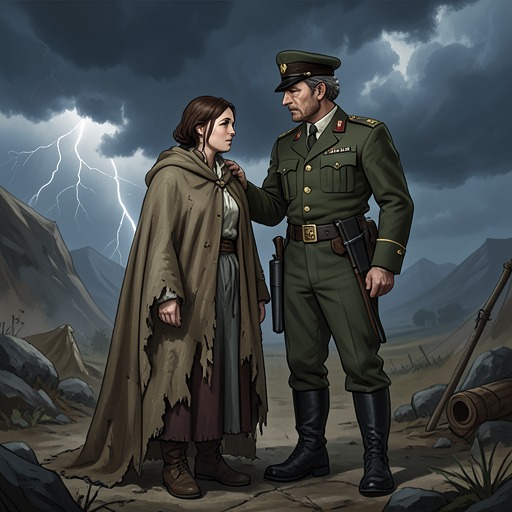
That divided position becomes especially sharp when Larem confronts the Others in the tunnels. Their leader calls him a traitor because he has chosen to live in the light, denying that they are brothers if he remains allied with the human world. Larem answers by invoking his Blademate status and his oath to protect the defenseless. He refuses to abandon Sasha Willis, even when the Others threaten her and offer her safety only in exchange for information. His declaration is not a claim of abstract virtue; it is a direct acceptance of the role’s consequences. He fights Kalith warriors from his homeland and kills them, cursing the necessity because the act deepens the spiritual damage already caused by exile.
After the fight, Larem is furious with Sasha because he believes her recklessness helped bring about the deaths, and he feels that killing the Others has taken another piece of his soul. Nevertheless, he does not leave her. His duty is unfinished until she reaches safety, so he sets aside his grief and escorts her out of the tunnels. The episode establishes the bond’s tragic logic: protection can demand violence, but fulfilling the obligation does not make the violence emotionally survivable.
Protection, Honor, and Violence
The Blademate code later governs Larem’s confrontation with Duke. After subduing him, Larem picks up Lonzo Jones’s sword and offers it to Duke pommel first, explaining that he wants to be able to tell Devlin Bane that he gave the man a chance to defend himself. Duke refuses the weapon, leaving the imbalance between a human and a Kalith warrior exposed, but Larem’s gesture shows that the code is not simple bloodlust. Even while prepared to kill, he frames the encounter as a formal challenge rather than an execution of an unarmed man.
Larem’s justification becomes personal when he explains the confrontation to Sasha. Duke’s insults toward her, toward Hunter Fitzsimon, and toward their relationship are, in Larem’s understanding, offenses that require a Blademate to act. He argues that challenging Duke was his duty and his honor, adding that Hunter or Lonzo would have done the same had the situation involved one of their own women. The episode reveals the collision between Kalith honor law and human discomfort with retaliatory violence. Sasha is grateful for Larem’s protection but disturbed by the fact that the same man who can be tender and passionate is also capable of killing for those he claims as his responsibility.
This tension prevents the bond from becoming a purely romantic ideal. It offers certainty about what Larem must do, but not about what his actions will cost. The title authorizes intervention, while the aftermath leaves him to bear guilt, alienation, and the fear that he has become defined by violence. Its ethical force lies precisely in that unresolved burden.
Relationship to Lusahn q’Arc
Larem’s original bond is with Lusahn q’Arc. He followed Lusahn and her Paladin lover, Cullen Finley, across worlds after betrayals threatened to end in his execution, making the relationship central to the circumstances of his exile. His service to Lusahn gave him purpose, but it also carried him into a new political and emotional landscape where the old role could no longer function normally.
When Sasha asks about Lusahn, Larem admits that he once believed he loved her. He later revises that judgment, deciding that he loved the idea of being in love with her more than he loved Lusahn herself. Lusahn, in turn, never felt more than friendship for him; her heart belonged to Cullen, a fact obvious when the two were together. This recognition separates the formal and emotional dimensions of the bond. Being a devoted Blademate does not guarantee reciprocated romantic love, and Larem’s eventual clarity allows him to distinguish honorable service from the fantasy that service will produce intimacy.
Care, Belonging, and a New Life
The bond’s protective impulse also appears in Larem’s work at Dr. Isaac’s animal clinic. There, no one cares that his DNA is not human. He is valued because he can approach frightened animals and reliably arrives to help them. His new healing gift lets him direct sunlight through himself to ease pain and encourage Chance’s damaged leg bones to knit, although he remains cautious because the power is new and accelerated healing can overwhelm a weakened animal. Care in this setting is quieter than sword combat, but it follows the same principle: protection begins by recognizing vulnerability and earning trust rather than imposing control.
Chance’s recovery mirrors Larem’s own struggle to find a place. The dog first huddled in a corner and growled whenever Larem approached; later, after exploring the run, Chance chose to rest his head on Larem’s knee and accepted his touch. The injured white dog, roughly thirty inches high at the shoulder and resembling a wolf, has been hurt by those who should have cared for him, just as Larem has been betrayed by people who mattered. Their relationship gives the Blademate ethic a nonhuman extension: healing and companionship become forms of mutual recognition rather than merely services performed by a stronger party.
Yet Larem cannot simply claim Chance as his own. Once the dog’s injuries heal, the shelter lists him for adoption. Larem wants to adopt him but lacks a home of his own, living with Lonzo Jones in an apartment too small for a large dog that needs a yard and a family. The prospect of losing Chance repeats Larem’s fear of displacement, while also showing that responsible protection may require accepting what another being needs rather than keeping him close.
Continuing Significance
Larem’s Blademate identity remains politically consequential because his presence changes the Paladins’ understanding of their mission. Chaz Willis believes that allowing Larem and the other Kalith people to remain in the human world may be a serious mistake, arguing that the Paladins’ purpose was once clear and that their presence has muddied it. He also warns that Sasha Willis may sacrifice her chance to become the first Regent of her generation because she has chosen Larem. The bond therefore links private devotion to institutional conflict: Larem is not only a warrior in love, but evidence that the boundary between Paladins, humans, and Kalith people can no longer remain clean.
At the same time, Larem’s conduct demonstrates that the bond is not reducible to allegiance to Kalithia. He protects Sasha despite her being human, defends those who cannot defend themselves, and continues to act according to honor even when his own people condemn him as a traitor. Its final significance lies in that transformation. The Blademate bond begins as a prescribed place in a warrior society, but exile forces Larem to remake it as a chosen ethic of loyalty, care, and responsibility across worlds.