Blake Trahern
Bound by DarknessBlake Trahern is a legendary Seattle Paladin, recognized both as a devastating broadsword fighter and as a man whose survival has depended on the persistence of his friends and healers. He is introduced through the reactions of other characters: when Sasha Willis announces that diagnostic scans will no longer be used as punishment, attention immediately turns toward Trahern because his test results have been moving toward a dangerous boundary for years. His importance therefore lies not only in what he can do in battle, but in how visibly the Paladin system is failing him and how fiercely his community refuses to abandon him.
Identity and Reputation
Blake Trahern’s public identity is that of a warrior among warriors. He is described as a legend among the Paladins and as a killing machine with a broadsword, a reputation reinforced when he cuts down an Other who is about to strike D.J. Clayborne from behind. The intervention is swift and decisive: Trahern breaks out of the melee long enough to remove the threat with a single blow, saving D.J. Clayborne before the attack can reach the Paladin’s neck. His battlefield skill is consequently both protection and burden, since Larem q’Jones cannot watch Trahern fight without thinking about the Kalith warriors who come through the barrier sick, enraged, and desperate for blood.
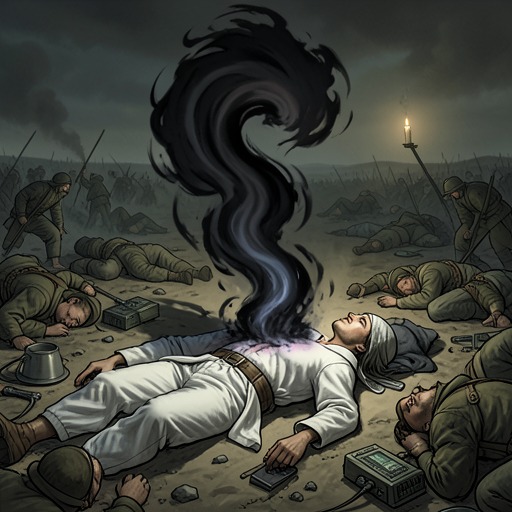
The story refuses to leave Trahern inside that heroic image. His legend is paired with medical danger. His test results have steadily approached the edge, and the other Paladins understand that he remains alive only because Brenna Nichols and Laurel Young were too stubborn to give up on him during his last death-and-return crisis. The episode was reportedly so close that survival itself becomes a measure of collective loyalty rather than an automatic feature of Paladin existence. Trahern’s body, in this account, is not an invulnerable instrument of war; it is a site where the Paladin Resurrection Cycle exacts its cost.
Loyalty, Care, and Vulnerability
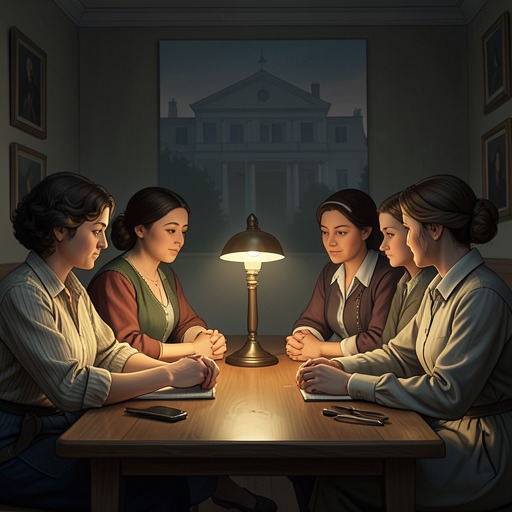
Trahern’s relationships with his companions reveal a tenderness that his combat reputation conceals. Devlin Bane leaves Sasha Willis’s side to stand beside Trahern during the contentious introduction of the new administrator, making support visible in a room already divided between the Regents and the Paladins. The gesture matters because it places Trahern within the Paladin community’s protective circle even while Sasha Willis is attempting to establish authority over that same community.
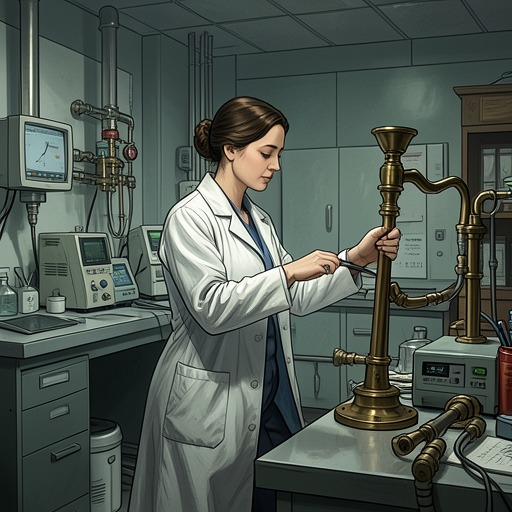
His bond with Laurel Young is especially significant. Laurel is not merely one of the people involved in his medical care; she is pursuing studies intended to prevent Paladins from reaching the same edge that threatens Trahern. Sasha Willis supports those studies because no one should suffer as David Booker did, but Trahern’s condition gives that research an immediate human face. The funding announcement is therefore both institutional policy and an acknowledgment that the fate of a respected warrior may depend on whether medicine can interrupt the cycle that has already nearly taken him.
Trahern also appears as a figure whose emotional force can be disguised as rough humor. Lonzo Jones recalls how much it meant that the supposedly formidable man threatened to kick him up and down the hall if he failed to recover quickly, joking that the memory makes him emotional. Laurel Young confirms the joke while describing Trahern as mushy when his friends are hurt. The contrast between the hard-edged threat and the care beneath it gives Trahern a recognizable private identity: his way of loving the injured is to bully them toward survival.
Battle and Moral Conflict
Trahern’s most consequential action in the available account occurs during the tunnel battle. D.J. Clayborne is engaged in the fighting and does not see an Other approaching from behind with a sword aimed at his neck. Trahern’s single stroke removes the danger before D.J. Clayborne can be killed. The act is unquestionably protective from the Paladin point of view, yet it leaves Larem q’Jones confronting the moral cost of the warrior’s role. The dead Other was also someone’s son, brother, or friend, but the battle reduces him to blood and remains.
That response does not diminish Trahern’s courage or skill; it complicates their meaning. To the Paladins, the Other is an immediate lethal threat, and Trahern’s violence preserves a comrade’s life. To Larem q’Jones, who is a healer and is caught between the Kalith and human worlds, the same act belongs to an endless cycle of suffering for which no cure has yet been found. Trahern thus functions as the sharpest edge of a system that protects one community by killing members of another. His broadsword carries both heroic necessity and the tragedy of a conflict in which every dead warrior has a history that the battlefield cannot see.
Place Within the Paladin Community
Trahern’s status gives him authority without separating him from communal dependence. He can be treated as a legend and still require Brenna Nichols and Laurel Young to fight for his recovery. He can save D.J. Clayborne in combat and still be watched anxiously because his own tests are worsening. These paired facts make his character resistant to a simple division between strong and weak. Strength is what he offers the group in battle; vulnerability is what the group answers with persistence, teasing, medical work, and public solidarity.
His presence also exposes the political consequences of Paladin illness. Sasha Willis’s decision to end punitive scans directly affects Trahern because Colonel Kincade had used diagnostic procedures as punishment. Regular monitoring is presented as necessary, but coercive monitoring has made medical care part of institutional discipline. The promise of additional staff and funding for Laurel Young’s research offers a possible change in that relationship, though Trahern’s history shows why reform cannot be abstract. The policy becomes meaningful precisely because the community knows what happens when a Paladin’s deteriorating condition is treated as an administrative problem rather than a life-and-death emergency.
Narrative Significance
Blake Trahern embodies the novel’s refusal to separate violence from care. His legend is built on killing, yet his most revealing social description is that of a friend who becomes embarrassingly tender when someone is wounded. His survival depends on the same kind of stubborn attachment that his rough manner expresses toward others. In this way, the character links the public mythology of the Paladins to the private labor required to keep that mythology alive.
He also gives form to the story’s critique of inherited conflict. Trahern is celebrated for killing Others, while Larem q’Jones mourns the dead warrior and recognizes the sickness driving Kalith fighters toward the light of this world. The contrast does not make Trahern a villain; it shows how a justifiable act of protection can remain morally costly. His arc, as evidenced here, is less a completed transformation than a continuing tension between legendary warrior, endangered survivor, loyal friend, and participant in a war whose human and Kalith casualties cannot be reduced to enemies and allies.