Cullen Finley
Bound by DarknessCullen Finley, known by the nickname “The Professor,” is one of Seattle’s Paladins and one of its principal computer specialists. His importance lies in the steady, discreet labor through which he keeps people moving safely through a suspicious institution: he helps Sasha Willis find her way, protects Larem q’Jones’s concealed Kalith identity, works with D.J. Clayborne to uncover Colonel Kincade’s financial crimes, and becomes the human partner of Lusahn q’Arc. Cullen’s quiet helpfulness is therefore not passivity; it is a form of competence that repeatedly turns confusion, secrecy, and institutional danger toward connection and accountability.
Identity and Introduction
Cullen is first presented as a Paladin whose calm manner contrasts with the louder tensions surrounding the organization’s new administrator. When Devlin Bane gathers the Paladins and the room erupts in hostile questions, Cullen is among the men present, part of a group resisting the attempt by the Board of Regents to impose its will. The scene places him within an institution under pressure, but Cullen himself is defined less by public confrontation than by the controlled, useful presence he offers inside it.
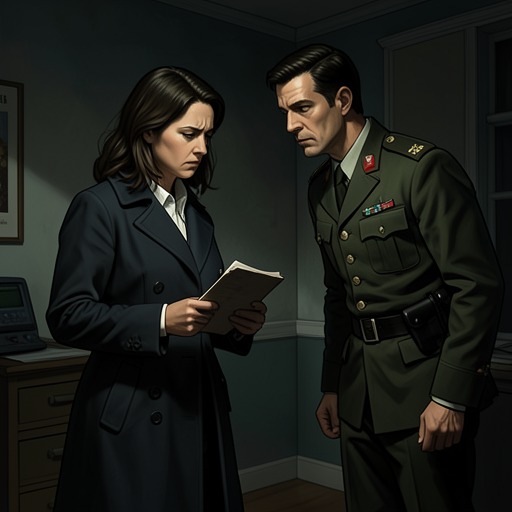
Sasha Willis encounters that quality before she knows his name. When she becomes disoriented in the Paladin headquarters, Cullen appears while she is leaving a conversation with Larem. Larem immediately uses the opportunity to withdraw, asking Cullen to show Sasha back to her office. Cullen accepts the practical responsibility without drama, making him the safe guide through a building whose occupants and rules are unfamiliar to her. Sasha later recognizes him while working through Paladin files and finds that his nickname, “The Professor,” matches the impression he made: quietly helpful, methodical, and intellectually capable.
Skills and Investigative Role
Cullen is described as the other computer expert among the local Paladins, alongside D.J. Clayborne. The two are reputed to be capable of compromising any server if they chose to work together, a reputation that establishes Cullen’s technical ability even before the investigation into Colonel Kincade’s records reaches its decisive stage. His expertise is not ornamental. It becomes an instrument for testing the official story of power and tracing wrongdoing through the administrative systems that conceal it.
When D.J. discovers something in Colonel Kincade’s former office, he summons Cullen to the administration building because he needs help examining the material. Cullen joins him at the computer, and together they find that Kincade’s corruption extends beyond allowing Kalith people to buy access into the human world. The records show that he was also stealing directly from the Regents. Cullen points Sasha to the numerical entries and confirms that deposits lead back to St. Louis, establishing that Kincade was not acting alone. The money trail transforms suspicion into a broader conspiracy and gives the Paladins a concrete route toward identifying other participants.
This work also connects Cullen’s intelligence to Sasha’s administrative investigation. He does not merely operate behind a screen; he makes the discovery legible to her, showing her what the numbers mean and helping convert technical evidence into institutional knowledge. His role is consequently both investigative and interpretive: he uncovers hidden structures and helps others understand their consequences.
Protection, Secrecy, and Relations with Sasha
Cullen’s relationship with Larem is marked by loyalty and situational awareness. When Larem sees Sasha approaching, he abandons the escort rather than risk exposing himself as Kalith. Larem has been instructed to keep a low profile, and Sasha has already noticed his accent. Cullen becomes the person who can complete the task without forcing Larem to perform a more dangerous public identity. The handoff shows Cullen as a trusted colleague whose usefulness includes preserving another person’s ability to remain unseen.
Sasha’s curiosity about Larem grows partly because Cullen’s identity is easier to classify. She can match Cullen to his file and to the helpful man who introduced her to the guard outside the alley, while Larem remains the more difficult figure: recognizable, conspicuous, and not yet understood. Cullen’s transparency within the Paladin records thus throws Larem’s concealment into relief. He occupies the institutional interior that Sasha can read, while helping shelter the person whose origins must remain hidden.
The same pattern appears when Larem guides Sasha out of the tunnels after she recognizes that he is “one of them.” Cullen is not present in that immediate confrontation, but his earlier assistance establishes the network of ordinary Paladin cooperation that makes such rescues possible. Against Sasha’s fear and Larem’s hurt, Cullen represents the quieter possibility that contact between the groups can be managed through practical trust before it is fully understood emotionally or politically.
Family and Cross-Cultural Belonging
Cullen’s most consequential personal relationship is with Lusahn q’Arc. He stands beside her with his arm around her shoulders, openly sharing a domestic and emotional bond that crosses the human-Kalith boundary. Their family includes the two Kalith orphans Lusahn has adopted, making Cullen not simply a lover but part of a household built from care, adoption, and deliberate coexistence.
Larem’s response to seeing them marks an important change in the surrounding relationships. Lusahn’s earlier decisions had torn his life apart, and her happiness with Cullen once carried the possibility of renewed pain. Yet he now feels genuine gladness for her, recognizing that she has created a good family in this world. His ability to acknowledge both the injury she caused and the life she has built reflects the stabilizing force of Cullen and Lusahn’s relationship: it is no longer merely a symbol of Larem’s loss, but evidence that damaged people can form a different future.
Cullen’s partnership with Lusahn also gives the Paladin-Kalith conflict a concrete domestic counterimage. The institution may treat Kalith identity as a security problem, and some Paladins may respond to Kalith people with hatred, but Cullen’s household makes coexistence visible as an everyday arrangement rather than an abstract policy. His place within that family quietly challenges the assumption that human and Kalith lives must remain separate.
Narrative Function and Significance
Cullen functions as a bridge character. He guides Sasha through the Paladin headquarters, collaborates with D.J. on the technological investigation, protects Larem by taking over an escort, and shares a family with Lusahn. These actions place him at several boundaries at once: between newcomer and institution, between public knowledge and concealed identity, between data and interpretation, and between human and Kalith domestic life.
His characterization is built through repeated acts of competent assistance rather than dramatic declarations. He is the colleague who can be called when a computer investigation becomes complicated, the companion who can make a newcomer feel oriented, and the partner whose presence helps transform a former source of conflict into a livable family arrangement. Even the wider emotional movement around him depends on this steadiness. Larem’s decision to move forward is made while observing Cullen’s happiness with Lusahn, and the discovery of Kincade’s larger criminal network depends on Cullen’s ability to read the evidence.
For that reason, Cullen is more than a supporting Paladin or a technical specialist. He embodies the book’s argument that institutions and worlds change through trusted intermediaries as much as through battles or official decrees. His intelligence exposes corruption, his discretion protects vulnerable identities, and his relationship with Lusahn gives cross-cultural belonging a durable human shape.