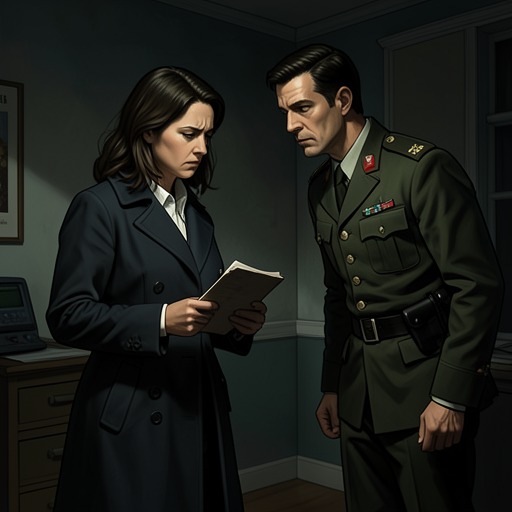
D.J. Clayborne
Bound by DarknessD.J. Clayborne is a Seattle Paladin whose role extends beyond ordinary combat duty: he helps interpret institutional threats, investigates financial corruption, and repeatedly places himself between vulnerable people and violence. His work links the Paladins’ practical security operations to the hidden economic network surrounding Colonel Kincade, while his conduct also shows the strain of defending a community divided over the presence of Kalith refugees and other survivors from another world.
Identity and Position
D.J. Clayborne appears within the Paladin headquarters as a trusted member of the local group and as a close associate of Cullen Finley. He joins Larem q’Jones, Lonzo Jones, and Hunter Fitzsimon at the rear of a meeting, where the placement is tactically meaningful: Lonzo must be able to reach the exit first if the Barrier crashes. D.J. is attentive to the room’s political atmosphere, watching the gathered Paladins and asking why the new administrator has been avoiding Devlin Bane. His humor about the administrator’s possible fear of Devlin and his willingness to imagine a Regent representative disappearing reveal both familiarity with the Paladins’ tensions and contempt for the authority being imposed on them.
D.J.’s position is therefore neither detached nor purely administrative. He is part of a working security community that regards the Regent leadership with suspicion, yet he also operates within the organization’s information systems and helps uncover the abuses threatening it. His presence in discussions about policy, finances, wounded personnel, and armed pursuit makes him one of the characters through whom the novel shows the Paladins as a functioning institution rather than only a fighting force.
Investigation of Kincade’s Corruption
D.J. becomes especially important when Sasha Willis begins examining irregularities in Paladin financial records. The records authorize salaries for three additional Paladins who have no names on duty rosters and no discoverable personal information. Sasha understands that these apparent “phantoms” are likely Kalith who crossed from another world, and she is furious that Regent funds may be supporting them. She delays confronting Devlin Bane because she still needs his support and believes his cooperation is essential to regional stability.
D.J. contributes the technical means for testing and expanding that suspicion. He warns Sasha that he is returning to work on Colonel Kincade’s records and does so openly, so that the sounds from the adjoining office will not alarm her. When she asks to observe, he allows her to watch after he has begun. His method is collaborative rather than secretive: the investigation becomes a shared effort in which Sasha supplies institutional access and political judgment while D.J. and Cullen Finley trace the electronic evidence.
The discovery quickly widens. D.J. finds Colonel Kincade’s offshore bank accounts and explains that Cullen is slightly better at tracking that kind of financial trail. The accounts may allow the Paladins to recover money taken from them, but the more consequential finding is that Kincade appears to have had partners. Some transfers originated on the Regents’ server, and the trail points toward St. Louis. Later, D.J. and Cullen show Sasha that Kincade was not merely taking money from the Kalith by allowing them to buy passage into the human world; he was also stealing directly from the Regents. The deposits leading back to St. Louis confirm that he was not acting alone and offer a route toward identifying others involved.
This investigation gives D.J. a distinctive function in the plot. He turns suspicions about missing personnel and hidden Kalith transactions into a traceable network of offshore accounts, institutional servers, and transfers. Corruption is presented not as one official’s private dishonesty but as an exchange system in which money buys access, access exposes vulnerable people to political manipulation, and the resulting secrecy helps sustain violence.
Attitudes Toward the Kalith Conflict
D.J. works in an environment where hostility toward the Kalith is openly circulated. George reports that a guard nearly killed one of Seattle’s “pet Others” and treats the survival of that Kalith as a waste of scarce resources. D.J.’s own position is not reduced to a single speech in the supplied scenes, but his association with the investigation places him beside Paladins who are confronting the consequences of such dehumanizing policies. The contrast is significant: the same institution that contains voices calling Kalith “bastards” must also rely on people capable of recognizing their presence, tracing the money used to shelter or exploit them, and defending them when necessary.
D.J. also operates alongside Larem q’Jones, whose identity is marked by exile and suspicion. Larem remembers his former life as a Blademate to a Sworn Guardian, where he had served his people honorably, but now accepts a small Paladin paycheck for teaching weapons practice and worries that he is living on charity. He considers returning to Kalithia despite the possibility that his death sentence may remain in force. D.J.’s place among Larem’s friends and colleagues helps make visible the unstable social space that Larem occupies: tolerated by some Paladins, distrusted by others, and still bound by duties to a people who call him a traitor.
The conflict becomes personal and violent when Kalith Others seize Sasha Willis in the tunnels. Their leader rejects Larem as a brother because he lives in the light and calls him a traitor, then threatens Sasha because she is human. Larem nevertheless keeps his oath to protect her and gets her to safety after the encounter costs lives and leaves him with another profound emotional wound. D.J.’s broader work belongs to the same struggle over classification and obligation. The Paladin community must decide whether Kalith are enemies, refugees, assets, or people entitled to protection; D.J.’s investigations show how those categories are being manipulated for profit.
Combat and Rescue Work
D.J.’s technical role does not replace his combat responsibilities. In a later pursuit, he moves low along a trail with a gun in one hand and a sword in the other. The sword is his preferred weapon, but he keeps the gun available because Reggie depends on him to rescue her and he cannot risk allowing the Other to gain the advantage. The Other searches by smell, slowly sweeping his head from side to side, and recognizes D.J.’s scent before D.J. attacks.
At that moment D.J. could end the encounter with a single shot, but he holsters the gun and follows the Kalith with Larem’s sword in his hand. The choice places him in a more dangerous form of engagement and connects his action directly to Larem: even while pursuing an enemy, he carries the weapon of the exiled Kalith whose position remains contested inside the Paladin world. His restraint is not presented as safety or reconciliation; it is a decision to confront the Other on terms that preserve the significance of the blade and the rescue mission.
D.J.’s operational character is also reflected in the meeting-room and headquarters scenes. He watches exits, tracks political rumors, gives Sasha advance warning about his work, and responds quickly when new evidence appears. These small acts establish a professional who treats information and readiness as forms of protection. His usefulness lies in moving between systems: computers and weapons, office records and underground pursuit, institutional conspiracy and immediate rescue.
Narrative Role and Significance
D.J. Clayborne serves as a connective figure in the novel’s account of institutional breakdown. Through him, the hidden financial dimensions of Colonel Kincade’s scheme become legible: Kincade exploits Kalith access, diverts Regent money, maintains offshore accounts, and appears connected to transactions leading back to St. Louis. D.J.’s work gives Sasha evidence with which to challenge a corrupt structure, even as the wider Regent leadership presses for details about Kincade’s effects on the Seattle sector and beyond.
His relationships with Sasha Willis and Cullen Finley also establish a practical alliance built on shared scrutiny. Sasha is cautious about releasing what she knows, while D.J. and Cullen continue following the digital trail. Their cooperation contrasts with the secrecy surrounding the missing Paladins, the guarded tunnels, and the anonymous threats demanding Colonel Kincade’s account numbers and the return of money taken from him. In that atmosphere, investigation is itself a contested form of power: whoever controls the records can define who exists, who is authorized, and who is blamed.
D.J.’s significance ultimately rests on the combination of competence and exposure. He is capable of uncovering corruption, but the evidence places him within a conflict where information can provoke retaliation and where rescue requires entering the same darkness that institutions prefer to conceal. By carrying Larem’s sword while hunting an Other and by tracing Kincade’s money alongside Cullen, he embodies the novel’s unstable passage between human and Kalith worlds. His actions do not resolve that divide, but they help reveal that the divide has been sustained by fear, financial exploitation, and competing claims of duty as much as by genuine danger.