Kalithia
Bound by DarknessKalithia is the parallel world separated from the human realm by the Barrier, a place whose political violence and endangered population shape nearly every major conflict in the novel. For Larem q’Jones, it is not an abstract alien territory but the homeland he served, lost, and sometimes still imagines returning to. Its significance lies in the contradiction it embodies: Kalithia is the source of his honor, relationships, and cultural identity, yet it is also the place where he was condemned as a traitor and where return could mean execution.
Homeland and Political Order
Kalithia is associated with the Kalith people and with a warrior society governed by strict obligations. Before his exile, Larem q’Jones served Lusahn q’Arc as a Blademate to a Sworn Guardian, a position that gave him a defined place within Kalith society and allowed him to serve his people honorably. He remembers that former life as orderly in comparison with his uncertain existence among humans: he had known his duty, his status, and the code by which his conduct was judged.
That order is also shown to be unforgiving. Lusahn q’Arc’s decision to choose Cullen Finley, a human Paladin, as her lover entangled both her and Larem in a political and personal catastrophe. Larem had been unable to speak openly for her before her life became bound to Cullen’s, and the result was that both were condemned to execution as traitors. Kalithia therefore functions not only as a homeland but as a legal and moral system capable of turning loyalty into criminality when it crosses the boundary of accepted relationships.
The Barrier and Cross-World Conflict
The Barrier makes Kalithia a site of controlled passage, military danger, and incomplete knowledge. Paladins fight in the tunnels around it, while the Kalith people and the human defenders interpret one another through fear, rumor, and past violence. Sasha Willis views the volcanoes surrounding Seattle as beautiful but threatening because they shelter Others and because the Paladins who defend humanity live and die beneath that landscape. Her perspective reveals how Kalithia’s presence extends beyond its own territory: the world on the other side of the Barrier alters the meaning of the human landscape and turns contact into a permanent security crisis.
The conflict is intensified by the fact that not every Kalith person is understood as an individual. Guards and Paladins speak of what comes across the Barrier as a collective threat, and rumors spread that Seattle Paladins are consorting with the enemy by allowing Others to move through their headquarters. Rusty’s hostile reaction to seeing Others alone in headquarters shows how Kalithia has become a source of moral panic as well as military concern. The existence of genuine attacks does not erase the institutional prejudice that treats every person from Kalithia as interchangeable with the killers who cross into the human world.
Larem q’Jones’s Exile and the Possibility of Return
Larem q’Jones’s route out of Kalithia began with the rescue organized by Cullen Finley, Lusahn q’Arc, and her brother Barak q’Young. During the group’s fight back across the Barrier, Lonzo Jones was badly injured, and Larem saved his life. Lonzo repaid that debt by offering Larem a home and the use of his family name on forged paperwork, allowing Larem to function in the human world. Their unexpected friendship gives Larem a practical refuge, but it cannot restore the place he occupied in Kalithia.
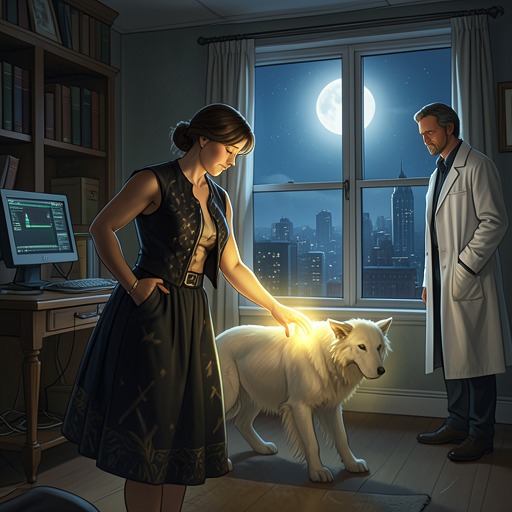
In Seattle, Larem accepts a paycheck from the Paladins for teaching weapons practice only a few hours each month and dislikes the sense that he is living on their charity. He also volunteers at Dr. Isaac’s animal clinic, where no one cares that his DNA is not human. The clinic offers a different kind of belonging: frightened animals respond to his touch rather than to his origin, and his Kalith Healing Gift allows him to ease pain and encourage injured bodies to heal. His care for Chance, a large white dog who initially huddled defensively and later rested his head on Larem’s knee, parallels Larem’s own movement from fear toward trust.
Yet the possibility of return remains unresolved. Larem sometimes considers crossing back into Kalithia and gambling that the death sentence against him might be rescinded, but he has so far resisted. The temptation is powerful because the human world has not fully accepted him either. During the battle at the Barrier, he remembers that he once would have fought to protect his own kind; now he has friends among the Paladins, while his own people regard him as a traitor. His position is explicitly one of being caught between two worlds, wanted completely by neither.
Kalithia’s Consequences in the Human World
The political history of Kalithia is inseparable from Colonel Kincade’s crimes. Kincade’s involvement in the theft of the blue stones from Kalithia led directly to the chain of events that destroyed Larem’s old life and forced him into human society. Instead of continuing as an honored warrior, Larem finds himself walking a dog and working in an animal clinic. He takes genuine satisfaction in soothing the wounded spirits of Dr. Isaac’s patients, but that meaningful work does not cancel the loss; life in the human world is permanently different from the life he was supposed to have.
Kincade’s activities also damaged trust between the two sides of the Barrier. He played games with lives on both sides, while concealing his actions so effectively that, according to Sasha Willis, no one suspected what he was doing. Larem q’Jones counters that the Paladins did know, or that someone prevented the truth from being heard. Kalithia thus becomes evidence of institutional failure: its stolen resources, displaced people, and resulting violence expose how decisions made by human authorities can destabilize an entire other society while leaving individuals such as Larem to bear the consequences.
A Contested World Rather Than a Simple Enemy
Kalithia is repeatedly invoked as an enemy territory, but the narrative resists reducing it to that role. D.J. Clayborne taunts a Kalith opponent by recalling that the Paladins did not try to kill him when he was in the human world, contrasting human restraint with the attack now directed at him. The exchange reveals the mutual accusations that govern cross-world encounters, yet it also exposes the limits of collective blame: soldiers on either side inherit histories they did not personally create.
Later, the discovery that an unknown figure has found someone in the darkness near a campfire renews the atmosphere of pursuit and danger associated with Kalithia. The possibility of another person being hunted turns the world beyond the Barrier into an active, threatening presence even when it is not directly shown. At the same time, Larem’s survival, his friendship with Lonzo Jones, his bond with Chance, and his growing attachment to Sasha Willis demonstrate that contact with Kalithia produces more than warfare. It creates hybrid lives, improvised identities, divided loyalties, and relationships that neither world’s older rules can comfortably contain. Kalithia’s decisive narrative function is therefore to make belonging a political question: home is the place Larem lost, the culture that condemned him, and the world whose people he cannot simply stop loving.