Others
Bound by DarknessThe Others are Kalith warriors afflicted by Light sickness whose violence makes them the apparent enemy behind the Barrier. They are feared as killers from another world, yet the novel repeatedly distinguishes their actual danger from the broader human panic surrounding them. Their decisive narrative function is to force characters and institutions to confront the difference between a genuine threat, a diseased condition, and a stigmatizing category applied to an entire people.
Identity and Condition
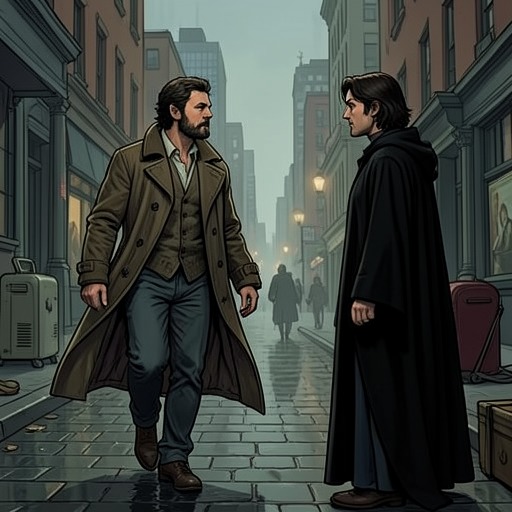
The Others are not presented as a separate species. Devlin Bane explains that the Kalith warriors and the Others are fundamentally different conditions of the same broader people: Larem q’Jones, Barak q’Young, and Lusahn q’Arc remain highly trained warriors, whereas the Others are Kalith who have become “crazy bastards” through the sickness. The distinction matters because human observers often collapse both groups into one hostile category. Sasha Willis arrives in Seattle knowing only that the Others are murderers from another world, but her experience with Larem gradually makes that inherited description impossible to sustain without qualification.
The physical signs of the afflicted group intensify their alien appearance. When the Barrier ruptures, the attackers initially look human except for their clothing, but their pasty gray skin and pale eyes reveal the transformation. Their speech is often guttural or heavily accented, and their movements are organized around predation: they shout as they cross the opening, spread through the tunnels, and carry curved blades while searching for victims. The novel therefore gives the horror a visible body, but it also locates the cause of that body’s violence in sickness and the darkening condition of Kalithia rather than in an innate moral nature.
Threat and Violence at the Barrier
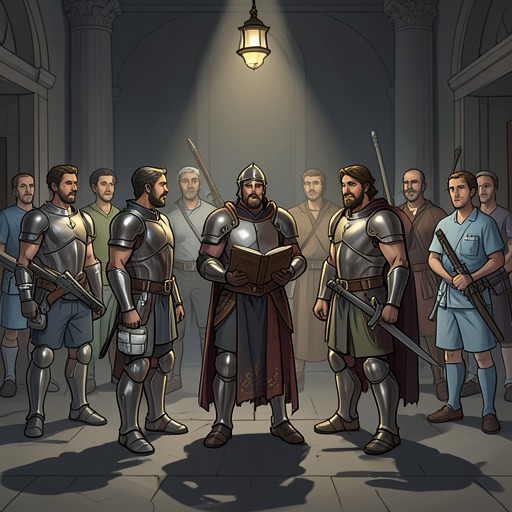
The Others become most immediately dangerous when the Barrier begins to fail beneath the Paladin headquarters. The curtain grows translucent, revealing shadows beyond it, and healthy colors give way to gangrenous yellows and greens, signs that the boundary is close to collapse. When the center tears open, the Others pour through during a full-scale battle, forcing the Paladins to defend the passage and leaving civilians trapped below because ordinary security codes no longer work on the elevators while fighting continues.
Their attack on Sasha shows how the group’s violence operates at its most terrifying. Four Kalith males stalk her through the tunnels, laughing while she retreats. Their leader threatens her with sexual violence and demands information about escaping the tunnels, treating her as both a human enemy and an object to be used. When Sasha refuses him and says she would rather die, he orders the others to silence Larem q’Jones so that the assault can proceed. The encounter makes clear that the danger is not merely military; the Others’ sickness has corrupted the honor and restraint associated with Kalith warrior culture.
Larem q’Jones nevertheless recognizes the attackers as people he once might have fought beside. Moving through the battle, he remembers serving his own people as a Blademate to Lusahn q’Arc and prays for the dead and dying. He approaches the four attackers with an appeal to their former honor, offering the possibility that the light-enhanced healing gift he possesses might help restore them. The leader rejects this offer as a lie, accusing Larem of wanting Sasha for himself and denouncing him as a traitor who has chosen to “live in the light.” The exchange turns a straightforward rescue into a confrontation between two competing definitions of loyalty: the Others treat solidarity with the afflicted as the only legitimate allegiance, while Larem defines loyalty as protecting those unable to defend themselves, whether human or Kalith.
Human Fear and Institutional Response
The Others’ violence supplies real grounds for fear, but the novel shows how that fear expands into rumor, contempt, and political agitation. Sasha initially sees the volcanoes around Seattle as beautiful landscapes that conceal killers, and she understands the Paladins as warriors who live and die beneath the mountains to protect people like her from the Others. This perspective is shaped by secrecy and incomplete information: even her work for the Regents has exposed her to only occasional glimpses of the Paladins, leaving the enemy image largely intact.
That image circulates through ordinary conversation. Rusty repeats rumors that the Paladins have been “hanging out with the enemy” and describes the arrest of Colonel Kincade as evidence that the Seattle organization has gone astray. After seeing two Others walking through headquarters, he wonders whether Kincade had been right to oppose the Paladins and their “pet Others.” The language converts Kalith residents from protected allies into domesticated threats, even when the speaker has little direct knowledge of them. Duke’s own account of Kincade’s removal shows how political resentment and anti-Kalith suspicion reinforce each other: the former administrator is remembered by some guards as fair to them, while his hostility toward the Paladins and their Kalith associates is treated as a virtue.
The same suspicion appears inside the security structure. George reacts to news that a guard nearly killed one of Seattle’s Kalith residents by wishing the injured man had been left to bleed to death. His response reveals an exterminatory logic in which the Others, and by extension any Kalith associated with them, are treated as expendable uses of institutional resources. Other guards question why the Seattle budget pays the adult Kalith, speculate that Barak q’Young earns his salary through his relationship with Lacey Sebastian, and wonder whether Larem q’Jones and the others have been sent across the Barrier to steal human weapons technology. The possibility that the Kalith can reproduce firearms or stun guns becomes another reason to treat cooperation as treason rather than as a defensive necessity.
Sasha Willis’s administrative reforms directly challenge that climate, though the suspicion does not disappear. She announces that Colonel Kincade’s use of scans as punishment will end and orders diagnostic procedures to follow a regular schedule unless the Handlers judge additional monitoring necessary. She also authorizes staff and funding for Dr. Laurel Young’s research. Her policy matters to the Kalith because medical surveillance has been used as coercion, while the Paladins’ own fear of their instability has made medical status a matter of life and death. Yet when Sasha says she will study the files of the Paladins, guards, support personnel, and special guests, Larem q’Jones hears the possibility of a threat against the local Kalith population. Even a reform framed as administrative familiarity can appear, under conditions of persecution, to be the beginning of a roundup.
Relations with the Kalith and Paladins
The Others function as a negative image against which the sane Kalith are defined. Devlin Bane insists that Larem q’Jones, Barak q’Young, and Lusahn q’Arc are not monsters but trained warriors whom the Paladins can trust in battle. The distinction is supported by action: Larem fights the afflicted Kalith to save Sasha, and the Paladins accept the cost of treating him after he is gravely wounded. Laurel Young reports that Larem is stable but must be kept apart because some Paladins become distressed when they awaken and sense a Kalith nearby. Human and Paladin blood cannot safely be used for a transfusion because Kalith blood is sufficiently different; Barak gives what he can, and Larem’s own partial healing ability helps him survive.
This treatment does not erase the injury caused by the fight. Sasha realizes that Larem had to kill members of his own people because she was placed in danger, and she fears that he may never forgive her even though she did not intend to force that choice upon him. Larem’s position is therefore defined against the Others but not separated from them emotionally. He is a man caught between two worlds: Paladins have become his friends, while his own people regard him as a traitor. The afflicted warriors make that divided identity visible, because every battle against them is also a confrontation with the people Larem once served.
The surrounding relationships demonstrate how unstable the human-Kalith boundary has become. Lacey Sebastian lives with Barak q’Young despite having a Paladin brother, and Cullen Finley lives with a Kalith woman and her children. These domestic and intimate connections contradict the assumption that contact with Kalith inevitably produces danger. Lonzo Jones jokes with Larem q’Jones about Sasha Willis and looks after his roommate’s interests, while Larem remains concerned with ensuring that Sasha has a way back to her hotel. Such ordinary loyalty stands in sharp contrast to the Others’ predatory behavior and to the guards’ insistence that all Kalith relations are signs of contamination or betrayal.
Narrative Significance
The Others embody the novel’s conflict between classification and recognition. They are genuinely lethal opponents, and the text does not excuse the attack on the Barrier or the attempted assault on Sasha. At the same time, their existence exposes the inadequacy of treating all Kalith as “craziness waiting to happen.” Their gray skin, pale eyes, damaged speech, and manic violence mark a condition that has social as well as biological consequences: once the afflicted are named as Others, the label spreads outward to sane Kalith, human allies, and even Paladins who defend them.
Their presence also turns medicine into a moral test. The question is not only whether Light sickness can be cured, but who is allowed to receive care, who controls diagnostic procedures, and whether treatment becomes punishment or a pretext for surveillance. Larem’s recovery after the battle demonstrates that Kalith bodies possess distinctive healing capacities rather than simply deficits, while the inability to use ordinary blood underscores the practical reality of bodily difference. The Others thus remain both an external danger and a warning about what happens when sickness, foreignness, and violence are fused into a single identity.
By the end of the represented conflict, the Others have not been reduced to a simple defeated enemy. They remain the force that makes the Barrier dangerous and the Paladins’ military duty necessary, but their contrast with Larem q’Jones establishes a more difficult ethical landscape. The story asks its human and Paladin communities to defend themselves without allowing defense to become a license for extermination. In that tension, the Others are essential not because they can be redeemed within the evidence presented, but because their existence reveals how easily protection becomes persecution when fear refuses to distinguish among the sick, the sane, and the merely different.