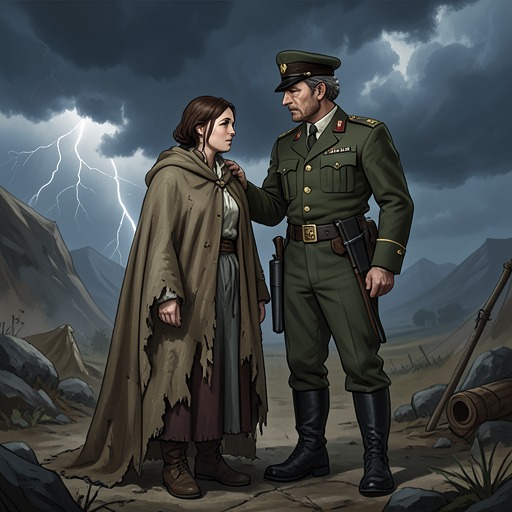
Sworn Guardians
Bound by DarknessThe Sworn Guardians are Kalithia’s elite militia of highly trained warriors, charged with protecting their people. In the novel, the organization is known less through formal administration than through the conduct and memories of its members: Larem q’Jones served as Lusahn q’Arc’s Blademate, while Lusahn and her brother Barak q’Young were themselves Guardians. Their institution therefore joins military expertise to a personal ethic of sworn protection, making service a defining identity rather than merely a profession.
Nature and Responsibilities
The Guardians’ central responsibility is the defense of Kalith people. Devlin Bane describes them as an elite force whose members are highly trained warriors, distinguishing them sharply from the violent Kalith extremists known as the Others. Larem, Barak, and Lusahn are presented as disciplined fighters whom Devlin would trust at his back, while the Others’ brutality is treated as a corruption rather than a representative expression of Kalith warriorhood.
The organization’s authority is also moral. Larem explains that he is a Blademate to Lusahn q’Arc and sworn to protect those who cannot defend themselves, whether human or Kalith. His declaration shows how the Guardians’ obligations can extend beyond ethnic or political boundaries when the protection of the vulnerable is at stake. The vow is not passive: when the Others threaten Sasha Willis in the tunnels, Larem frames retreat and combat as matters of honor, and he fights despite the anguish of killing warriors from his homeland.
Members and Warrior Bonds
The Sworn Guardians’ structure is closely connected to the Blademate relationship. Larem’s service to Lusahn was not an isolated military assignment but a bond that gave him a recognized place in Kalith society. He remembers that life as one in which he knew his position, served his people honorably, and understood what was expected of him. The contrast with his later existence is severe: in Seattle, he accepts payment from the Paladins for teaching weapons practice only a few hours each month and resents feeling dependent on their charity.
Larem’s former status continues to govern his choices even after exile. Betrayal by his own kind makes him distrust human allies, yet the Guardian ideal prevents him from responding to danger through flight alone. When a new policy threatens Kalith residents associated with the Paladins, Hunter Fitzsimon offers him a safer retreat, but Larem refuses to hide while others remain exposed. He points to Barak q’Young, whose sister has two Kalith children at home, and insists that the affected people cannot all disappear. His response translates the Guardians’ protective duty into a new, mixed-world setting.
Honor, Violence, and Protection
The Guardians’ honor code does not eliminate violence; it disciplines and directs it. Larem’s training enables him to defeat the Others in the tunnels, but the victory carries a moral cost because his opponents are members of his homeland’s species. He curses the gods for forcing him to kill his own kind, even as he continues the fight required to protect Sasha Willis. The scene establishes the difference between trained Guardian violence and the Others’ predatory cruelty: both can be lethal, but only one is governed by a duty to defend.
That duty later shapes Larem’s confrontation with Duke. Duke’s treatment of Sasha Willis, as well as his insults toward Hunter Fitzsimon and the relationship between Larem and Sasha, provokes Larem to challenge him. Larem regards punishment as necessary because he is a Blademate and a sworn protector; allowing Duke to demean people under his protection would, in his view, make him unworthy of the title. His restraint is limited—Duke is fortunate to survive—but the act is presented as an extension of Guardian responsibility rather than a private quarrel alone.
Life Beyond Kalithia
The Guardians’ meaning becomes most visible when their former members are displaced into Seattle’s Paladin society. Larem longs for his old life and sometimes considers returning to Kalithia despite the possibility that his death sentence may still stand. Remaining in the human world means learning unfamiliar forms of work, dependence, and belonging, while continuing to carry a warrior identity that no longer has an official institutional home.
His work at Dr. Isaac’s animal clinic reveals how the protective ethic can be redirected into care. Larem helps frightened and injured animals, using the healing gift strengthened by the light of this world to ease pain and encourage Chance’s damaged leg bones to knit. The wounded white dog, initially reduced to bones and dried blood, gradually learns to trust him; when Chance rests his head on Larem’s knee, Larem responds with healing rather than force. The scene does not erase his warrior nature. Instead, it shows the same commitment to vulnerable lives operating through patience, tenderness, and controlled power.
Narrative Significance
The Sworn Guardians provide the novel with a standard against which competing groups are judged. Paladins, human guards, Regents, Kalith warriors, and Others do not share the same relationship between power and responsibility. The Guardians are invoked to show that Kalith identity cannot be equated with monstrosity, and that a warrior’s legitimacy depends on whom the warrior protects and under what code.
For Larem q’Jones, the organization is simultaneously home, lost status, moral inheritance, and unresolved burden. It explains why he mistrusts easy assurances, why he refuses to abandon people threatened by policy, why he kills only under a protective obligation, and why he responds so fiercely when Sasha Willis is endangered or insulted. Even after his life moves among Paladins, humans, animals, and a future family represented by Sasha’s pregnancy, the Sworn Guardians remain the institution through which he understands honor—and the measure by which he tests whether his new life still permits him to live honorably.