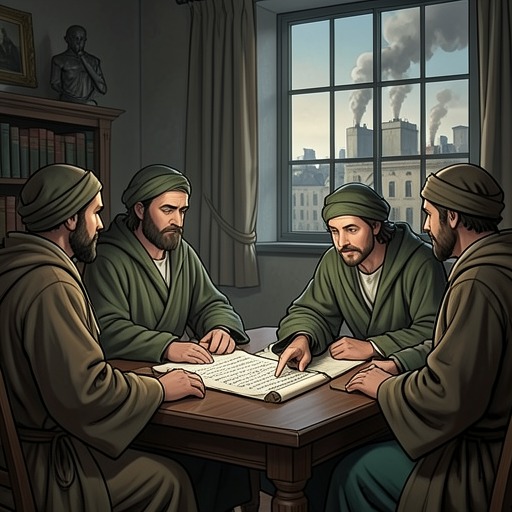
Tunnel civilian escort restriction
Bound by DarknessThe tunnel escort restriction is the Paladins’ rule that civilians may not wander through the headquarters’ tunnels without an escort. Although Sasha Willis possesses the Board of Regents’ authority to inspect Paladin facilities, Devlin Bane insists that access rights do not cancel his responsibility for the safety of everyone entering the headquarters. The rule therefore defines the tunnels as controlled operational space rather than ordinary corridors, and its importance becomes clear when Sasha’s unauthorized exploration leaves her trapped below during a Barrier emergency.
Definition and Institutional Basis
The restriction is presented by Devlin Bane as a safety measure, not merely as an attempt to conceal information. He tells Sasha Willis that certain areas are closed to civilians because of the danger involved and that he will not allow her to wander the tunnels unescorted. He makes the same point by citing Lacey Sebastian, a geologist employed by the organization who is subject to identical limits. The comparison establishes that the rule applies according to operational risk rather than simply to Sasha’s status as a Regent representative.
Sasha Willis challenges the restriction because the Board of Regents has granted her full access and because she believes direct observation is necessary for her hands-on management of the Seattle sector. Devlin separates institutional authority from physical responsibility: she may have the right to see the facilities, but he remains accountable for the safety of those who enter them. The resulting dispute exposes a broader conflict between civilian oversight and Paladin field knowledge. Sasha regards unrestricted movement as part of legitimate administration, while Devlin treats escorted access as a non-negotiable condition of preventing avoidable casualties.
The Tunnels as a Restricted Operational Space
The rule gains force from the unusual geography of Paladin headquarters. The headquarters is built into the hillside beside the Seattle Underground, whose apparently abandoned subterranean streets remain connected to a secret world of warriors, elevators, security codes, and the Barrier. Monitors show tourists moving through the famous Seattle Underground while the Paladins occupy the hidden spaces beyond their understanding. This contrast makes the tunnels both a concealed workplace and a dangerous threshold between public Seattle and the hidden conflict with the Others.
The physical descent itself marks a change in status. When Sasha enters an elevator alone, it drops toward the Barrier with such violence that she grips the handrail while her heart pounds and her stomach churns. At ground level, damp rock, restricted sightlines, and heavy silence replace the ordinary institutional environment above. The tunnel is not simply an inaccessible archive or administrative annex; it is a zone in which unfamiliar space, limited communications, and emergency procedures can determine whether a person escapes alive.
Enforcement During a Barrier Emergency
Sasha’s experience demonstrates why the escort requirement exists. After separating from her intended escort, she notices that the Barrier has become translucent and that sickly yellows and greens are spreading across it. These are recognized signs that the Barrier may go down. She runs for the elevator and discovers that her security code produces no response, realizing that she has placed herself in exactly the situation Devlin warned against: a civilian alone in a restricted tunnel with the exit unavailable.
The response depends on Paladin security authority and cooperation. Devlin uses a high-level code to recall the elevator and keep it topside, despite the fact that his normal clearance does not warrant that degree of control. Elsewhere, D.J. Clayborne gives Larem q’Jones access to another elevator and instructs him to find Sasha and get her back aboveground as quickly as possible. The alternative route will not bring them out immediately beside the Barrier, and D.J. warns that the fighting may make it difficult to distinguish friend from a dangerous opponent. The restriction thus operates through escorts, coded access, controlled elevators, and knowledge of routes that civilians do not possess.
Larem q’Jones eventually all but drags Sasha Willis to an elevator. Her own code still cannot open it, and she believes they are trapped until Devlin sounds the all-clear. Larem’s security numbers work instead, showing that authorized rescue depends on Paladin clearance rather than on the civilian’s official position. The scene converts the rule from a contested principle into a practical division of competence: Sasha has administrative authority, but Larem has the access knowledge needed to move her through the emergency.
Consequences and Narrative Significance
The restriction is repeatedly tested because Sasha Willis refuses to let suspicion or procedural limits obstruct her investigation. Her unauthorized movement brings her into direct contact with the hazards that the Paladins’ secrecy has concealed from her, while the Paladins’ reluctance to trust her makes the restriction feel politically charged. The rule protects civilians, but it also preserves the Paladins’ control over information, movement, and the interpretation of danger.
That tension mirrors the larger struggle over Seattle’s leadership. The Regents are attempting to supervise the Paladins more closely, while Devlin Bane and his fighters believe that decisions made far from the front lines fail to account for the risks borne by those who fight. Even small operational rules become instruments in that conflict. Sasha’s authority is genuine, yet it cannot by itself make the tunnels safe; the Paladins’ expertise is indispensable, yet their secrecy makes civilian oversight difficult. The escort requirement therefore embodies the novel’s recurring collision between bureaucratic power and embodied danger, between the right to inspect a hidden world and the responsibility to survive it.