Vampirism
Box Set: Samsons Sterbliche Geliebte & Samson's Lovely Mortal (Deutsch·Englisch) (Scanguards Vampire) (German Edition)Vampirism is both a supernatural bodily state and a concealed identity in Samson’s Lovely Mortal. It grants abilities and demands adaptations, yet it also exposes the limits of the human routines its members try to preserve. Through Samson Woodford, the novel connects vampirism to vulnerability, sexual difficulty, secrecy, and the danger of judging a person by the category to which he belongs; through Carl, it shows that transformation can follow a human life’s violent end without erasing the value its survivor places on living.
Identity and Bodily Conditions
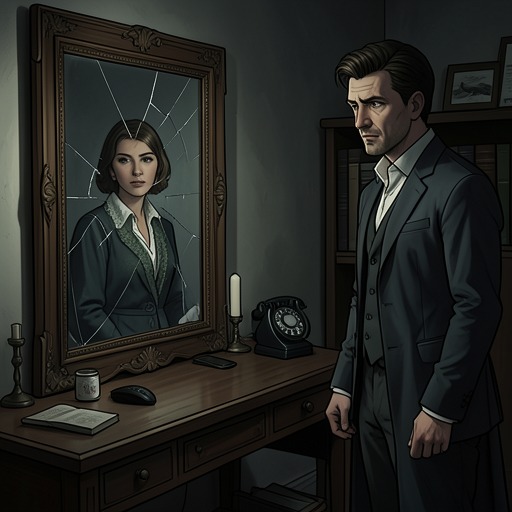
The condition announces itself through specific physical limits. Sunlight can turn a vampire to ash: Delilah Sheridan eventually connects Samson’s inability to be with her during the day to the danger of going outside, and recognizes that his house’s lack of a bathroom mirror may also be explained by the belief that vampires do not appear in reflections. Her reasoning begins with a visible clue—Samson’s eyes flashing red—and gathers force as she reinterprets details she had previously found puzzling. The supernatural state is therefore disclosed not through a single explanation but through a pattern of bodily and domestic anomalies.
Daylight does not make Samson entirely immobile. He can remain awake and move around inside his house so long as direct sunlight does not touch him, but his senses are less sharp and his energy diminished. After visiting Dr. Drake, he stays awake to read reports from Scanguards’ branches and waits to learn whether Delilah accepted his theater invitation. The scene places ordinary work and romantic anticipation beside the conditions that constrain them: he can carry on with business in the day, but does so tired, weakened, and unable to risk the sun.
Other details make the state difficult to conceal. Samson’s eyes can glow red, a change Delilah sees during a moment of anger and later remembers as an unmistakable warning sign. His identity also changes the meaning of familiar objects: a missing mirror becomes evidence, and the blinds in his bedroom are not merely a way to manage sleep but protection against sunlight. At Dr. Drake’s office, Samson encounters a coffin adapted as a couch or chaise longue in place of an examination bed, bringing the condition into the setting of medical consultation. The vampire body cannot simply be treated as an invisible difference; it alters rooms, routines, and what those around Samson are able to infer.
Becoming a Vampire and Continuing to Live
Samson’s own transformation is recalled as a violent rupture. He and his companions had ridden for about an hour when three men suddenly attacked them; the assault came too quickly for escape. The next day he woke in a shed, unable to explain how he had been brought there. His wounds had disappeared, but when sunlight touched his arm he recoiled from the burning sensation. For Samson, the combination of inexplicable healing and immediate solar pain made the conclusion unavoidable: he had been condemned to a life as a vampire. He understood the change not as a chosen new identity but as something imposed on him through an attack and its aftermath.
Carl’s history offers a different emphasis on what that life means. Samson revived him after a gang of criminals had robbed him of his human life. Carl is now a vampire, but regards survival as preferable to being dead and remains devoted to the man who saved him. His loyalty makes the transformation consequential not only for the person changed, but also for the relationship created by the act of saving him. The novel does not present vampirism as an uncomplicated gift: Samson experiences his state as a condemnation, while Carl measures it against the death he escaped.
Samson’s conduct also reveals how he manages the condition in society. He has learned to drink brandy and appreciates its warmth, although it does not affect his senses; being able to handle a human drink helps him at social occasions with mortals. At night he moves through the streets expecting that more vampires will cross his path after midnight, while earlier in the evening he ignores the people still outside. These habits present a life organized around timing and performance: he can participate in human social rituals, but must do so with an awareness of the differences those rituals do not remove.
Powers, Vulnerability, and Treatment
Vampirism does not mean every vampire has the same additional talent. Samson knows that some of his kind can read minds or foresee the future, but is unsure how common such gifts are. He identifies his own special ability as a photographic memory. His knowledge is partial, and the uncertainty matters: the supernatural community is not described as a uniform body with interchangeable powers. The condition establishes a shared identity while leaving room for individual capacities.
Samson’s account of himself is shaped by an aversion to weakness. He insists that he has never been vulnerable since becoming a vampire and equates vulnerability with weakness; when Dr. Drake presses him, Samson becomes angry enough to imagine a physical fight. Yet his confidence is complicated by the problem that has brought him to the doctor. He loves sex, but can no longer get an erection with the seductive vampire women he has tried to be with. He tells himself that sex is overrated, though the reassurance never holds for long. His difficulty makes the body’s limits personal and humiliating rather than merely a matter of supernatural rules.
Dr. Drake offers an emotional interpretation of the difference. He suggests that Samson allowed himself to become vulnerable when facing a vulnerable mortal, lowering the defenses that returned when Samson was with a vampire woman; in the doctor’s formulation, the erection disappeared as the protective wall went back up. This remains the physician’s explanation, not a general rule about vampirism. Its importance is specific to Samson: the condition does not account for every failure of his body, and the treatment conversation turns instead toward the emotional defenses he associates with strength. Samson’s choice to seek help from a psychiatrist also complicates his insistence that vulnerability is unacceptable. He approaches care while resisting the language through which Dr. Drake tries to understand him.
Secrecy, Recognition, and Intimate Relationships
For much of Delilah’s relationship with Samson, the facts of his condition remain hidden behind visible clues. She sees his eyes flash red when he shouts at Ricky, and later recognizes that the color change was not normal. When she sees the red glow again, that earlier memory becomes part of a larger deduction: the absent mirror, his limits in daylight, and the danger of sunlight all fit together. Her discovery changes the meaning of their prior intimacy. She realizes that she has repeatedly made love to a vampire, and asks herself why neither Samson nor Amaury has bitten her if vampires are supposed to drink from people’s necks. The question reveals both her fear and the gap between what she assumes about vampires and what these particular men have done.
Samson answers the fear of transformation directly: he would never turn Delilah into a vampire and could not understand why she thought he would wish that on someone he cared about. He identifies Dr. Drake as his psychiatrist, clarifying that the doctor’s presence is not a sign that Samson intends to change her. The exchange makes an important distinction between Samson’s own condition and Delilah’s future: knowing the truth does not mean she must share his state. Their intimacy can include an invitation to be bitten—Delilah lays her neck bare and tells him to do so—but the moment is presented as her deliberate offer, not proof that she has already been transformed.
Disclosure also fails to dissolve the external danger surrounding them. Amaury reminds Delilah that learning the truth about vampirism does not resolve the interference with Samson’s company or the threat against her. He insists that good and bad people exist among vampires as they do among humans: becoming a vampire does not make someone bad, just as being human does not make someone good. This principle counters the fear that supernatural identity supplies a complete moral explanation. It also allows Delilah to confront Samson as a person whose actions and assurances matter, rather than treating his species as a verdict.
Narrative Significance
Vampirism in the novel repeatedly places hidden identity beside ordinary life. Samson reviews company reports, waits anxiously for a date’s answer, and navigates social occasions with brandy, even as his daylight weakness, danger from the sun, and glowing eyes set limits on those routines. The contrast makes concealment practical as well as emotional: domestic arrangements and daily schedules can protect him, but they can also become clues that invite scrutiny.
The condition is likewise not a simple synonym for predation or evil. Samson’s fears about being vulnerable, his sexual difficulty, his request for psychiatric help, and his refusal to turn Delilah all complicate the image of the vampire as a creature governed only by appetite. Carl’s gratitude for being alive and Amaury’s insistence that morality crosses the human-vampire boundary reinforce that distinction. Vampirism changes the body and the terms on which a person can move through the world; the novel leaves moral character to be judged by what that person chooses to do.