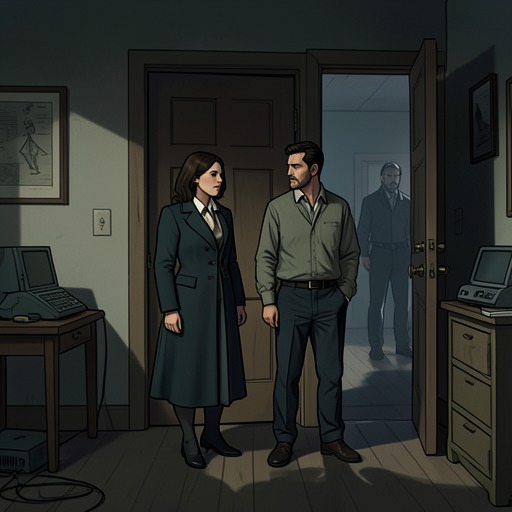
Gabriel restores Delilah’s father’s memories
Box Set: Samsons Sterbliche Geliebte & Samson's Lovely Mortal (Deutsch·Englisch) (Scanguards Vampire) (German Edition)Gabriel Giles restores Delilah Sheridan’s father’s memories in one of the novel’s most consequential acts of supernatural compassion. By temporarily unlocking the memories obscured by late-stage Alzheimer’s disease, Gabriel enables Delilah to speak with her father as though he were healthy again. The brief encounter corrects the story she has carried since Peter’s death: her parents did not blame her, Peter died from Sudden Infant Death Syndrome, and the guilt that has governed her nightmares and self-understanding was founded on a tragic misunderstanding rather than parental condemnation.
Causes and Background
Gabriel’s intervention is arranged after Samson Woodford asks him to see Delilah’s father. Gabriel runs Scanguards’ headquarters in New York and is identified to Delilah as one of the vampires within Samson’s circle. The revelation is initially alarming, but Gabriel assures her that her father is safe and explains that the purpose is personal rather than connected with Delilah Sheridan’s audit of Scanguards. Gabriel understands that Delilah’s father is in the later stages of Alzheimer’s disease and no longer recognizes his daughter. Delilah believes this makes closure impossible: the person whose forgiveness she needs can no longer remember either her or the event that has haunted her. Gabriel corrects that assumption without denying the severity of the illness. Her father’s memories, he explains, are not wholly gone but locked away, and his special gift can release them for only a few minutes. The limitation gives the scene both its urgency and its fragility; the opportunity will exist only briefly, and Delilah must decide what truth she most needs to tell.
The Restoration and Conversation
The encounter takes place through a video connection. Carl introduces Gabriel on the monitor, where Delilah sees the tall man with long hair tied back in a ponytail and a scar running from his ear to his chin. Gabriel states openly that he is a vampire and tells Delilah that Samson speaks very highly of her. When she asks whether the conversation concerns the audit, Gabriel says that the audit has been settled, that Scanguards knows what Milo and his sister Ilona Hampstead attempted, and that the organization is working to reverse their actions. He then returns to the reason for the call: Samson has asked him to see her father. Gabriel promises that Delilah’s father will not be harmed and frames the meeting as an opportunity to end the burden she has carried for more than twenty years. Delilah resists because she expects no genuine response from a father who no longer knows her. Gabriel nevertheless offers to unlock the man’s memories long enough for her to speak to him as if he were healthy again. The offer depends on trust in a vampire’s extraordinary ability, but it also places the emotional decision entirely with Delilah: Gabriel can open the door, yet she must cross the threshold and speak. Gabriel turns the camera toward the chair where Delilah’s father sits with a blank stare and slumped shoulders. He places his hands several inches above the old man’s head and closes his eyes. After a few seconds, the father’s expression becomes animated. He looks directly toward the camera and recognizes Delilah, greeting her affectionately and immediately asking why she is crying and whether someone has hurt her. The change is not presented as a cure. It is a narrow restoration of access to memory, a temporary return of the father Delilah remembers before the disease clouded his recognition.
Peter’s Death and the Reversal of Guilt
Delilah uses the restored interval to confess the central accusation she has directed against herself. She brings up Peter and says that she should have done something. Her father responds with surprise rather than anger. Peter, he tells her, died of Sudden Infant Death Syndrome; neither Delilah nor either parent could have prevented his death, even if they had been present that night. He remembers the horror on Delilah’s face when she saw Peter die in his crib and explains that the adults had always worried about what the experience had done to her. The conversation then exposes the source of Delilah’s long-standing misinterpretation. She had read her mother’s continuing sadness as evidence that the family blamed her. Her father insists that the blame was directed inward, toward himself and Delilah’s mother. They felt guilty for leaving Delilah in charge of Peter, but they did not hold her responsible for his death. They recognized that she suffered recurring nightmares in which she saw him dead in his crib, yet they did not know how to help her and never spoke openly about what had happened. In retrospect, her father admits that they should have sought professional help and apologizes for failing her. The revelation changes the moral meaning of Delilah’s past. The death remains irreversible, and the childhood trauma remains real, but the imagined judgment that has kept it alive is removed. Her father tells her that she was the only light he and her mother had during that dark period, not the cause of it. Delilah answers that there is nothing to forgive, says that she loves him, and hears him return that love on behalf of both parents. His final request is that she stop dwelling on the past and think about her future. She promises, receiving not an abstract absolution but a direct paternal instruction about how to live afterward.
Consequences and Aftermath
The restored memories fade as suddenly as they appeared. Her father says goodbye, and his eyes become blank again. The return to Alzheimer’s-related absence makes the preceding recognition more painful, but it does not undo what was said. Delilah collapses into sobs, finally understanding that her father loved her and never blamed her for Peter’s death. The scene gives visible form to the release of a burden she has carried for decades: she is free of the guilt that had shaped her emotional life, nightmares, and inability to imagine closure. Samson’s presence immediately after the conversation reinforces the event’s place in Delilah’s broader transformation. He carries her to the couch while she is overwhelmed by grief and relief. The intervention does not erase Peter’s death or restore her father permanently; instead, it gives Delilah a truthful account and a final exchange of love before the disease closes his memories again. Gabriel’s gift therefore functions as a limited but decisive act of repair: it cannot reverse time, cure illness, or resurrect the dead, but it can restore the missing testimony that allows Delilah to revise her understanding of herself.
Narrative Significance
The event links supernatural power with a recognizably human problem: the need to be remembered, answered, and released by a parent whose illness has made ordinary reconciliation impossible. Elsewhere, the novel associates bodily and mental states with hidden emotional wounds. Samson Woodford’s impotence is initially treated as an inexplicable humiliation within vampire society, while Dr. Drake interprets his vulnerability toward a mortal as the condition that allowed his psychological defenses to fall. Delilah’s insomnia and recurring nightmare likewise express trauma that has never been properly named. Gabriel’s restoration extends this pattern into memory itself, turning a supernatural ability into a temporary therapeutic opening. The scene also contrasts coercive and restorative forms of mental power. Vampires possess mind control, and Samson uses it to stop Delilah from being shot, but Gabriel’s gift is offered as an opportunity rather than imposed as a command. Delilah is warned that the window will last only minutes and is urged to use it wisely; the decision to confront the past remains hers. The result is not control over Delilah’s feelings but the return of information necessary for her autonomy. Most importantly, Gabriel’s act produces recognition in the deepest narrative sense. Delilah learns the factual cause of Peter’s death, discovers that her parents’ grief was self-directed rather than accusatory, and hears her father affirm both his love and her future. The father’s memories close, but the truth remains available to Delilah. In that final contrast between a mind that can no longer retain the encounter and a daughter who can finally carry it without guilt, the event turns memory from a prison into a form of release.