Alvar’s Rescue of Lucy in Cursed Form
Bride of AlvarAlvar’s Rescue of Lucy in Cursed Form is a turning-point action in which Alvar’s most feared identity becomes the force that frees Lucy. Surrounded by terror on the mountains of Ferar, Lucy sees the dragon-like Cursed destroy the immediate threat, release her from bondage, and carry her toward safety. The rescue therefore does more than remove Lucy from danger: it makes visible the contradiction at the center of Alvar’s life, namely that the form used to define him as a monster is also the form through which he protects others and resists the powers that have exploited him.
Causes and Background
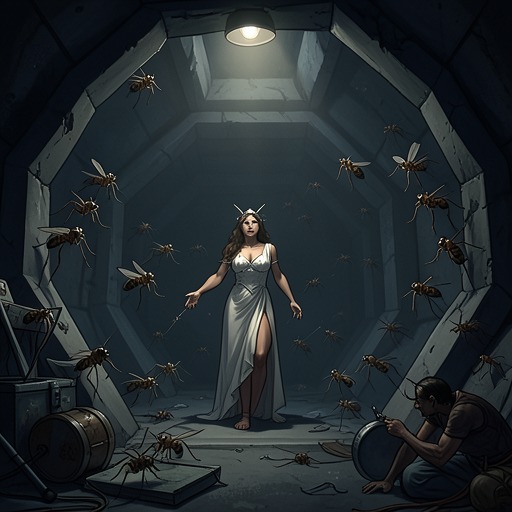
Lucy’s rescue follows her abduction and confinement among hostile gobli. The danger is announced before the rescuer is seen: gobli shriek, running feet strike the stone, and an immense roar shakes the ground. The suspense depends on Lucy’s limited knowledge; blindfolded and bound, she can hear violence without understanding what creature has entered the scene. When an extraordinarily deep voice orders the gobli to untie her, the unseen threat becomes an active force with authority rather than a merely approaching beast.
The immediate setting intensifies the reversal. Once the blindfold is removed, Lucy discovers that she is outside on the mountains of Ferar rather than in the mines and caverns. Full moons illuminate the rocky landscape, a crushed gobli lies only a few feet away, and the evidence of violence confirms that the rescue has not been gentle. Lucy then looks up at a dragon-like creature with immense jagged black wings, sharp white teeth, red eyes, and a scar running up the side of its serpentine face. The paintings of Alvar in the Underland Palace had prepared her for his appearance, but not for the terror of his anger in physical presence.
Alvar’s history explains why this form carries both protective power and moral danger. His family rejected him after discovering that he carried Cursed blood, and the priests burned his mother after learning of his condition. When villagers drew their swords, Alvar changed into his Cursed form and plunged into the pyre to seize his mother’s corpse, declaring that he would bury her if the villagers would not. The form is thus associated with grief, ostracism, and defiance long before it becomes Lucy’s means of escape.
What Happens
After the gobli guard releases Lucy, the guard flees, but Lucy approaches the creature instead of remaining at a distance. She identifies him as Alvar, and the monster answers by speaking her name. This exchange is the emotional hinge of the scene: the terrifying body is not an unknown predator but her husband, and recognition allows personal attachment to survive the shock of transformation.
Alvar does not leave Lucy exposed on the mountain. He tells her to get on his back, extends his right wing downward, and lowers his chest to reduce the height she must climb. The practical care of the gesture matters because it interrupts the scale of the spectacle. His body is enormous and frightening, yet he deliberately reshapes his posture to make himself usable as Lucy’s means of escape.
He then leaps from the cliff with Lucy holding his collar and gripping his shoulders. The apparent plunge becomes flight. From Alvar’s back, Lucy sees the snowcapped black peaks of Ferar, feels the cold wind against the heat of his body, and watches mist form around him as the temperature difference turns his warmth into visible vapor. The dragon form is not only an image of horror; it is also the physical vehicle that carries Lucy beyond the reach of her captors.
When Lucy asks where he is taking her, Alvar answers that he is taking her somewhere safe. He explains that a secret gobli encampment lies south of the mountains and that its inhabitants resemble Fletch’s variety of gobli. They want peace, freedom from the old oppressive ways, and a new ruler. Alvar sees the upheaval created by Remora as an opportunity to help them establish new leadership in Ferar, but he rejects the idea that the region should belong to the human race. In his view, Ferar should continue to be ruled by the gobli because it belongs to them. The rescue therefore becomes part of a broader liberation strategy rather than a private act of extraction.
Protection and Moral Conflict
The scene refuses to make rescue synonymous with uncomplicated violence. Lucy sees the crushed body of a gobli and understands that Alvar has killed at least one captor, yet she also knows that he would not kill lightly. His violence is presented against the background of coercion, captivity, and the need to free her, not as an expression of uncontrolled appetite. The action preserves the disturbing fact of bodily destruction while allowing Lucy to distinguish Alvar from the cruelty associated with the powers that rule Ferar and Underland.
That distinction is central to Alvar’s moral identity. Earlier, when a frightened girl offered herself to him because she believed he wanted to eat her, he withdrew his hands rather than exploit her fear. He rejected the possibility of mirroring King Saul’s lust and privately held to the God of the Light, whose teaching required men to treat women lovingly, respectfully, and as equals. His conduct in Lucy’s rescue extends the same principle: immense physical power is placed under restraint and directed toward another person’s safety.
The rescue also contrasts with Alvar’s history under Saul’s control. Saul placed a Fe collar on him, and after Alvar transformed between human and Cursed forms, the device made him a slave to Saul’s will. Saul forced him to perform acts he would never have chosen, including sexual acts, and used him as an instrument of death. Alvar later describes himself as a Cursed shell of a human being and admits that he erased some memories of Saul’s degradation from the Mystar because he could not bear to retain them. In this context, the flight from Ferar is a reversal of forced transformation: Alvar chooses when and how to use the Cursed body, and the body serves Lucy rather than a master.
Consequences and Aftermath
By taking Lucy to a sympathetic gobli encampment, Alvar places her within a possible political alternative to both Remora’s actions and the older oppressive order. His stated aim is not human conquest but gobli self-determination. The rescue consequently joins intimate protection to political ethics: Lucy is saved, while the people whose territory shelters her are treated as subjects entitled to freedom and their own ruler.
The event also changes the meaning of Alvar’s identity for Lucy. His appearance initially fulfills the nightmare associated with the Cursed: a creature larger than any living land animal Lucy knows from Earth, with black wings, red eyes, a scarred serpent-like face, and jaws lined with teeth. Yet the same figure speaks to her, lowers his body so she can climb aboard, and carries her over the mountains. Fear and trust are not resolved by denying the monstrous appearance; they coexist within the relationship, with care giving the form a different moral meaning.
That trust becomes especially important after later violence leaves Lucy vulnerable to recurring fear. Following Vessin’s attempted assault, Lucy sees his leering gaze whenever she closes her eyes and asks Alvar to stay beside her. Alvar promises that he will remain with her until adequate security is established, and when she asks him to stay, he answers that he will always do so, holding her until his warmth and breathing lull her to sleep. The Ferar rescue anticipates this pattern of safety: Alvar’s protection is expressed not only through battle or flight, but through physical presence that allows Lucy to recover a sense of security.
Narrative Significance
As a rescue plot, the episode follows a classic captivity-and-escape structure but complicates the expected rescuer. The rescuer is also the figure the world has condemned as monstrous, and the escape route begins with a leap that appears fatal before becoming flight. This transformation from apparent descent to controlled movement gives the action its governing image: what looks like ruin from one perspective becomes liberation from another.
The episode is equally an ordeal of recognition. Lucy must recognize Alvar through a body designed to provoke terror, while readers must revise the moral vocabulary attached to the Cursed. Alvar’s later public confession that he was the “monster” Saul used to enslave the people makes the rescue retrospectively more significant. He does not deny the harm carried out through his body; instead, the rescue shows the same body acting under a different will, directed toward release rather than domination.
Alvar’s Rescue of Lucy in Cursed Form therefore crystallizes the book’s concern with agency after coercion. Alvar cannot undo the deaths, humiliations, and forced acts imposed through the Fe collar, nor can he erase the shame that remains after them. He can, however, reclaim the form that others used as proof of his inhumanity. In saving Lucy, carrying her across Ferar, and guiding her toward gobli allies who seek freedom, he turns the Cursed form from a mark of imposed identity into an instrument of chosen protection and resistance.