Dark magic
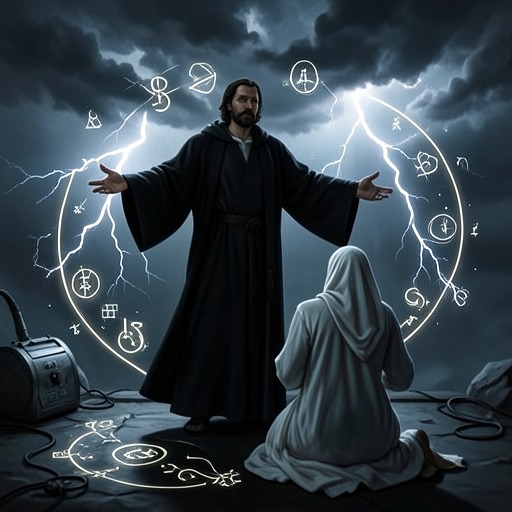
Bride of AlvarDark magic is the supernatural power associated with pain, anger, hatred, chaos, betrayal, greed, and perversion. It is not merely a source of unusual abilities: it enters bodies, shapes bloodlines and pregnancies, empowers political domination, and feeds on social disorder. Its most consequential manifestations are the Curse carried by Alvar and Lucy, the Fe collar used to control Alvar, the Sorceress’s dependence on turmoil, and the continuing danger posed by Saul’s tyranny.
Definition and Sources
Dark magic is presented through the uncertain boundary between magical illness and supernatural force. When Alvar’s wife becomes gravely ill during pregnancy, a physician identifies the condition as a magical problem caused by a dark Curse rather than an ordinary medical complication. The language of illness matters because the Curse is experienced through bodies and reproduction, yet it cannot be treated through ordinary medicine. Alvar concludes that he is a scourge to those he loves because his Cursed condition caused the pregnancy crisis and, earlier, contributed to the death of Triss after she became pregnant with his child.
The story also distinguishes dark magic from the healing abilities of Alvar’s people. Alvar once gave blood that saved Lucy’s life while she was still in the womb, and he later gives her Cursed blood again when she is near death. The same supernatural inheritance can therefore appear as rescue, disease, or danger depending on how it is used and on the body receiving it. This ambiguity prevents magic from functioning as a simple moral category: its effects are shaped by coercion, knowledge, consent, and consequence.
The Curse and the Body
The Curse is a bodily state that can remain hidden beneath an apparently normal human form. Leeza explains that Cursed people look ordinary except that their eyes turn red when they are stressed. Alvar eventually reveals to Lucy that she has Cursed blood, making her discovery a crisis of identity rather than merely an abstract piece of magical lore. Lucy’s Earth origin does not protect her from the condition, because her connection to Alvar’s blood and the circumstances of her survival place the Curse within her own body.
For Alvar, the Curse is also a visible and psychological threat. Stress makes it harder for him to remain human, and his eyes glow dark red when he struggles to restrain the monster within him. He repeatedly fears that he will surrender to the beast as earlier Cursed people did. The condition consequently operates on several levels at once: it is a supernatural inheritance, a bodily marker, a source of stigma, and a danger that can alter a person’s appearance and conduct.
Dark magic also governs reproduction. Alvar learns through research and through records kept by Father Ryland that a Cursed pregnancy can be fatal to a woman without Cursed blood. Not all of Alvar’s future children would necessarily be Cursed, but the possibility remains uncertain. The story thus connects magical inheritance to questions of marriage, succession, maternal death, and the legitimacy of royal lineage. Lucy’s survival challenges the assumption that Cursed blood inevitably makes love and family impossible, while Triss’s death remains the devastating evidence behind Alvar’s fear.
Enslavement and Political Power
Dark magic becomes an instrument of political control through the Fe collar. Saul placed the collar on Alvar after Alvar’s family rejected him for carrying the Curse. Whoever possesses its key can control the wearer, turning Alvar into the mechanism of Saul’s violence. Alvar describes himself as both Saul’s slave and the instrument of his death-dealing, insisting that the crimes committed through him were outside his control. The collar transforms a stigmatized body into a weapon while allowing the ruler who controls it to claim power at a distance.
The collar is also a material emblem of shame. Alvar has a noble sylph priestess bless it so that it appears invisible, but its concealment does not remove its presence. He continues to feel enslaved because the device remains around his neck, reminding him every day of the coercion that shaped his past. Its invisibility mirrors the broader concealment of his identity: he can appear to be a human king while carrying the physical and moral history of the Cursed servant Saul exploited.
Saul later offers a different magical solution. His wife, a sorceress, claims that the Curse can be drawn into a silver artifact worn by Alvar, preventing his Cursed form from manifesting. Saul presents this possible treatment as part of his offer to name Alvar as heir, because laws forbid a Cursed person from inheriting the throne. The proposed cure is therefore inseparable from political legitimacy. It promises Alvar freedom and a life of his own, but it also makes acceptance conditional on suppressing the body that marks him as dangerous.
The Sorceress and the Economy of Chaos
The Sorceress embodies dark magic in its most explicit and predatory form. She explains that dark magical beings survive in Axus by feeding on chaos and pain, betrayal and malice, greed, and perversion. When those forces diminish, their power weakens as well. After Remora falls and Axus becomes less chaotic, the Sorceress describes herself as weakened and identifies Emily as her last hope of restoring disorder. Dark magic therefore has an ecological or economic logic: it requires suffering as nourishment and treats peace as a threat to existence.
The Sorceress is described not simply as surrounded by darkness but as having darkness living within her. Her speech reveals that her desire is not limited to personal survival. She serves the Dark Lord and hopes to use Emily, Saul, and the conflict between worlds to produce enough betrayal and agony to renew her power. She had intended to become more powerful than any Cursed person and overthrow Saul herself, but Alvar’s discovery of the Bridge and Saul’s exile to Earth interrupted that plan.
Her method depends on deception as much as on supernatural force. She sends Lucy’s friend to find Saul and deliver a message in exchange for the arlite needed for his return, disguising the arrangement as an act of kindness and presenting Saul and herself as lovers separated by worlds. Emily’s desperation to return home makes her vulnerable to the lie. Dark magic thus spreads through emotional weakness and manipulated trust, not only through spells or visibly monstrous transformations.
Removal, Exposure, and Destruction
Dark magic repeatedly forces hidden truths into the open. Alvar conceals his history because he fears that Underland’s people will reject him if they learn that he was Saul’s enslaved Cursed weapon. During his public confession, however, he identifies himself as the monster Saul used against them and explains the Fe collar’s function. The revelation exposes both his responsibility and his lack of freedom, asking the community to distinguish between the violence of an enslaver and the coerced actions of the enslaved.
The decisive physical break with Saul’s magic occurs when Lucy uses the stolen key to unlock Alvar’s Fe collar while Alvar’s flames engulf Saul. The collar falls away and melts into a blood-like substance; the flames then vanish, and Alvar’s monstrous form contracts until he becomes a man again. The scene gives dark magic a concrete weakness: the device that enabled control can be destroyed, but only through extreme risk, bloodshed, and Lucy’s intervention. Alvar collapses afterward, and Lucy is also close to death from the wound she made herself, so liberation is not presented as costless.
The destruction of the collar does not erase the Curse. Alvar later admits that remaining human requires increasing effort, and his red eyes signal that the monster is still pressing against his control. Lucy is praised as Queen Lucy, the Fireblood, slayer of the tyrant, and rescuer of Axus, yet Alvar urges her to distance herself from him. Dark magic has therefore been defeated as an instrument of Saul’s enslavement without being completely removed from the lives of those it marked.
Thematic Significance
Dark magic gives physical form to the story’s central conflict over whether a person is defined by blood, appearance, action, or choice. The red eyes, the Cursed blood, the hidden collar, and the returning monstrous form all make identity legible through the body, while Alvar’s history demonstrates that visible monstrosity does not explain moral responsibility. The same narrative that calls him a monster also shows him as a victim of family rejection, enslavement, and political law.
Its deepest threat lies in the conversion of suffering into power. The Sorceress needs chaos to live; Saul uses the Fe collar to turn coercion into rule; and the Curse makes love, pregnancy, and succession matters of mortal danger. Yet the story also presents blood as a medium of healing and sacrifice. Alvar’s blood saves Lucy before birth and again after the destruction of the collar, suggesting that inherited darkness is not fixed to a single meaning. Dark magic remains dangerous because it can be exploited, concealed, and passed through bodies, but its moral force depends on the choices made around it.