Earth–Axus Bride Treaty
Bride of AlvarThe Earth–Axus Bride Treaty is the foundational diplomatic rule governing Lucy Hammond’s promised marriage to Alvar, King of Underland. Made before Lucy was born, it presents one child’s body and future as the instrument for preventing war between Earth and Axus. Its decisive significance lies in the contradiction at its center: the agreement is described as protection for two worlds, yet its immediate operation removes Lucy’s ability to choose whether, when, or whom she will marry.
Definition and Origins
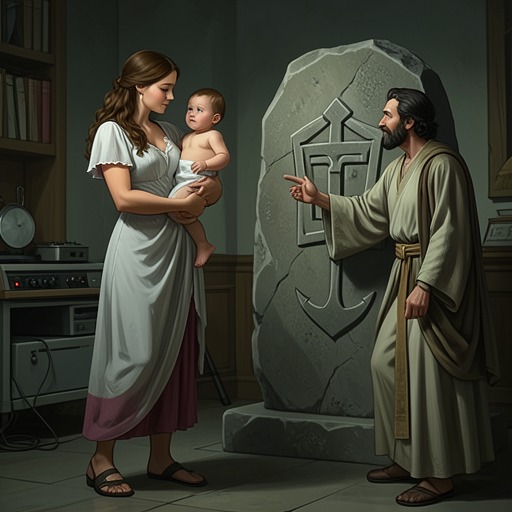
The treaty originates in Hannah Delaney’s desperate promise to Alvar. Hannah tells Lucy that Alvar needed an Earth-human bride to preserve peace with his world, and that she promised Lucy to him because Lucy was expected to die in the womb. Alvar’s people possessed healing abilities unavailable to humans, and saving Lucy’s life became inseparable from the obligation Hannah accepted on her daughter’s behalf.
The agreement therefore joins medical rescue, maternal consent, political diplomacy, and betrothal in a single transaction. Hannah does not describe Alvar as a god, but as a ruler whose people possess extraordinary healing abilities. The treaty’s moral logic is consequently difficult to separate from debt: Lucy’s survival is treated as the reason the promise had to be honored, even though Lucy herself never consented to the bargain.
Terms and Legal Force
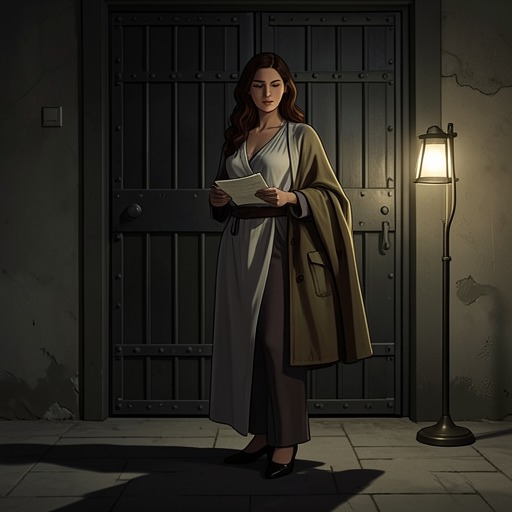
Alvar later gives Lucy the written agreement on a yellowed sheet of paper. It is sworn to Elias, the God of Light, and dated both by Earth’s calendar and by Axus’s calendar: October 10, 1993, and the twenty-third day of Havath, 2918. It records an agreement between Hannah Delaney and King Alvar of Underland that the female child Hannah carries will be betrothed to Alvar as his future wife and queen, with the stated purpose of securing a peace treaty between Earth and the realms of Axus.
The document grants Alvar the right, after the child has come of age to marry, to return and retrieve Hannah and her daughter so that they may reside in Underland. In return, Underland is to provide their material and personal needs, the protection of the Underland Guard, and instruction from the Institute of Underland in the ways and customs of its people. Hannah’s and Alvar’s signatures make the promise appear formal and reciprocal, but the practical terms remain asymmetrical: Lucy is the person transferred across worlds, while the political and material benefits are defined by rulers and parents.
The treaty is also treated as exclusive. When Lucy argues that she is already involved with someone else and asks how Alvar can be told to choose another bride, her mother insists that Lucy cannot be “taken” by another person. She has been Alvar’s chosen bride for years, and the agreement concerns Lucy alone. Hannah warns that denying the betrothal would constitute more than a personal insult to Alvar and his people; it would risk war between Earth and Axus, a war she believes Earth would lose.
Enforcement Through Marriage
The treaty’s diplomatic purpose becomes urgent when Emily Hall is threatened with execution under gobli custom. Alvar tells Lucy that the danger can be stopped if their marriage is sealed. Once Lucy becomes his wife, he says, killing Earth humans will be a crime against Underland, and Remora will not want war with him. The marriage is thus used as a legal shield for Emily and as a deterrent against Remora, but the urgency leaves Lucy almost no meaningful alternative.
Alvar openly admits that Lucy cannot know whether he created the crisis to force an immediate marriage, saying that marriage is nevertheless the only way to secure Emily’s release. His claim is set against the brutality of the Star Wheel, where criminals are torn apart limb by limb before being beheaded. The treaty therefore operates within a wider legal landscape in which different societies recognize radically different punishments and protections. The Earth–Axus Bride Treaty does not erase those conflicts; it becomes the instrument Alvar uses to place Lucy and Emily under the protection of his authority.
Lucy agrees to marry Alvar that night in order to save her friend, while explicitly refusing sex. Alvar accepts the boundary and explains that he must spend the night with her only to create the appearance that he is treating her as his wife. He invokes an old law requiring the couple to sleep together so that the rest of Axus will take the marriage seriously. This distinction separates the treaty’s marital status from sexual consent, but it also shows how social law can compel the performance of intimacy even when physical intimacy is refused.
Ceremony and Ritual Confirmation
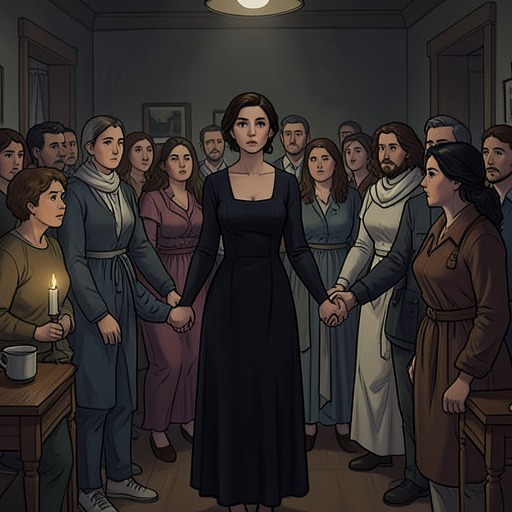
The wedding is arranged with extraordinary speed. Hundreds of people fill a chapel-like space, while Hannah holds the train of Lucy’s wedding dress as Fletch leads Lucy down the stairs. The crowd’s whispers and mutters establish that the treaty is not merely a private document between Hannah and Alvar; its fulfillment is a public spectacle watched by the people whose political stability it is meant to secure.
A human priest blesses the couple, gives Alvar a gold goblet, and then places it in Lucy’s hands after Alvar drinks. The priest declares that the union must be sealed with a kiss in front of everyone gathered. Lucy meets Alvar’s kiss because she wants the assembled people, including possible spies for Remora, to regard the marriage as legitimate. The ritual converts the written betrothal into a publicly recognizable alliance, while Lucy’s private reluctance remains concealed beneath the outward signs of consent.
The ceremony consequently has two functions. It establishes Lucy as Alvar’s wife in the eyes of the court and provides the political protection needed to save Emily, but it also dramatizes the difference between appearance and freedom. Lucy performs legitimacy because the treaty’s survival depends on public recognition, even as the circumstances surrounding the wedding are coercive.
Political Consequences and Legacy
The treaty’s stated objective is to prevent Axus from attacking Earth. Alvar’s kingdom is powerful, and his mother explains that the other countries of Axus are bound by his authority: if Alvar orders them not to attack, they will not dare invade Earth. The agreement therefore treats Alvar’s personal marriage as a mechanism for controlling international violence. Peace is not secured through equal institutions but through the word of a king and the promised status of one Earth-human bride.
Its implications extend beyond the original betrothal. Lucy’s movement from Earth to Underland is carried out through Alvar’s power: when he says she must leave earlier than expected, he touches her forehead with a glowing white crystal and embraces her, transporting them through a cold black space filled with passing lights. The treaty’s promised relocation thus becomes an enforced threshold between worlds rather than a freely chosen migration.
Later disputes over Alvar’s fitness to rule reveal that marriage, succession, and political legitimacy remain intertwined. Sola Brightfeather explains that once Lucy and Alvar’s heir reaches the traditional age of twenty-five, the Underland Council will judge whether the heir is worthy to succeed Alvar. She also argues that Alvar has ruled without abusing his Cursed state and that Underland would be better served by allowing him to resume his duties. The treaty’s original promise of a queen therefore develops into a dynastic framework in which Lucy’s marriage and future children affect the succession of Underland.
The Earth–Axus Bride Treaty is ultimately both peace instrument and source of conflict. It prevents the threatened war between Earth and Axus, supplies the legal basis for Lucy’s queenship, and helps protect Emily Hall, yet it also makes Lucy’s life the collateral of diplomacy. Its repeated invocation of vows, ritual, protection, punishment, and inheritance reveals a world in which law is never neutral: the same agreement that promises safety can authorize abduction, demand public performance, and convert a child’s survival into an obligation lasting into adulthood.