Ferar
Bride of AlvarFerar is the mountainous region of Goblia where the conflict with Remora becomes a struggle over territory, political rule, and the survival of entire peoples. Its grey sky, muddy ground, and mist distinguish it sharply from the vibrant blue sky of Underland, while its caves conceal the gobli society that Alvar and his allies must confront. The region’s importance lies not only in its danger but in the competing claims to its mountain: Remora treats the land as the property of her hive, whereas the stog maintain that they have always lived on its surface.
Setting and First Appearance
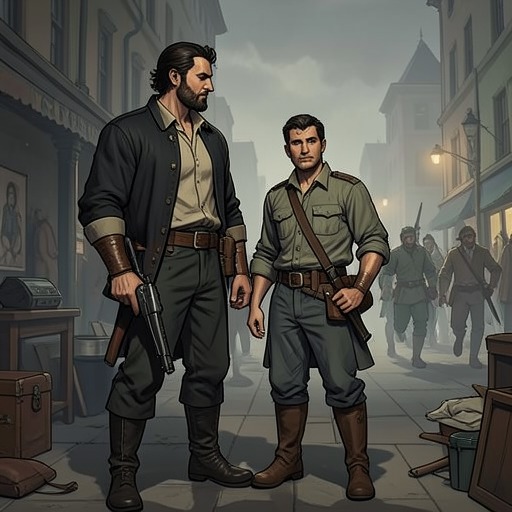
Ferar first appears as a destination reached through the Arlite. The passage transports Alvar, Lucy Hammond, and Grey from Underland into a landscape of brown mud and mist, where the sky is grey and the terrain seems recognizably unchanged from Alvar’s memories. The transition makes Ferar feel less like a simple neighboring territory than a separate sphere with its own atmosphere, history, and threat. Almost immediately, the sound of approaching four-legged riders turns the landscape into a scene of uncertainty; the creatures resemble hybrids of rats and rhinoceroses, reinforcing the region’s alien and intimidating character.
Alvar identifies Ferar as the place where Maggort, a gobli lord, lives in the mountains. Maggort seeks Lucy because he opposes peace, and the queen who sent him shares that opposition. Ferar therefore functions as the geographical source of an immediate political danger: its mountains shelter an authority connected to the attempt to disrupt peace between Underland and Goblia and to seize Lucy.
Peoples and Territorial Conflict
Ferar is not inhabited by a single unified population. A gobli encampment lies on the side of the mountain, and the gobli living there are visibly different from those in the depths of Goblia. They are warty but relatively well-proportioned and kindly, and they wear shaded spectacles to protect their eyes from the sun. Their discomfort on the surface recalls Lucy’s own earlier displacement from Earth to Axus, giving the mountain’s surface a humanizing dimension rather than presenting all gobli as a single monstrous group.
The stog also claim the mountain’s surface. Agnor, a large and heavily tattooed deer-like leader with magnificent antlers, explains that Remora and her followers have hunted and killed stog people while denying that they have any right to live there. According to the stog account, their people have always occupied the mountain’s surface, while the gobli lived in caverns and caves. Ferar’s geography thus becomes the basis of a territorial dispute between surface-dwelling stog and subterranean gobli, with Remora’s violence transforming an old division of habitation into a campaign of genocide.
Agnor offers an alliance with Underland on behalf of the stog. He says that his son Jahn, chief stag of a northern tribe, will join him, and promises support if Alvar ends the destruction of his people. Alvar accepts the assistance because he needs fighters and because Remora’s forces are vulnerable in comparison, although the mountain’s single heavily guarded entrance remains a major obstacle. Ferar consequently gathers several oppressed communities around a common military objective: removing Remora and opening a path into Goblia.
Remora’s Rule and the Caves of Goblia
The region’s subterranean order is shaped by Remora’s restoration of an extreme version of the old ways. Fletch explains that Goblia permits only one female to live in a hive at a time, with Remora serving as the mother of the entire population. Most male drones die in infancy, while female hatchlings are destroyed unless Remora chooses one to survive as a princess and eventual successor. Remora lays approximately ten eggs each week, making reproduction itself the mechanism through which she maintains the future of the hive.
This system is justified through the Great Matriarch goddess religion established in Goblia, but the narrative presents its religious language as inseparable from political control. Goblia had once been organized around family clans and a matriarchal tradition; Remora’s rule reduces that older social structure to a single-female regime. Saul helped install her as queen and promoted these practices, while the gobli were enslaved in his mines before Remora was appointed their leader. Her supposed elevation therefore did not amount to liberation. Ferar preserves the memory of domination beneath the appearance of local rule, with Saul’s imperial strategy and Remora’s hive order reinforcing each other.
The mountain’s caves also embody the region’s violence. They are the setting of a society in which reproduction, class, gender, and survival are regulated through extermination and enforced dependence. The contrast between the relatively welcoming surface encampment and the grotesque depths makes Ferar internally divided: the same mountain contains communities displaced by sunlight, peoples hunted from their homes, and a subterranean regime built around Remora’s authority.
Military and Political Significance
Ferar becomes the operational threshold for Alvar’s campaign against Remora. The region houses the enemy’s leadership, but reaching that leadership requires crossing terrain controlled by forces that know the mountain and guard its only entrance. The danger is also personal for Lucy, since Emily Hall’s threatened execution and Maggort’s connection to Ferar turn the region into the place where rescue, diplomacy, and war converge.
The gobli execution custom heightens the stakes of any delay. Criminals are torn apart on a Star Wheel, with their limbs pulled away one at a time before the head. This practice reveals the severity of the authority Alvar is confronting and explains why the campaign cannot be treated as an abstract dispute over succession. Ferar contains institutions capable of spectacular punishment, and the prospect of such an execution gives the alliance an immediate human cost.
Alvar’s coalition is therefore assembled through competing claims rather than simple loyalty. The surface gobli welcome him, the stog seek protection from extermination, and his own Underland forces require a route into the mountain. Their interests overlap in opposition to Remora, but they arise from different histories of dispossession. Ferar makes alliance-building possible precisely because its inhabitants have been harmed by the same broader system of conquest in different ways.
Narrative Significance
Ferar operates as a threshold between the ordered promise of Underland and the concealed violence of Goblia. Its mist, mud, guarded entrance, and unfamiliar riders create a setting of passage and uncertainty, while the division between surface and cave turns physical space into a map of political hierarchy. The region’s apparent strangeness gradually gives way to recognizable questions of occupation, enslavement, religious legitimation, and resistance.
At the same time, Ferar complicates the idea that victory consists only of defeating a ruler. Remora’s power depends on a social order she has revived and intensified, and that order was enabled by Saul’s earlier intervention. Alvar’s proposed campaign must therefore address both the queen and the conditions that made her rule possible. Ferar is significant because it converts a rescue mission and a peace effort into a wider contest over who has the right to inhabit the mountain, govern its peoples, and define the customs by which survival is measured.