Goblia
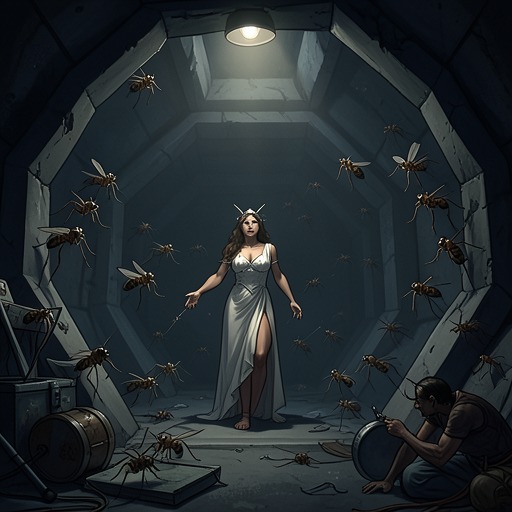
Bride of AlvarGoblia is a subterranean city reached at the edge of an enormous pit, and its setting gives it decisive narrative force. Its rock-and-mud buildings, perilous stairways, central pool, and absence of protective railings make the city feel less like an ordinary settlement than a hostile vertical enclosure. The journey into Goblia turns geography into a warning: descent is literal, but it also carries the characters toward Remora’s concealed power and the violence that has shaped the city’s order.
Physical Setting and First Approach
Goblia lies far below the surface, inside a vast pit whose ridges are lined with staircases descending toward the dimly lit city. The buildings are made from rock and mud, sharply contrasting with the pristine white stone of Underland City. The change in materials and illumination marks a change in social and moral atmosphere as well as location: the bright, orderly capital gives way to a rougher and more threatening environment.
The approach is dangerous because the stairs are narrow and carved directly into the stone, with no railings anywhere along the drop. A misstep could send a traveler hundreds of feet to their death. Lucy Hammond is visibly afraid of heights and grips Alvar’s arm while trying to steady herself, making the city’s architecture an immediate bodily experience rather than a neutral backdrop. Goblia is introduced through vertigo, darkness, and exposure; the visitor must physically surrender a sense of safety before reaching its center.
At the middle of the underground city stands a giant pool of water. The pool is one of the few clearly identified landmarks in Goblia, but it does not soften the setting. Surrounded by rock and mud and viewed from precarious stairs, it contributes to the impression of a place shaped by elemental forces rather than civic comfort. The city’s vertical design separates those above from those below and makes movement itself an ordeal.
Remora’s Palace and Political Power
The route through Goblia leads to Remora’s palace, which is carved into the side of the pit. The palace does not stand apart from the city as an independent monument; it is cut into the same enclosing geology that defines Goblia. Its position suggests that Remora’s authority is embedded in the city’s subterranean structure, watching over the settlement from within the rock while remaining difficult for outsiders to approach or escape.
Remora receives Alvar and Lucy Hammond at the palace and announces that their feast will be memorable. Her cackling welcome and fixed attention on Alvar make hospitality feel like a threat rather than a gesture of peace. Lucy shivers at the wording, while Alvar’s eyes briefly turn red, suggesting that he also senses something wrong. Goblia therefore becomes the site where a formal welcome conceals danger and where ceremonial contact with its ruler carries the possibility of betrayal.
The city is associated with Remora’s people and political order, but the evidence presents that order through its consequences rather than through a full civic description. Goblia’s oppressive architecture, Remora’s palace, and the fear surrounding the feast establish a society in which power is concentrated, movement is controlled by the terrain, and visitors are exposed to the ruler’s intentions.
Moral and Religious Contrasts
Goblia is also connected to the conflict between competing explanations of power, suffering, and salvation. Alvar secretly worships Elias, the God of the Light, and believes that men should treat women lovingly and respectfully as equals. He rejects the idea that his own desire should imitate King Saul’s lust or that religious devotion should become an excuse for domination. His ethical restraint matters within Goblia because the city surrounds him with a contrasting world of appetite, fear, and coercive authority.
Elsewhere, Alvar invokes Elias while resisting Saul, asking that the God of the Light see Saul destroyed by fire. Saul answers that there are no gods and presents himself as the new god of Axus. Although this confrontation does not occur inside Goblia itself, it clarifies the religious and political tensions that Goblia’s setting helps dramatize: divine justice, magical power, kingship, and violence compete for the right to define reality.
Goblia’s darkness consequently works on two levels. It is a literal subterranean environment, but it also houses a political and ethical atmosphere in which the distinction between ruler and predator is unstable. The city’s material roughness and dangerous descent externalize a world where domination has become part of the landscape.
Destruction and Remembrance
Goblia later survives in memory as the place associated with Remora’s catastrophic decision. Alvar explains that Remora killed herself and all her people because she considered self-inflicted death, accompanied by the destruction of her community, more honorable than defeat by an enemy. She knew that she was outnumbered and overpowered, so the end of Goblia becomes an act of deliberate refusal rather than a simple military collapse.
Lucy interprets the decision as selfish, emphasizing the human cost of choosing collective destruction. Alvar offers a different explanation, describing the act as a culturally intelligible response to overwhelming defeat while still calling it unfortunate. Their exchange preserves the tension between moral judgment and historical understanding: Goblia’s fall cannot be reduced either to noble sacrifice or to mere madness.
The city thus changes from a threatening destination into a remembered ruin within the narrative’s moral geography. Its palace, pit, and subterranean streets first embody hidden danger; after Remora’s action, they signify the destructive endpoint of isolation and overmatched power. Goblia’s fate also deepens the contrast between rulers who claim authority through coercion and characters who seek survival, reconciliation, or a more humane order.
Narrative Significance
Goblia functions as a gothic space of descent, enclosure, and revelation. The city is physically impressive but unsafe, aesthetically strange but never reassuring. Its beauty is inseparable from danger: the immense pit and underground pool create scale and wonder, while the unguarded stairs make that same scale fatal. This mixture of fascination and fear gives Goblia the quality of a sublime environment whose forces exceed the visitor’s control.
The location also organizes the movement of power. Lucy, Alvar, Fletch, and their companions approach from outside and are drawn toward Remora’s palace, where the promise of a feast masks a hostile political encounter. The city’s spatial arrangement turns arrival into submission to a route determined by the pit, the stairs, and the palace. In this sense Goblia is not merely where events happen; it produces an experience of vulnerability before the characters can confront its ruler.
Goblia’s importance finally lies in the contrast it creates with Underland City. Underland City is characterized by white cobblestone streets, uniform white-rock buildings, dark slate roofs, glowing circular windows, and a nighttime curfew that empties the streets. Goblia replaces that regulated stillness with rough materials, dim light, extreme elevation, and the looming presence of Remora’s palace. Together, the two cities show different forms of control: one appears orderly and institutionally governed, while the other is enclosed, precarious, and personalized around a ruler whose final response to defeat is the destruction of her own realm.