Koburi Shūsei
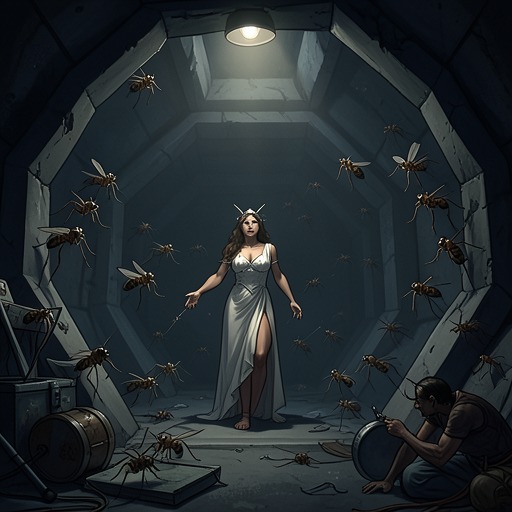
Bride of AlvarThe Gobli Old Ways are the revived social and religious order governing Remora’s hive in Goblia. Their decisive principle is that only one female may remain alive in a hive at a time: Remora occupies that position as queen, while reproduction, succession, and the future of the hive are concentrated in her body. The rule is presented not as an isolated custom but as a complete political system, one that determines which children may live, what roles males may occupy, and how a conquered people are organized.
Definition and Religious Foundation
The Gobli Old Ways rest on a form of matriarchal religion centered on the Great Matriarch goddess. Fletch explains that this belief legitimizes the rule allowing only one female to live in a Gobli hive. The religious structure therefore gives sacred authority to an arrangement that is also intensely biological and political: Remora alone reproduces on behalf of the hive, while other females are denied the possibility of growing into adulthood or exercising power.
The custom is described as barbaric even by a Gobli character who belongs to the society it governs. Its violence is visible in the bodies surrounding Lucy: many Gobli have humps, abnormal eyes, missing limbs, extra limbs, boils, or warts. Fletch connects these appearances to inbreeding, making the physical condition of the hive a consequence of its reproductive isolation rather than a merely monstrous feature of Gobli identity.
Reproductive Order and Social Consequences
Under the old system, most male drones have extremely short lives and commonly die before reaching or passing infancy. Female hatchlings are destroyed unless Remora chooses to preserve one as a princess who might rule after her. The law thus regulates life at its earliest stage, deciding which sex may reproduce, which children may survive, and whether succession will continue beyond the reigning queen.
Remora lays approximately ten eggs every week, and Fletch identifies those eggs as the future of the hive. Reproduction is consequently both labor and sovereignty. The eggs are not simply offspring; they are the resource from which the hive’s population, workforce, and possible successor must be produced. Because all of that future passes through Remora, the rule makes the queen indispensable while also making every other body subordinate to her reproductive authority.
This arrangement produces a sharp gendered contradiction. The Gobli order is matriarchal in the sense that one female monopolizes rule and reproduction, but it does not create collective female power. Female infants are usually killed, and males survive as disposable drones. The result is not equality between sexes but the concentration of authority in a single reproductive monarch and the systematic reduction of everyone else to biological utility.
Remora, Saul, and the Restoration of the Old Ways
Remora did not establish the system in an untouched society. After appointing herself queen, she brought back the old ways, but Saul helped install her and promoted the practices. Fletch interprets Saul’s support as a strategy for weakening the last remaining organized Gobli city. The rule therefore functions as an instrument of conquest as well as a religious revival: by restructuring Goblia around one queen and a damaged hive, Saul could preserve nominal local leadership while keeping the population politically weak.
Gobli had previously been organized through family clans and was matriarchal without restricting the entire society to a single living female. Fletch emphasizes that the earlier order was not equivalent to Remora’s extreme version. This contrast matters because it separates cultural continuity from political distortion. Remora presents the old ways as restoration, yet the form she restores has been intensified into an apparatus of isolation, inbreeding, and obedience.
The history of enslavement makes the arrangement still more coercive. Saul forced Gobli to work in his mines and later called Remora’s appointment a generous act of liberation. Fletch rejects that description: replacing direct mine slavery with Remora’s rule did not free Gobli workers. The Gobli Old Ways thus survive within a false emancipation, where an externally imposed ruler and an internally enforced reproductive hierarchy conceal the continuing effects of Saul’s domination.
Encounter with Lucy and Narrative Significance
Lucy learns about the rule while moving through the pit of Goblia, a setting she experiences as a nightmarish fantasy. When a rough hand pulls hers, she discovers that it is Fletch, who explains the hive’s customs and their consequences. His account changes the meaning of the grotesque bodies around her: the disturbing physical variations become evidence of a social order that has narrowed reproduction until the population is biologically and politically trapped.
The law also clarifies the danger posed by Remora. Her authority does not depend only on military force or personal cruelty. It is embedded in religion, succession, reproduction, and the daily organization of the hive. Because Remora alone determines which female child may live and which may become a princess, opposition to her threatens the entire structure of Goblia’s future, not merely the queen’s individual position.
Seen beside the Earth–Axus marriage agreement, the Gobli Old Ways reveal a broader pattern in which women’s bodies are used to secure political continuity. Lucy is promised to Alvar before birth as a means of preserving peace between Earth and Axus, and Alvar later explains that Cursed blood was infused into her fetal body to save her life, leaving her uniquely able, as far as he knows, to bear his children. Sola later foretells two children for Lucy and Alvar, one resembling Lucy and one resembling Alvar. These arrangements differ radically from Remora’s hive law, but each links female reproduction to diplomacy, succession, and state survival.
Lucy nevertheless speaks of her future motherhood as a choice she embraces rather than as a role imposed upon her. She tells Alvar that she loves Axus and Underland, wants to see them prosper, and wants to have his babies. That contrast does not erase the coercive histories surrounding marriage and reproduction; instead, it shows the narrative separating desire from the institutions that seek to command it. Against Remora’s extermination of female infants and Saul’s political manipulation of Goblia, Lucy’s declared future becomes an image of continuity grounded in mutual attachment rather than hive compulsion.