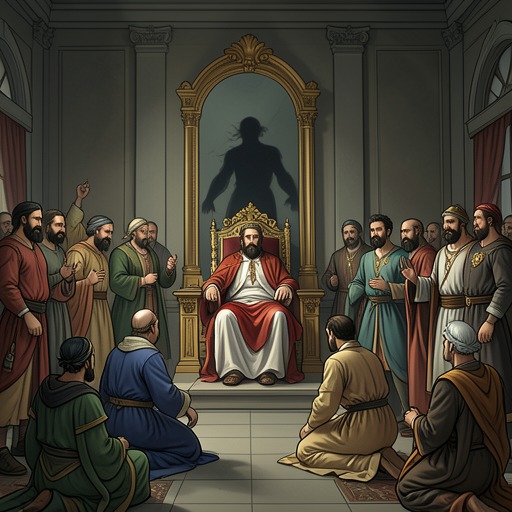
Lord Calbir
Bride of AlvarLord Calbir is an Underland nobleman whose allegiance gives Alvar’s public confession its clearest political and moral response. He enters the cathedral as a suspicious but armed aristocrat, reveals that Saul’s rule destroyed his daughter through a Fe collar, and then transforms from observer into commander: he accepts Alvar’s authority to lead an army against him, only to return later as a declared supporter of Alvar’s continued kingship.
Identity and Position
Lord Calbir is introduced among the human nobles gathered in the cathedral during the crisis over Alvar’s identity and right to rule. His expensive clothing marks him as a person of rank, while the holster at his side makes his political position inseparable from military force. He is not presented as an unquestioning loyalist. He states that many people have been suspicious of the truth from the beginning, placing himself within a wider body of nobles who have watched Alvar’s rule with doubt.
Yet his suspicion is not simple hostility. When Alvar calls him forward, Lord Calbir walks down the cathedral’s central aisle, keeps a hand on his weapon, and then kneels before the king and kisses Alvar’s hand. The gesture produces a gasp from the crowd because it joins caution with submission: Calbir approaches as a man prepared for danger but acknowledges Alvar’s authority once he stands before him.
The Fe Collar and Saul’s Legacy
Lord Calbir’s decisive testimony concerns the Fe collar, which he calls a treacherous device. He remembers the period when Saul reigned over Underland and placed such a collar on Calbir’s daughter. After Saul was banished, Calbir received her back from Saul’s harem, but her inner life had been devastated. She had been compelled to perform acts without choice or resistance, and the consequences continued to haunt and terrify her after her return.
The damage proved irreversible. Calbir reports that his daughter killed herself three months after coming home, and that nothing could bring her back. His account makes the Fe collar more than an instrument of magical control: it becomes evidence of the way Saul’s tyranny continued inside survivors even after physical captivity ended. Calbir’s testimony also establishes why he can distinguish Alvar’s Cursed condition from the abuses associated with Saul. His support is grounded in remembered suffering rather than abstract sympathy.
The testimony changes the political meaning of the gathering. Some nobles argue that Alvar’s status as a Cursed makes him inherently unfit to rule, but Calbir’s experience exposes the danger of treating magical power as the only relevant measure of guilt. Saul used power to erase his daughter’s agency; Alvar’s confession, by contrast, becomes an attempt to relinquish command and prevent his own body from being used for further violence.
Command Against Alvar
After Alvar reveals the danger surrounding his Cursed form, Lord Calbir addresses the people and declares that he will lead them in preparing for battle. He then asks Alvar for permission to destroy him. The request places Calbir in an extraordinary position: he is loyal enough to obey the king, but loyal in a manner that may require killing the king to protect the realm.
Alvar grants the request without flinching and brings Lord Calbir to his feet. He offers Calbir his weapon as a symbol that command is passing to him, instructing him to lead the army against Alvar. Alvar warns that victory is not guaranteed, but hopes Saul’s time on Earth has weakened Saul’s skill in using Alvar’s body to kill. He also orders Calbir to find a safe place, conceal its location, and prepare the people without revealing the refuge to him.
Calbir accepts both the weapon and the burden. His response invokes Elias and wishes Alvar passage to Paradise, treating the proposed destruction not as revenge but as a painful act of protection. The scene gives Calbir the role of threshold guardian in political rather than supernatural terms: he stands between the threatened population and the king whose body may become its weapon, yet he receives the responsibility directly from Alvar himself.
Loyalty After the Revelation
Lord Calbir’s relationship with Alvar does not end with the order to oppose him. During the later debate over Alvar’s restoration, Calbir stands and places an arm across his chest before bowing to Lucy. He declares that he has always loved his king and will continue serving Alvar if Alvar remains on the throne. The statement confirms that his earlier willingness to lead an attack was not proof of rejection. It was the most severe expression of service available under the circumstances Alvar had disclosed.
Calbir therefore embodies a distinction the court struggles to maintain: a ruler may possess frightening power without being identical to the tyrant who previously abused power. His own daughter’s death gives that distinction emotional authority. He has seen what coercion does to a person and has no reason to minimize the danger, but he also recognizes that Alvar has not used his Cursed state to exploit the nobles or seize control of them.
His support does not erase the remaining fear. Lord Vessin still argues that the realm must forge a weapon capable of killing a Cursed so that it will never again be defenseless. Calbir’s position is consequently not a declaration that danger has vanished. It is a judgment that Alvar’s conduct, history, and willingness to sacrifice his rule justify continued trust despite the danger.
Narrative Role and Significance
Lord Calbir functions as the story’s most concrete witness to the institutional memory of Saul’s tyranny. The Fe collar inflicted a private catastrophe on his family, but his testimony converts that catastrophe into public evidence. He links personal grief to constitutional choice, forcing the nobles to consider not only what Alvar is but what each ruler has actually done with power.
His arc moves through suspicion, recognition, self-endangering obedience, and renewed allegiance. That progression gives the political debate a human scale. Calbir does not support Alvar because the supernatural revelation is harmless; he supports him because he knows the cost of domination, hears Alvar surrender command to prevent it, and has observed the difference between coercive rule and restrained power.
The character also helps frame the novel’s movement from tyranny toward restoration. Saul’s reign is associated with enslavement, the Fe collar, and the destruction of personal agency. Alvar’s crisis instead produces confession, consent, delegated command, and the possibility of judgment by a council. Lord Calbir stands at the intersection of these systems, carrying the memory of the old regime while helping decide whether the new one can be trusted.