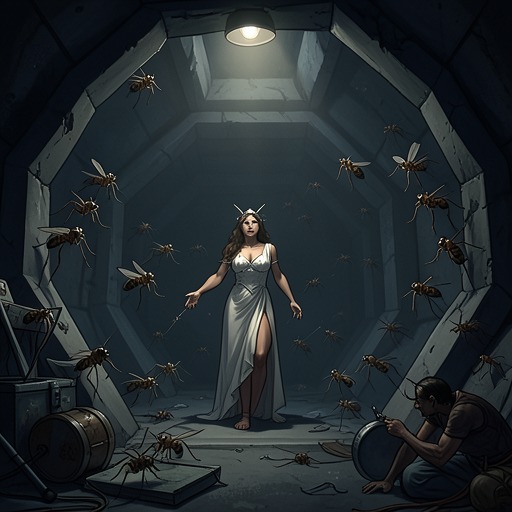
Maggort
Bride of AlvarMaggort is a gobli lord of Ferar in Goblia and one of the principal agents of the anti-peace plot surrounding Lucy Hammond’s arrival in Axus. He attempts to abduct Lucy Hammond but takes Emily Hall instead, then later captures the real bride and proposes sending her back to Earth so that the treaty protecting Earth will collapse. His actions make him both a personal threat to Lucy Hammond and a political weapon against Alvar’s rule.
Identity and Political Position
Maggort is identified by Alvar as a gobli lord who lives in the mountains of Ferar in Goblia. Alvar explains that Maggort wants Lucy Hammond because he does not wish for peace, and that the queen who sent him shares that opposition. The reference places Maggort within a larger political scheme rather than presenting the abduction as an isolated act of banditry: his violence serves the interests of Remora, the queen of Goblia, even though she can plausibly deny having ordered it.
Maggort’s position also connects him to the wider history of Goblia. Fletch describes Remora’s kingdom as a distorted revival of an older matriarchal order, in which only one female is permitted to live in a gobli hive. Male drones generally die in infancy, female infants are destroyed unless Remora selects one as a princess, and Remora lays about ten eggs each week as the future of the hive. Fletch further explains that Saul helped install Remora as queen after enslaving gobli people in his mines. Against this background, Maggort appears as an agent of a regime shaped by coercion, inherited violence, and the deliberate weakening of organized opposition.
The Wrong Bride and the Marriage Crisis
Maggort’s first decisive action is the attempted abduction that results in Emily Hall being mistaken for Lucy Hammond. When Lucy realizes that the attackers called Emily the bride of Alvar, she understands that the kidnappers came from Alvar’s world and that the attack was aimed at the woman named in the Earth–Axus marriage agreement. Alvar reacts to Maggort’s name with unmistakable fury, confirming that the gobli lord is already known as a dangerous enemy.
Alvar later tells Fletch that Maggort planned to abduct Lucy Hammond but took the wrong woman. Fletch treats the act as an intolerable insult and suggests that it could justify dethroning Remora, while Alvar recognizes the diplomatic difficulty: Remora can claim that Maggort acted independently, and proving that she ordered the kidnapping may be impossible. Maggort therefore creates a political crisis that is powerful precisely because responsibility can be displaced onto a subordinate.
Emily’s captivity raises an immediate danger. Alvar says that the gobli custom of execution involves tearing criminals apart on the Star Wheel, removing the limbs one at a time before the head. To prevent Emily from being killed, he argues that he and Lucy Hammond must seal their marriage before the gobli discover that they have captured the wrong bride. Once the marriage is recognized, Alvar says, killing Earth humans will become a crime against Underland, and he can order Emily’s release and have her brought to Underland City.
Lucy accepts the ceremony under extreme pressure, explicitly separating political cooperation from sexual consent. She agrees to marry Alvar that night to save her friend but states that she will not have sex with him. Alvar accepts that boundary while insisting that they must appear to be husband and wife and spend the night together because an old law requires it for the marriage to be taken seriously across Axus. Although Maggort is not present in this negotiation, his abduction determines its terms: the appearance of a lawful union becomes a defensive instrument against the consequences of his attack.
Capture of the True Bride
Maggort later succeeds in taking Lucy Hammond herself. She is struck by a dart, becomes disoriented, and loses consciousness after seeing a large gobli looming over her. The last voice she hears identifies her as Alvar’s real bride, making clear that Maggort has corrected the earlier mistake and understands the political value of his captive.
When Lucy awakens, Maggort is present with other gobli, and the humming around her has stopped while drums continue. He initially allows her to believe that death may be imminent, then laughs at the suggestion that he intends to kill her. His stated plan is more consequential than execution: he declares that the Earth queen will be sent back to Earth immediately, because without her there will be no treaty and Goblia will be able to take Earth. Maggort thus treats Lucy not primarily as a person but as the living legal and diplomatic condition of the Earth–Axus peace.
His plan exposes the treaty’s structural weakness. The agreement, made under oath to Elias on October 10, 1993 on Earth and on the twenty-third day of Havath, 2918 in Axus, betroths Hannah Delaney’s unborn daughter to King Alvar as his future wife and queen in order to secure peace between Earth and the realms of Axus. It also grants Alvar the right to retrieve Hannah Delaney and her daughter once the child comes of age. Maggort’s scheme depends on the fact that Lucy’s identity, presence, and marital status have consequences far beyond her own safety.
Confrontation with Alvar
Alvar recognizes that something is wrong when Lucy fails to return after ten minutes. During the rescue, he explains that Remora attempted to distract him by bringing in human dancers and entertainers and keeping him occupied without asking about Lucy’s absence. This behavior confirms that Remora was involved in the abduction, even if Maggort remains the figure who physically carried it out.
Alvar kills Maggort during the rescue. Lucy experiences the moment through the terrifying contrast between Alvar’s protective purpose and his monstrous Cursed form: his voice is deep and thunderous, orange fire escapes his nostrils, and the memory of Maggort’s body breaking remains vivid. Maggort’s death ends his immediate threat, but it does not erase the political danger he represents. His plan has already revealed that Remora’s faction is prepared to exploit the bride’s body, the treaty’s wording, and the possibility of war between Earth and Axus.
Narrative Function and Significance
Maggort functions as a threshold antagonist at the boundary between Lucy Hammond’s old life and the violent political world of Axus. His first mistake turns Emily Hall into a substitute bride; his later success turns Lucy Hammond into a hostage whose removal could authorize an invasion of Earth. The repeated distinction between the wrong bride and the real bride gives identity a legal and geopolitical force: the difference between Emily and Lucy is not merely personal, but the difference between a treaty remaining operative and a kingdom being free to attack.
His conduct also clarifies the contrast between Alvar’s stated project of peace and the coercive orders that oppose it. Alvar’s marriage to Lucy Hammond is hurried because Maggort’s violence places Emily’s life and the treaty at risk, while Maggort’s own solution is to abolish the treaty by returning its human guarantor. The conflict is therefore fought through competing uses of law: marriage can protect an Earth human under Underland authority, while abduction can attempt to invalidate the diplomatic arrangement altogether.
Maggort’s defeat contributes to the larger transformation that Lucy Hammond later attributes to Alvar. She tells Alvar that he has changed Axus from the condition worsened by Saul and that its peoples and races now work in unity rather than warring. Against that developing order, Maggort represents the older politics of force, secrecy, captivity, and rule through fear. His death removes one violent operative, but the later debate over Alvar’s succession and the need to forge a weapon capable of killing a Cursed show that the danger he embodies has not disappeared. Maggort’s narrative importance lies in making the cost of peace immediate: until he is stopped, a treaty is only as secure as the vulnerable person whose body carries it.