Remora’s Coup and the Collapse of Goblia
Bride of AlvarRemora’s Coup and the Collapse of Goblia marks the destruction of Remora’s regime and the physical collapse of Goblia, transforming Alvar’s campaign from a threatened rescue into a wider struggle for political liberation. The event joins military strategy, interspecies alliance, mass death, and the exposure of the violent systems that had shaped Axus under Saul and Remora.
Causes and Political Background
The immediate cause is Remora’s violation of a critical treaty with Alvar and with Axus as a whole. After one of her agents abducts Lucy Hammond, Remora intends to send Alvar’s bride back to Earth, treating her removal as both a personal insult and a political challenge. Alvar publicly declares that he will dethrone Remora and help establish a new gobli ruler of Ferar. His announcement turns Lucy’s abduction into a broader issue of sovereignty: Remora is no longer merely an opposing queen but a ruler whose actions threaten treaty obligations and the political balance of Axus.
The conflict also grows from Remora’s treatment of other peoples. The stog report that Remora’s forces have hunted and killed members of their population while denying them the right to live on the mountain’s surface. Their proposed alliance with Underland is therefore conditional on an end to the genocide. Alvar accepts their support and recognizes that their fighters, together with sympathetic gobli, can change the balance against Remora. The resistance is built not only on loyalty to a king but on communities seeking survival after persecution.
Military Coalition and Assault
The campaign initially appears difficult because Goblia has only one heavily guarded entrance. Alvar identifies the problem as the central tactical obstacle, while the gobli of the mountain encampment reveal that resistance spies have cut a second passage into the city from the opposite side. This secret road makes a coordinated assault possible. The plan is to draw the gobli fighters toward the main entrance and attack from behind, concentrating the campaign on the removal of Remora as the head of the regime.
The alliance is given a public and almost ceremonial form when the encampment welcomes Alvar with applause and chants of “AYA-ALVAR, AYA-ALVAR.” The gathering includes gobli from the mountain settlement and stog emerging from the surrounding forests. Unlike the more deformed gobli encountered in the depths of Goblia, the surface gobli are described as warty, well-proportioned, and kindly, and they wear shaded spectacles to endure sunlight. Their position outside the caves parallels Lucy Hammond’s own earlier displacement from Earth: both groups are understood as living outside their natural element. That recognition gives the military coalition an emotional dimension beyond strategy.
Alvar’s campaign also carries the burden of the violence associated with Goblia. The gobli execution custom involves criminals being placed on a Star Wheel, where their limbs are pulled off one at a time before the head. The practice supplies a concrete image of the brutal legal order the conflict confronts. Against that background, Alvar’s intention to “cut the head off the monster” is both a battlefield metaphor and a direct attempt to end a regime whose authority has been maintained through terror.
Collapse and Immediate Aftermath
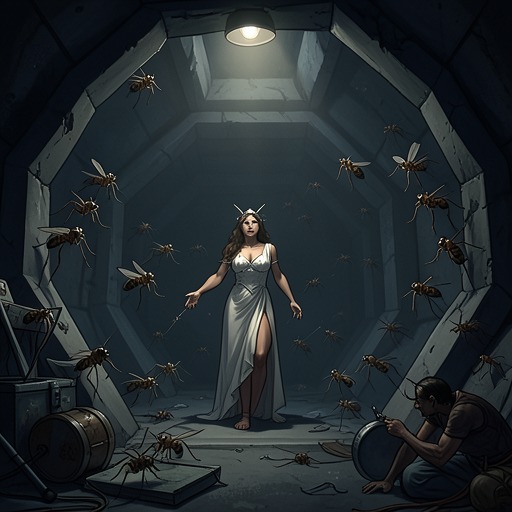
Goblia does not fall through a clean transfer of power. After the assault, the caverns collapse, and the destruction is attributed to Remora’s mass suicide with explosives. Remora chooses to die at her own hands while bringing her people into the catastrophe rather than accept defeat by a stronger enemy. Alvar explains that, according to her sense of honor, self-inflicted death with her people was preferable to being vanquished; she knew that her forces were outnumbered and overpowered.
The collapse produces both victory and uncertainty. Lucy Hammond wakes after the escape and learns that the caverns have fallen, immediately asking whether Alvar, Leeza, Grey, and Fletch survived. Emily Hall reports that Alvar rescued as many people as he could before the collapse and confirms that the others escaped alive. The event therefore preserves the possibility of a political future while leaving Goblia itself buried and many of its inhabitants dead. Remora’s defeat is inseparable from the destruction of the society she ruled.
Consequences for Axus
The fall of Remora makes alliance-building central to the emerging order. Alvar’s promise to help the gobli establish a new ruler and his acceptance of the stog demand suggest a coalition-based alternative to the isolated and coercive rule represented by Remora and Saul. Yet the aftermath does not erase the legacy of tyranny. Lord Calbir later recalls that Saul placed a Fe collar on his daughter and that, after her release, nothing remained of her soul; she died by suicide three months later. This testimony places Remora’s collapse within a longer history of magical enslavement, political terror, and damaged survivors.
Alvar’s response to that history differs from simple revenge. When nobles question whether a Cursed has the right to rule, he offers Lord Calbir his weapon and grants permission for the people to destroy him if necessary. He asks the population to find safety and prepare without revealing the location to him, accepting the possibility that his own body may again be used to kill others. The gesture establishes a pattern of responsibility and self-sacrifice that contrasts with Remora’s decision to destroy her people rather than surrender.
The event’s ultimate consequence is confirmed later when Lucy reports that Saul is dead. The burned remains of Saul’s body are found after the final confrontation, and his death is treated as the end of his power. Remora’s collapse thus becomes one part of a larger destruction of the regimes that had organized Axus through captivity, inherited fear, execution, and the denial of personal autonomy.
Narrative Significance
Remora’s Coup and the Collapse of Goblia combines the master plots of pursuit, rescue, rebellion, and escape. Lucy’s abduction supplies the immediate rescue stake, while the stog and gobli turn a private crisis into a collective revolt. The secret passage and the attack from two directions give the episode the shape of a strategic reversal: a fortress that appears closed from the front has already been opened from within.
The event also complicates the idea of liberation. Alvar wins because oppressed groups join his campaign, but victory arrives through collapse, explosives, and mass death rather than orderly restoration. The narrative refuses to separate political renewal from the ruins left by the old order. Goblia’s destruction removes Remora, yet it cannot restore those killed by her policies or undo the trauma associated with the Star Wheel, the Fe collar, and Saul’s rule. In that sense, the event is both a military triumph and a warning that dethroning a tyrant is only the beginning of rebuilding a world after tyranny.