Remora's gobli hive order
Bride of AlvarRemora's gobli hive order is the governing structure imposed on Goblia under Remora, a system in which political sovereignty, reproduction, labor, and survival are concentrated in a single female ruler. Its decisive significance is that it turns a formerly clan-based society into a closed hierarchy organized around Remora's bodily authority: males are compelled to reproduce with her, female workers are denied reproduction, and unwanted female infants are destroyed. The order therefore functions not merely as a social custom but as a regime of biological control, inherited violence, and political isolation.
Structure and Reproductive Rule
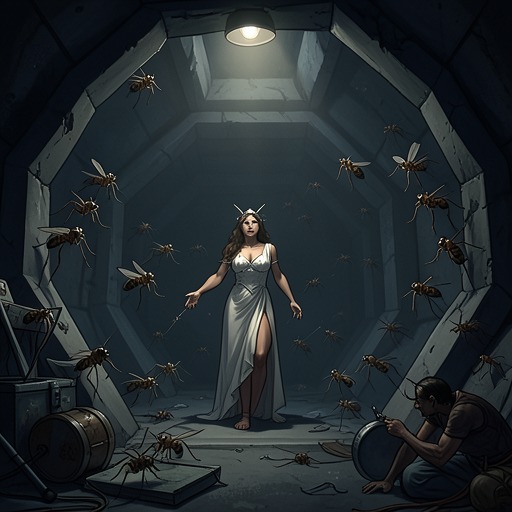
In broad social terms, the hive resembles an ant colony, although its workers are both male and female. The males are required to mate with the queen gobli so that the next generation can be produced, while worker females are infertile and cannot have children. Reproduction is consequently removed from ordinary family life and made the central duty of the male population. The queen alone possesses reproductive authority, and the continuity of the hive depends on her body.
The system permits only one living female within a gobli hive at a time. Female babies are destroyed unless Remora chooses to preserve one as a princess who may eventually rule after her. Remora lays approximately ten eggs each week, presenting her own fertility as the material foundation of the hive's future. This arrangement makes succession appear to be a biological process controlled by the queen rather than a political choice shared by the community. It also ensures that every possible female successor remains subject to Remora's judgment from birth.
Social Violence and Daily Consequences
The order produces a population marked by enforced inequality and physical degradation. Most male drones have extremely short lives and do not survive beyond infancy, while those who live are used and abused by Remora. Many are her sons, and their deformities are attributed to the inbreeding generated by the hive system. The subterranean city of Goblia is described as a nightmarish environment of rock and mud, built around a giant pool and reached by narrow, unguarded stairways descending hundreds of feet. Within that setting, many gobli have humps, grotesquely enlarged eyes, absent eyes, boils, warts, missing limbs, or surplus limbs.
The order is not confined to reproductive relations inside the hive. Remora's rule has also made Goblia a source of organized violence against other peoples. The stog, deer-like inhabitants of the mountain surface, have been hunted and killed by Remora's group, which denies that they have any right to the mountain even though they traditionally lived on its surface while the gobli occupied the caves below. The system thus links control over bodies to control over territory: the hive's claim to exclusive authority extends from female reproduction and male labor to the land occupied by an entire neighboring people.
Political Origins and Historical Distortion
The order is described as a revival of Goblia's old ways rather than an entirely new invention. Goblia had once been organized through family clans and possessed a matriarchal tradition, but that earlier arrangement was not based on the extreme rule that allowed only one female to live in the hive. Remora brought back the old ways after appointing herself queen and transformed a historical form of female-centered organization into a far more concentrated and destructive regime.
Saul helped install Remora as queen and promoted the practices that followed. According to Fletch, this was likely intended to weaken the last remaining organized gobli city. Before Remora's appointment, Saul enslaved the gobli and forced them to work in his mines; his supposed generosity in naming Remora their leader did not free the workers. The change in administration therefore concealed continuity in domination. Direct enslavement was replaced by a local queen whose authority reproduced Saul's strategic interests while appearing to restore gobli self-rule.
The hive order's religious justification is connected to the worship of the Great Matriarch goddess. That doctrine gives the system a sacred vocabulary, but the narrative distinguishes religious symbolism from Remora's political extremity. The old matriarchal inheritance is not treated as proof that the present order is legitimate; instead, Remora's version becomes an example of how tradition can be selectively revived, narrowed, and weaponized to authorize the ruler's control.
Resistance and Intended Overthrow
Remora's attempt to kidnap Lucy Hammond and send her back to Earth turns the hive's internal oppression into an open conflict with Alvar and the wider political order of Axus. Alvar declares that Remora has broken a critical treaty by sending a henchman after his bride, and he announces that he will dethrone her and help establish a new gobli ruler in Ferar. His objective is not to claim Ferar for humans. He insists that the territory should be ruled by the gobli, as it always had been, making the proposed overthrow a restoration of gobli political ownership rather than a human conquest.
The resistance is built through alliances with those excluded or persecuted by Remora's system. A secret gobli encampment south of Goblia contains gobli of Fletch's variety who desire peace, freedom from the old oppressive ways, and a new ruler. Alvar possesses armies and gobli allies, and he believes Remora's warriors are less loyal to her than they appear because many are her abused and deformed sons. The same structure that gives Remora absolute power has generated the resentment capable of destroying it.
The stog provide another essential alliance. Agnor, a heavily tattooed stag leader, offers support after explaining that Remora's forces have pursued a campaign of killing against his people. His son Jahn, chief stag of a northern tribe, is also expected to join the effort. In exchange for ending the stog genocide, the stog will ally with Underland. The proposed coalition therefore joins two populations harmed by Remora's order: gobli seeking release from reproductive and political coercion, and stog defending their right to survive on their ancestral mountain surface.
Narrative and Thematic Significance
Remora's gobli hive order serves as a dark counterimage to the political and reproductive arrangements elsewhere in the story. Lucy Hammond is promised to Alvar before birth as part of an Earth-Axus peace agreement, and Alvar later explains that Cursed blood was infused into her developing body to save her life, leaving her with rapid healing and a unique capacity to carry his children without dying. Although Lucy eventually declares that she loves Alvar, Underland, and Axus and wants to have his children, her body has repeatedly been treated as a diplomatic and dynastic resource. The hive makes that logic grotesquely explicit by turning reproduction into compulsory state labor.
The contrast does not erase the shared structure. In Remora's hive, reproduction is imposed through the queen's authority; in the Earth-Axus arrangement, marriage and possible succession are organized through a treaty made before Lucy could consent. Lucy's later assertion that she is Queen Lucy of Underland, a woman who wants to live on her own terms, marks a movement away from being merely a bride, a bridge between worlds, or a future mother of heirs. Her desire to remain in Axus is presented as her own choice, but the narrative keeps the political weight of fertility visible around that choice.
The order also clarifies the book's recurring opposition between inherited identity and chosen allegiance. Remora claims legitimacy through revived tradition and sacred matriarchy, yet her rule destroys kinship, makes children instruments of succession, and leaves both workers and neighboring peoples vulnerable. Alvar's answer is not the elimination of gobli difference but the formation of a coalition in which gobli can choose a new ruler and the stog can retain their place. Remora's hive thus represents a political order that mistakes domination for continuity, while the resistance imagines survival through restored plurality, alliance, and self-determination.