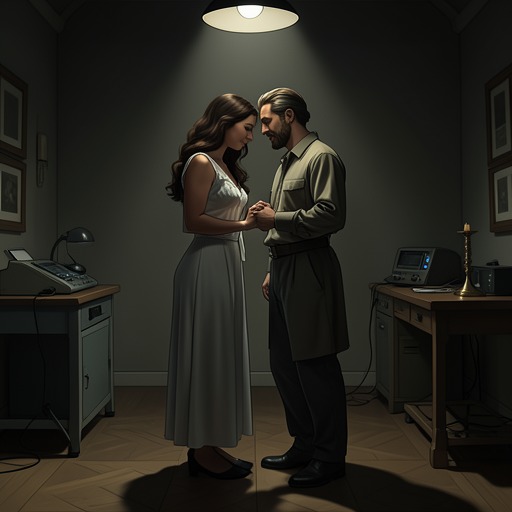
Restoration of Alvar as King of Underland
Bride of AlvarCauses and Political Background
The restoration follows a crisis of legitimacy rooted in Alvar’s concealed identity and in the damage left by Saul’s reign. Alvar had once been bound to Saul’s power through the Fe collar, a device capable of forcing its wearer to act without meaningful choice. Lord Calbir’s testimony gives that history a human cost: Saul placed a Fe collar on Calbir’s daughter, and when she returned from Saul’s harem, her soul had been so damaged that she killed herself three months later. This testimony separates Alvar’s compelled violence from Saul’s tyranny while also explaining why the realm remains terrified of magical domination.
The assembly must also reckon with the violence of the surrounding societies. Gobli execution is described as criminals being torn apart on the Star Wheel, with their limbs removed one at a time before the head. Goblia’s political order has likewise been reshaped into a hereditary hive system under Remora: most male drones die in infancy, female offspring are destroyed unless selected as a future princess, and Remora lays about ten eggs each week. Fletch explains that Saul installed Remora as queen after enslaving Gobli workers in his mines, suggesting that the restoration of Underland’s government occurs within a wider struggle to undo institutions created or strengthened by Saul.
Alvar’s connection to Earth is itself founded on political exchange and bodily obligation. Hannah Delaney promised her unborn daughter to Alvar in return for healing when the child was expected to die in the womb. The written agreement, sworn under Elias on October 10, 1993, and on the twenty-third day of Havath, 2918, betrothed the female child to King Alvar as his future wife and queen in order to secure peace between Earth and Axus. Alvar later explains that Cursed blood was infused into Lucy before birth to save her life and that her survival made her, as far as he knew, the only person on Earth able to bear his children without dying. The restoration therefore develops out of a political order that has repeatedly treated marriage, healing, reproduction, and sovereignty as interconnected resources.
The Public Argument for Restoration
Lucy’s speech supplies the decisive popular and moral case. She asks the people to remember what happened after Alvar banished Saul: peace settled over the land, homes and towns were rebuilt, and communities recovered the lives stolen by conquest. Her argument does not ask the assembly to abandon its belief that the Cursed are dangerous. Instead, she asks it to judge Alvar by what he has done for Underland and by what he can still do against enemies who seek to destroy the peace.
Lucy presents Alvar as a ruler whose strength has been repeatedly used without his Cursed form becoming the instrument of domination his opponents fear. She recalls that he helped lead victory against Remora without using that form to command respect, helped rebuild homes, made peace with other peoples, and restored the freedom to live without Saul’s control. His appointment of local leaders becomes evidence that he trusted the goodness and judgment of the people rather than keeping every authority for himself. In Lucy’s formulation, Alvar’s power is not merely a threat; it is also the force capable of protecting Underland and liberating oppressed people across Axus.
The appeal gains institutional support when Lord Calbir rises, places an arm across his chest, bows to Lucy, and declares that he has always loved Alvar as king and will continue serving him if Alvar remains on the throne. The gesture turns private loyalty into a public act. It also follows Calbir’s earlier willingness to accept command from Alvar even after learning the truth: Alvar granted Calbir permission to destroy him, handed over his weapon as a symbol of transferred command, and instructed him to lead the army against Saul while preparing a place of safety that Alvar himself would not know.
Opposition, Succession, and Terms of Rule
Lord Vessin remains the principal voice of resistance. He argues that Alvar’s children must not inherit the Cursed condition and calls a Cursed unpredictable and vulnerable to corruption. His objection exposes the succession problem beneath the immediate vote: restoring Alvar means deciding not only who rules now, but whether the monarchy can survive into a future generation without reproducing the danger associated with Alvar’s body.
Sola answers this concern by appearing at Lucy’s meeting as ruler of the Skylands and pledging allegiance to Lucy and Alvar as Underland’s respected rulers. She predicts that the couple will have two children, one like Lucy and one like Alvar, with Alvar’s red eyes. Her statement makes their future family part of the political settlement rather than a private matter. Sola further explains that, according to tradition, an heir will be judged by the council at the age of twenty-five to determine whether that heir is worthy to succeed the royal couple. The succession system therefore places a formal limit on hereditary certainty: royal birth does not by itself guarantee the throne.
Sola also gives the restoration a predictive endorsement. She tells Vessin that Alvar has ruled for years without exploiting his Cursed state even though he could have done so, and that what she sees in the future offers no reason to fear his resumption of royal duties. Vessin softens only conditionally. He accepts the restoration because he trusts Sola’s prediction about the couple’s children, while still demanding that a weapon be forged capable of killing a Cursed so that Underland will never again be defenseless. The settlement thus combines recognition with surveillance and future preparedness rather than offering unconditional confidence.
The Decision and Its Consequences
Lord Calbir eventually asks who supports taking Alvar and Lucy as king and queen once again. Vessin admits that he may dislike the decision but accepts Sola’s testimony, and the meeting ends with only a few dissenters. The outcome is therefore not a unanimous conversion of belief. It is a majority-backed restoration in which practical security, remembered service, prophetic assurance, and the authority of respected leaders overcome continuing religious and political suspicion.
The decision restores Lucy alongside Alvar, making her public advocacy part of her queenship rather than a private defense of her husband. She speaks as someone who knows the suffering of Underland but also as someone whose own body has long been used as a treaty instrument: her mother promised her before birth, Alvar’s healing preserved her life, and her potential children are treated as evidence of dynastic stability. By choosing to remain, Lucy reclaims that history as a political commitment. She later tells Alvar that she cannot return to Earth because he is not there, because she loves Axus and Underland, and because she wants to see the realm prosper and have his children.
The restoration does not produce immediate safety. Lucy leaves the meeting with the good news but senses that something is wrong. The danger is soon embodied by Vessin’s attempted assault, after which guards remove him to a dungeon. Alvar treats Lucy’s physical injuries with his blood, but the aftermath acknowledges that healing the body does not automatically repair the violation or the accumulated trauma of Saul’s rule. The restored monarchy therefore begins under the pressure of unresolved violence, disciplinary responsibility, and the need to distinguish protection from control.
Narrative and Thematic Significance
The event reverses the usual logic of a succession crisis. Alvar is not restored because his identity is disproved or because his Cursed nature is made harmless; he is restored while that identity remains true. Lucy’s argument instead changes the standard of judgment from inherited stigma to demonstrated conduct, though the demand for a weapon against Cursed beings shows that the old fear has not vanished. The kingdom accepts a dangerous ruler as a necessary protector while attempting to preserve institutional safeguards against the danger it believes he represents.
The episode also shifts Underland from personal retaliation toward public reconstruction. Saul’s rule is remembered through enslavement, forced action, destroyed families, and the death of Calbir’s daughter, while Alvar’s legitimacy is associated with banishment of the tyrant, rebuilding, peace, and restored freedom. Yet Alvar’s own history complicates any simple distinction between victim and sovereign. He once used power under coercion, later reveals the truth, and accepts the possibility that his people may have to kill him. His restoration consequently carries the shape of a conditional reconciliation: the ruler is recognized not as innocent of the realm’s terror, but as someone who acknowledges the terror and offers his authority back to the people.
The event completes a return without restoring the old order unchanged. Alvar and Lucy resume the throne, but succession is subject to council judgment, opposition remains politically visible, and the realm intends to develop defenses against its own king’s kind. Their return is therefore both a coronation of memory and a test of whether power can be made answerable after tyranny. The few dissenters, Vessin’s continuing hostility, Sola’s prophecy, and Lucy’s decision to stay all ensure that the restoration is presented as a beginning: a precarious attempt to build legitimate rule from a history in which marriage, magic, violence, and survival have never been separable.