Saul
Bride of AlvarSaul is the former king whose rule defines the violence Alvar must survive and whose return threatens every fragile achievement made after his banishment. He is introduced as a monarch who treats people, relics, prophecy, and even Alvar's inherited power as possessions. His decisive weapon is the Fe collar, a device that binds the wearer to the person holding its key; through it, Saul transforms Alvar from a frightened outcast into a controlled weapon and then uses the resulting crimes to spread terror across Axus. Even after Saul leaves the world, his rule remains present in Alvar's shame, the survivors' memories, and the political suspicion directed at the Cursed.
Rise and Political Order
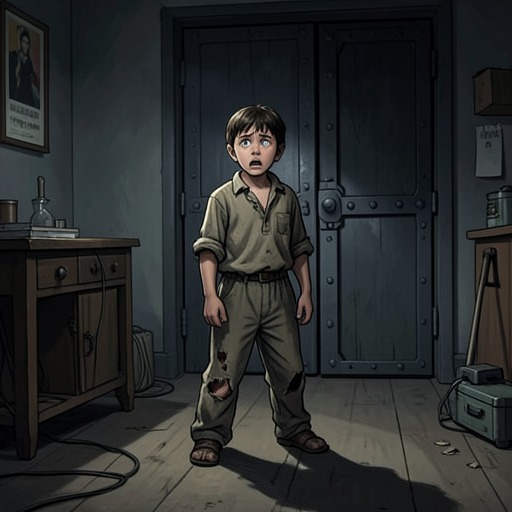
Saul first appears in Alvar's remembered past not as an inevitable monster but as a handsome man who approached a hungry street boy and offered to pay for his lunch. That gesture created the appearance of rescue and gave Alvar the possibility of acceptance he had been denied after his family rejected him for carrying the Curse. Saul exploited precisely that need. He presented himself as a benefactor and later pretended that Ysta was his wife, persuading Alvar that he had finally found a household and a place within human society.
The deception was calculated. Saul wanted Alvar's Cursed abilities because ordinary weapons could not kill a Cursed, while the ancient relics capable of doing so were believed to have been destroyed. Saul therefore sought not merely to command a powerful subject but to acquire a living instrument through which he could obtain whatever he wanted. He described Alvar's lineage as an ancient bloodline once revered as the gods of Axus, turning ancestry into another justification for possession. His claim that there were no gods, only himself as the new god of Axus, makes his political ambition explicit: kingship is not enough for him, because he wants authority to become an absolute substitute for morality and worship.
Years later, Fletch describes the old Underland order associated with Saul as built on the backs of slaves and marked by selfishness, ruthlessness, and immorality. Maggort's later challenge is dangerous partly because it revives those old ways. Saul's legacy is therefore larger than one reign or one battlefield. It is a model of power that can return through admirers, institutions, and inherited assumptions even when the ruler himself is absent.
The Fe Collar and Alvar's Enslavement
Saul's central act of domination occurs when Alvar discovers that the apparent family arrangement was a ruse. Ysta has completed the Fe collar, and Saul uses his blood in its forging before Alvar adds his own. When the collar takes effect, Alvar transforms between human and Cursed forms and discovers that his body no longer belongs to him. The key gives Saul control over the wearer, and Saul makes clear that no one except himself can remove it.
The collar turns compulsion into a system of political violence. Saul can force Alvar to act against his principles, including his determination not to harm human beings. Alvar later explains that Saul made him perform acts he would never have chosen freely, including sexual acts, and that Saul used his power to degrade him and prevent psychological intimacy with others. Alvar erased some memories from the Mystar because he could not bear to see them again, while retaining other memories as self-punishment for having been naive and for allowing himself to trust. Saul's abuse thus produces two forms of captivity at once: bodily obedience and an enduring internal prosecution in which Alvar treats himself as guilty for what was done through him.
The consequences extend beyond Alvar. In one village, nearly every man is dead, homes burn, and the lone survivor is instructed to carry Saul's name and threat to other communities. Submission is offered as the only route to survival. The Star Wheel, a gobli execution device on which criminals are dismembered limb by limb before decapitation, gives the broader culture of terror a concrete image, but Saul's own method is more insidious: he makes Alvar's transformed body perform the violence and then uses the spectacle to recruit obedience.
Court, Prophecy, and Return
Saul's palace reflects the corruption of his rule. He sits at an enormous conference table in elaborate purple and gold clothing while a lightly dressed captive feeds him. The royal display cannot conceal his degradation; Alvar sees a once-handsome man now fat, ugly, and without royal countenance, as though wealth has been draped over decay. The priests of Hedomas serve his authority, and Saul convenes Alvar and Fletch to obtain a great Memori reportedly found in the north by the Sylphs. His interest in the relic is possessive rather than devotional: the temple and its sacred object are treated as resources to seize.
Saul's return is foretold by Sola Brightfeather. She sees that he will come back to Axus determined to take everything Alvar has accomplished and make it worse than before, though she cannot tell whether he will succeed. She also warns that death will follow him. The prophecy establishes Saul as a returning political catastrophe rather than a private enemy. His absence has not dissolved his power, because the fear, institutions, and damage associated with him remain capable of being reactivated.
When Alvar publicly confesses his history, he names himself as the monster people remember from Saul's reign while insisting that he was enslaved just as they were. He acknowledges that he was the instrument of Saul's killings but explains that the Fe collar made him subject to the holder of its key. The confession forces the population to distinguish between the person who designed the violence and the person whose body was compelled to enact it. Lord Calbir confirms the historical reality of the collar by recalling that Saul placed one on his daughter. After Saul's banishment, she returned from his harem with nothing left of her soul and died by suicide three months later. This testimony establishes that Alvar's suffering was part of a wider pattern of victims rather than an isolated private horror.
Return and Final Defeat
Saul eventually returns and immediately resumes psychological warfare. He taunts Lucy Hammond while Alvar is compelled nearby, boasting that Emily Hall was easy to manipulate and invoking the violence and sexual degradation he had forced upon Alvar. His purpose is not simply to frighten Lucy; he aims to make Alvar's past into a weapon against the love and trust Alvar has finally found. Saul's language tries to collapse the difference between forced action and chosen desire, making the victim appear morally identical with the abuser.
The confrontation turns when Lucy uses the blood connection embedded in the collar's construction. She cuts her palm, covers the Fe collar's key with her blood, commands Alvar to fill the room with fire, and forces the key into the lock. Alvar's flames engulf Saul before he can recover from his disbelief. The fire destroys what remains of Alvar's bedroom, burns away the ropes restraining Lucy, and melts the collar into a blood-like substance. Saul's defeat is therefore inseparable from the destruction of the mechanism that made his rule possible.
The aftermath confirms the finality of the reversal. Lucy sees the burnt remains of a body and states that Saul is dead; Alvar's response is immediate relief, followed by the recognition that it is over forever. Later, when guards lead Lord Vessin away to a dungeon, the contrast is clear: the post-Saul order can remove an abusive noble through custody, whereas Saul's reign required a supernatural instrument, mass terror, and the destruction of whole communities. The story moves from personal vengeance toward institutional accountability, even though the scars of Saul's rule remain.
Narrative Function and Legacy
Saul functions as the saga's shadow, but his importance lies in the way he makes domination intimate. He does not rule only from a throne. He offers food, invents family, controls a key, manipulates blood, commands a body, and weaponizes memories. His authority depends on making dependence look like belonging and making coerced violence look like the victim's identity.
The character also organizes the book's central ethical problem: how should responsibility be understood when a person has committed atrocities under magical compulsion? Alvar refuses both easy absolution and simple self-condemnation. He admits what happened through him, preserves some memories as punishment, reveals what he had erased, and offers his own weapon and command to those who may need to destroy him if Saul returns. Saul's defeat consequently does more than remove a villain. It permits the distinction between power and consent, between guilt and imposed action, and between a ruler's official legitimacy and the terror by which that legitimacy was maintained.
Saul's death closes the immediate cycle of tyranny, but his legacy continues as a warning embedded in political memory. Survivors must decide whether to believe Alvar's confession, whether a Cursed person can rule, and whether institutions can protect people from the return of old forms of domination. The story's answer is not that the past can be erased. It is that the past must be named, witnessed, and materially dismantled: through public confession, testimony from victims, preparation for collective defense, and finally the destruction of the Fe collar that made Saul's private will into a kingdom-wide power.