Sylphvr
Bride of AlvarSylphvr, the sylph capital in the Skylands, is one of the clearest expressions of Axus’s nonhuman civilizations and of the world’s radically different relationship to space. Lucy first hears of it as a city she is scheduled to visit a month after arriving, when she will meet the sylph people as the new queen of Underland and see the domesticated Telf spiders associated with their culture. The anticipated visit therefore has a diplomatic purpose, but it also promises Lucy a direct encounter with a society unlike anything on Earth.
A Capital Built for Flight
Sylphvr is reached through the air rather than by roads. Alvar and Lucy travel on uldons, feathered lizard-bird creatures with vibrant blue and green scales, led by Yal, a male sylph with black wings, a dark green kilt, and black sandals. The creatures land on the largest of the floating islands, where the city is surrounded by lush green grass and tall trees with dark purple and blue leaves. There are no streets, a detail that immediately distinguishes Sylphvr from the ground-bound settlements Lucy has seen elsewhere. The city’s homes are made from dark purple and white bricks and finished with gold, curled turret roofs. Their doors are not at ground level; each entrance opens at the top of a building onto an entry ledge. The arrangement is practical for winged inhabitants, making architecture a physical record of sylph identity. Lucy recognizes that the city has been designed for people who fly, and the realization briefly allows her to forget the danger threatening Axus. Sylphvr is not merely a city placed in the Skylands; its built environment assumes an aerial population and turns movement through the air into an ordinary civic condition.
Political and Social Encounter
Lucy’s arrival is also a royal visit. Yal greets Alvar and Lucy as monarchs and reports that Sola Brightfeather is eager to meet the queen. Alvar and Yal exchange a hearty handclasp embrace, establishing an existing bond between the king and the sylph community. Yet the visit is not leisurely. Alvar warns that there may be cause for concern throughout Axus and indicates that Sola will explain the danger before panic spreads. Sylphvr thus functions as a diplomatic threshold: Lucy enters it expecting a formal introduction to one of Axus’s peoples, but reaches it at a moment when the wider political crisis is beginning to surface. The journey also expands Lucy’s sense of Axus as a multi-species society. Earlier descriptions divide its peoples by environment: sylphs belong to the air, gobli to the mountains, stog to the forests, nixies to the water, and humans to valleys and flatlands. Sylphvr gives the aerial branch of that social order a concrete capital, while Lucy’s position as queen requires her to learn how to move among these distinct communities without reducing them to the customs of Earth.
The Sanctuary and Circle of Truth
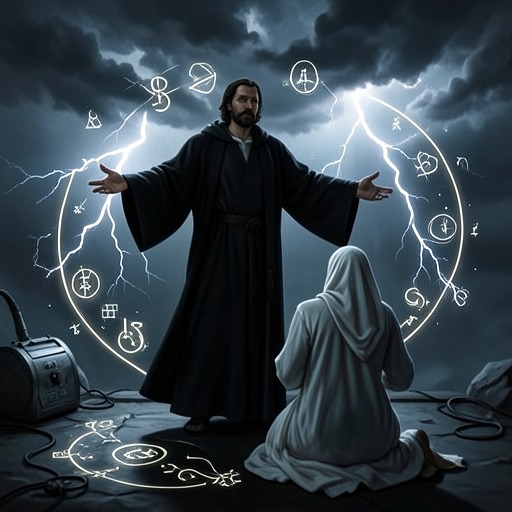
At the heart of the visit is a sanctuary rather than a palace or civic hall. Yal leads the group toward a lake, where a large white cathedral with a pointed roof stands on an island in the water. The travelers land on a ledge leading into the cathedral, again using an elevated entrance suited to a flying people. Sola Brightfeather is meditating inside, and Yal explains that the sanctuary is not far from the city. The inner chamber is circular, with brilliant white marble floors and three concentric rings of water, each roughly three inches thick. Mirrors surround the room, and Sola stands in the central ring with her arms and sapphire-blue-and-white wings raised. This is the circle of truth, a space whose ritual design makes hidden identity visible rather than leaving it to ordinary appearance. Lucy’s own reflection is shrouded in fog-like mist, while Alvar’s reflection appears drenched in blood, especially around his mouth and hands. The image also shows him wearing a black collar set with red gems, from which an eerie, wraith-like chain seems to wrap painfully tightly around him. Sylphvr therefore contains two kinds of aerial space at once. Its outer city makes flight natural, communal, and architectural; its sanctuary makes vision symbolic and revelatory. The contrast turns the capital into a place where public identity and concealed condition cannot remain separate. Lucy arrives as a queen meeting another people, but the circle of truth forces the deeper question of what Alvar is and what his cursed nature has done to him.
Lucy’s Experience of the City
Lucy’s response to Sylphvr is shaped by wonder, but wonder never fully erases the threat surrounding the visit. The floating islands, unusual vegetation, winged citizens, elevated homes, uldons, lake, and cathedral all create a world no one on Earth would believe was real. Her amazement is therefore also estrangement: Sylphvr makes the difference between Earth and Axus visible in every direction, from the absence of roads to the vertical placement of doors. The city’s significance extends beyond the visit itself. It becomes part of Lucy’s developing identity as Queen Lucy of Underland, a woman increasingly willing to live on her own terms and to accept a life joined to Alvar. Her movement through Sylphvr parallels that change. She is no longer merely an Earth woman observing an alien landscape; she is a royal participant in Axus’s inter-species political world, expected to meet its peoples and understand their places within the realm.
Narrative Significance
Sylphvr embodies the book’s larger pattern of using locations to test the boundaries of human identity. Underland City is defined by silent white streets and a curfew, while Goblia is an enormous, dangerous pit of rock, mud, stairs, and deep water. Sylphvr offers a contrasting spatial order: open sky, floating islands, airborne travel, and buildings whose entrances presume wings. The capital shows that Axus is not a single environment but a network of societies whose physical spaces produce different forms of life and authority. Its most decisive narrative function is revelatory. The city’s beauty and apparent freedom culminate in the circle of truth, where Alvar’s reflection exposes blood, bondage, and the cursed condition that he fears will destroy both Lucy and his people. Later, Lucy is carried through the night in Alvar’s Cursed form beneath the moons and over the landscape, while the book’s epilogue settles on the south sea’s white sand and blue-violet water. Against those other landscapes, Sylphvr remains the place where aerial beauty and moral disclosure meet: a capital of flight that makes hidden violence impossible to overlook.