Billy’s bassoon
Bridget Jones: Mad About the BoyBilly’s bassoon is the instrument through which Billy’s musical effort becomes a public performance and a private source of pride for Bridget. At the summer concert at Capthorpe House, it is a conspicuous burden to carry and the focus of Billy’s anxious solo; later, left behind in a church, it gives Mr Wallaker another occasion to take practical care of Bridget and her family. The instrument moves between stage and afterthought, making the work of supporting Billy visible in both settings.
Identity and Place in the Story
Billy’s bassoon belongs to Billy, who plans to play I’d Do Anything from Oliver! as a solo at the end-of-year concert. Bridget’s preparations reveal the instrument’s physical presence before a note is heard: she and Billy arrive carrying a bassoon case, a rug, a handbag, a picnic basket, and a second basket for Diet Cokes and oatmeal cookies. The route has already gone wrong because Billy tried to map it on an iPhone and they took the wrong junction. By the time they find the path to the concert, the bassoon is part of a larger load of family logistics.
That weight contrasts with the instrument’s role once the performance begins. In the case, it is one more thing Bridget must transport and keep track of; in Billy’s hands, it is the means by which he can take his turn before the assembled parents and musicians. The story does not dwell on the bassoon’s construction or appearance. Its significance instead comes from what it asks of its carriers and what Billy attempts with it.
The Summer Concert
At Capthorpe House, the concert takes place on the terrace of a gracious, wisteria-clad house, with a grand piano and music stands set out as a stage and rows of chairs on the lawns below. Billy holds Bridget’s hand while they take in the scene. When his school friends call to him, he looks to her for reassurance; she sends him on while she brings the things they have carried. The bassoon case thus accompanies a small separation: Billy goes toward the other boys and the performance, while Bridget stays behind with the family’s equipment.
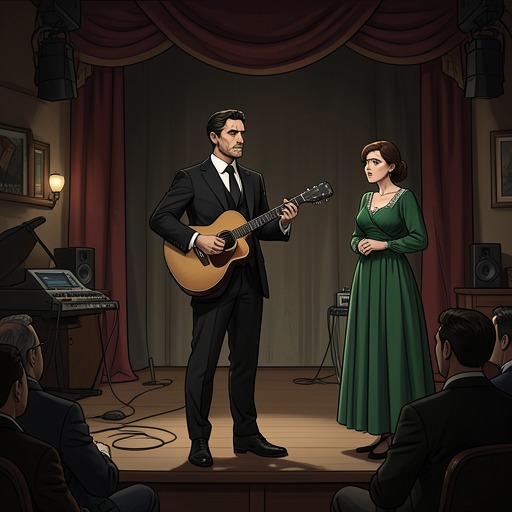
Billy is among the youngest performers and appears near the end of the programme. Before his solo, Bridget watches him walk to the piano with his music, looking small and frightened. Mr Wallaker comes over, whispers to Billy, and sits down at the piano. Bridget had not known that Mr Wallaker could play. He gives Billy a jazz introduction, then follows the uneven progress of the solo, gently accommodating each wrong note and wobble as Billy puffs through I’d Do Anything.
The bassoon’s importance here is not that Billy plays flawlessly, but that he continues while supported. Mr Wallaker adjusts his accompaniment to Billy rather than asking Billy to match an ideal performance. Bridget’s pride and worry converge in the moment: she thinks of how much she would do for her son, whose struggles are part of what makes the performance emotionally charged. When applause follows, Billy is bursting with pride. The instrument has carried him into a difficult public moment, but the performance is sustained by the care around him as well as by his own effort.
Left Behind and Retrieved
The bassoon recurs in a later, snowy church scene. Valerie, the school secretary, alerts Mr Wallaker that an enormous bassoon has been left in the church and asks what should be done with it. Bridget immediately recognizes it as Billy’s and offers to fetch it. Before she can go, Mr Wallaker says that he will retrieve it. When she objects that she can manage, he puts a hand firmly on her arm and repeats that he will get it.
After the gathering, Bridget suddenly remembers the instrument and starts back inside. Mr Wallaker stops her again with a gentle hand on her arm. She waits outside in the snow while he returns with the bassoon and a plastic bag of sausages, which he hands to her. The practical task ends in an incongruously ordinary bundle: a large instrument and supper supplies, both carried out by Mr Wallaker. The recurrence gives the bassoon a function beyond its musical use. It is an item that can be forgotten amid the activity of a school event, and its recovery creates a concrete opportunity for someone else to help.
Recurrence and Significance
The two appearances establish a quiet progression from Bridget bearing the bassoon’s weight to Mr Wallaker taking responsibility for retrieving it. At the summer concert, Bridget and Billy jointly transport the case through a wrong turn and across the grounds; during the later church gathering, she again assumes the forgotten instrument is hers to collect. Mr Wallaker’s repeated offer changes that pattern. His assistance is expressed not as a declaration but as an action: he goes back for Billy’s bassoon, then returns with it alongside the sausages.
The bassoon therefore connects two kinds of care. At the concert, Mr Wallaker’s sensitive piano accompaniment helps Billy complete a vulnerable solo; at the church, his practical intervention spares Bridget another trip inside. Neither moment turns the instrument into a symbol detached from its use. It remains Billy’s musical equipment, heavy enough to require carrying and important enough to go back for. Its repeated passage through other people’s hands makes the support surrounding Billy—and the ordinary labour of looking after him—visible.