Body Image and Weight Loss
Bridget Jones: Mad About the BoyBody Image and Weight Loss is a recurring concern in Bridget Jones’s diary, binding her grief and sexual self-doubt to a determined attempt to reshape her body. Her progress from feeling excluded from the world of sex to losing forty pounds and three dress sizes is real and medically monitored; it also exposes the shifting demands placed on women to look young, thin, stylish, and desirable. The diary finds comedy in Bridget’s changing self-assessments without treating the standards that provoke them as harmless.
The Body as a Measure of Desirability
In the aftermath of Mark Darcy’s death, Bridget describes herself as a Born-Again Virgin: she imagines herself shut out of a world of sex that modern advertising and public displays of affection continually put before her. Looking at the bulge beneath her black top, she connects her body to the belief that she is no longer sexually viable. She also anticipates widowhood as a process of becoming a little old lady, presenting that fate melodramatically in the hope that her friends will contradict her. Her distress is therefore not only about weight. It is entangled with grief, age, and the fear that sexual desirability has ended along with her marriage.
Talitha recasts this loss of confidence as a problem of self-presentation: Bridget has, in her formulation, misplaced her sexual self and must relocate it. Her proposed remedy is to alter the body’s signposts—reduce fat, remove wrinkles, and acquire shiny, swinging hair, however obtained. Tom’s interruption about hair purchased from impoverished Indian virgins punctures the makeover prescription, making its commercial and ethical costs part of the joke. The exchange captures a central tension: Bridget is urged to recover confidence through bodily alteration, while the extravagant language of the advice makes the promise of turning back time look like a sales pitch.
Medical Weight Loss and Changed Perception
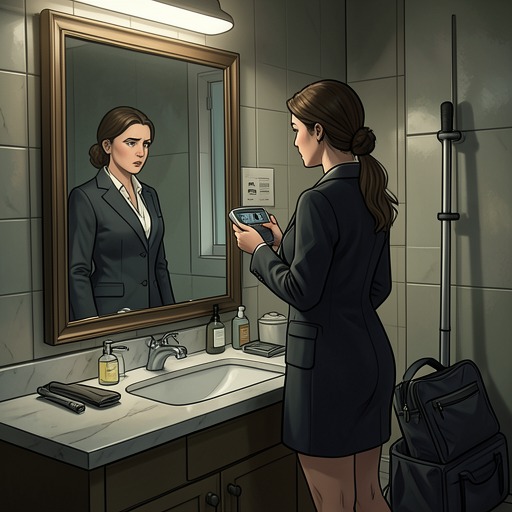
Bridget’s mirror turns that pressure into a comic physical image. She likens her upper body, while her arms and legs remain unchanged, to a large bird with a roll of fat around its middle; clothing makes her imagine a Christmas roast, while nudity evokes a bird cooked in a pot in Scotland. The image is deliberately grotesque, but it also shows how quickly her body becomes an object she inspects and judges. She decides that Talitha is right about changing the automatic positioning of middle-aged fat.
At the Obesity Clinic, the process becomes more complicated than a matter of willpower or a number on the scales. After awkwardly having to repeat the clinic’s name to the receptionist, Bridget encounters a very large patient wheeling his fat on a trolley. The sight makes fat appear to her as a distinct, tangible thing rather than a random act of nature: she begins to understand it as connected to what a person consumes. She also notices people looking at her with what she interprets as admiration, assuming they see a successful patient nearing the end of a programme. That moment briefly lifts her confidence, then she recognises that taking pleasure in the comparison is disrespectful to the other patients.
The clinic’s assessment includes blood tests, an ECG, and consultations; its staff initially classify Bridget as a geriatric mother, an uncomfortable label before the appointment proceeds smoothly. As she understands the advice, the goal is to reduce dress size rather than focus solely on body weight, and the relevant measure is the proportion of fat to muscle. She comes away believing that crash dieting without weight training can reduce muscle as well as weight, leaving a person lighter but proportionally fatter, and that she should go to the gym. Her prescribed diet consists of protein chocolate puddings and bars, followed by a small evening portion of protein and vegetables. The diary presents this as Bridget’s account of medical guidance, not as an independent verdict on the clinic’s claims.
Results, Recognition, and the Social Gaze
By August 2012, Bridget records a weight of 135 pounds, forty pounds lost, and three dress sizes dropped. The clinic declares her weight healthy and recommends maintenance; further loss, it tells her, would be for aesthetic rather than medical reasons. Her return to H&M ends with a size 10, turning an ordinary shopping trip into a milestone. The progression gives her efforts a concrete outcome, but the distinction between health and aesthetics also makes clear how easily the project can continue after its medical purpose has ended.
A later encounter with Daniel Cleaver makes the social consequences visible. Arriving late in a suit and bringing unsuitable gifts, Daniel remarks on Bridget’s diet and says he had thought he would never see her looking like this again. Bridget reflects that people treat her differently when she is fat and when she is not, and differently again when she is dressed up rather than simply herself. Her comparison imagines a planet populated by short, green, fat people whose advertising depicts only airbrushed, tall, thin, yellow figures. The fantasy makes the mechanism of comparison stark: the distress does not arise from a neutral assessment of bodies, but from repeated exposure to a narrow ideal presented as the norm.
Fashion, Beauty Work, and the Unfinished Project
The same pressure appears in Bridget’s response to celebrity coverage. A story judging Jessica Biel’s pantsuit by its distance from sexiness provokes her indignation: women, she argues in her diary, are offered red-carpet figures as role models, although those women arrive in borrowed clothes to be photographed and then return to their lives. Bridget nonetheless admits that she wishes she were one of them. The contradiction is revealing. She can recognise the artificiality of the image and still feel its pull.
After buying Grazia, she concludes that her own style is outdated and wrong, and imagines an approved uniform for the school run: skinny jeans, ballet pumps, a buttoned-up shirt, blazer, enormous handbag, and sunglasses worn like a celebrity at an airport. The timing sharpens the irony: the fashion verdict arrives just as she has to collect Billy and Mabel from school. Appearance is not an abstract concern detached from her daily responsibilities; it intrudes on the crowded routine of motherhood and work.
In June 2013, at 136 pounds, Bridget considers Botox after Talitha gives her a number and compares the procedure to going to the dentist. Bridget descends to a basement off Harley Street feeling as though she were going to a back-street abortionist, a sharp contrast with Talitha’s reassuring comparison. Together with the earlier makeover advice, this moment shows how bodily self-improvement expands beyond weight loss into the maintenance of youthful appearance. Across the diary, comic exaggeration and self-mockery reveal neither a simple triumph over insecurity nor a rejection of beauty practices: Bridget reaches a healthy weight, yet remains surrounded by messages that make her body feel perpetually open to revision.