Bridget Jones–Rebecca friendship
Bridget Jones: Mad About the BoyBridget Jones and Rebecca’s friendship grows from an accidental meeting into a vivid neighborhood bond built around their children, shared meals, and unpretentious mutual support. Its beginning is almost literally a collision: after Bridget Jones’s improvised parking leaves her car pressed against the vehicles around it, she discovers Rebecca sitting in the front seat, shouting at her children. The mishap becomes an opening rather than a grievance, and the friendship’s defining pattern soon emerges: embarrassment gives way to welcome, and domestic chaos becomes common ground.
A Collision Becomes an Introduction
Bridget Jones’s first encounter with Rebecca takes place during a difficult parking maneuver on their narrow, curved street, where cars line both sides. After fourteen attempts to reverse into a space, Bridget Jones resorts to what she calls Braille Parking, forcing the car into place by bumping the vehicles in front and behind. Her son Billy points out that someone is inside the car she has hit. Rebecca, in the front seat with her two children in the back, climbs out and examines her bumper; rather than rebuking Bridget Jones, she grins and disappears into her house. Rebecca’s two dark, wild-looking children appear to be close in age to Billy and Mabel, including an older boy and a younger girl. Bridget Jones takes this resemblance, and Rebecca’s amused response to the damage, as signs of potential kinship. She understands the exchange as the beginning of contact and imagines the two families moving onto a friendship road, while still wondering whether Rebecca might prove as disappointing as a spambot.
The friendship does not become established at once. On September 14, Bridget Jones sees Rebecca returning to her house in an elaborate outfit: a woollen hat with bobbles, platform Doc Martens, and a garment she compares to a mixture of a German officer’s coat and a crinoline. Rebecca recognizes her as the neighbor across the road and introduces herself. Bridget Jones, delighted and nervous, responds with a rapid series of questions about their children and a compliment about the hat. The conversation goes well enough for Rebecca to suggest that Bridget Jones knock on the door and bring the children over for a play date. Rebecca’s joke about how dispiriting the phrase sounds, and Bridget Jones’s awkwardly mimed response, make the invitation easy to accept without pretending that either woman is effortlessly conventional. As Bridget Jones crosses home, she is already imagining friendship and the possibility of introducing Rebecca to another acquaintance; Rebecca calls her back before that train of thought can carry her away.
Friendship Through Domestic Disorder
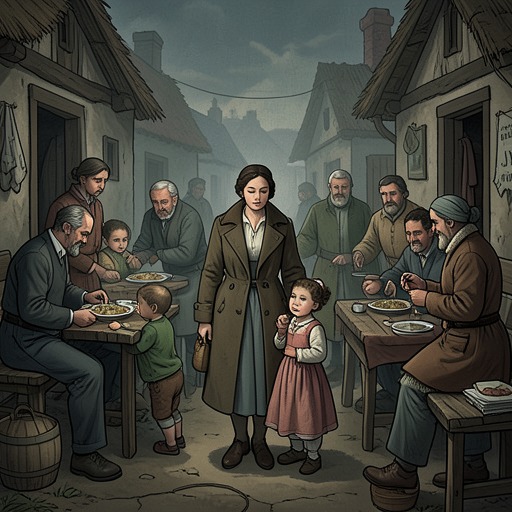
The relationship takes a more substantial form when Rebecca rings Bridget Jones’s doorbell after the school run in December. Her clothes are again striking: tartan knickerbockers, a low-cut frilly top, a heavy leather belt with chains and studs, and a robin-in-a-nest decoration in her hair. The invitation is immediate: Rebecca asks whether the household wants to come over. Bridget Jones, Billy, and Mabel respond with excitement and cross the road into Rebecca’s kitchen, a room with dark wooden floorboards, rough beams, an old school table, photographs, hats, paintings, and a huge bear statue. Beyond worn French windows lies a garden-like space of brick paths, long grass, a crowned life-size cow, a motel vacancy sign, and chandeliers in the trees. The unusual setting gives the visit a distinct atmosphere, but the friendship is made through ordinary company rather than display.
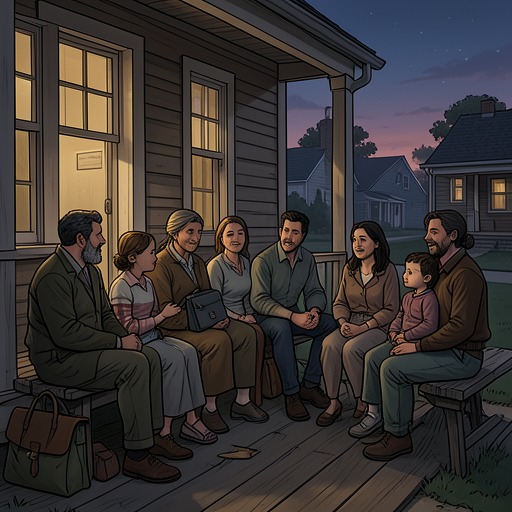
The evening is convivial and untidy. The adults drink wine at the kitchen table and push pieces of pizza toward the children; the girls dress Rebecca’s cat in scarves and doll’s clothes, while the boys protest when asked to stop playing Xbox. Rebecca admits that she can be too frightened of her own son to tell him to get off, then abruptly commands the boys to stop. Bridget Jones appreciates the relief of a friend who portrays her own children as worse behaved than hers. The moment is more than a shared joke: each household’s difficulties become speakable without requiring either mother to claim perfect authority. The children’s noisy behavior does not interrupt the friendship; it supplies its setting.
Shared Ideas About Raising Children
Over wine, Bridget Jones explains her ideal of parenting as resembling a large Italian family eating beneath a tree while children play. Rebecca offers a deliberately contrary theory: parents should behave as badly as possible so their children will rebel and turn out like Saffron in Absolutely Fabulous. The difference between the two ideas is part of the pleasure of the exchange. Bridget Jones imagines a warm, communal scene; Rebecca turns parental misbehavior into an extravagant strategy. Neither account is presented as a formal program being tested. Instead, the women use humor and speculation to share the pressures of family life without making the conversation solemn.
Their plans extend beyond the kitchen. They imagine casual suppers and holidays they will probably never take, including ferry journeys between the Greek Islands on a ferry-only InterRail pass. In the fantasy, adults and children travel with only a toothbrush, swimsuit, and floaty sarong. The details make the plans deliberately light and impractical, yet the imagining itself marks a change: these neighbors are now picturing future time together. The friendship has moved from a hopeful interpretation of a parking mishap to the easy invention of shared rituals and adventures.
The Christmas Invitation and Its Consequences
The friendship’s practical importance becomes clear at Christmas. Bridget Jones has first sent a round of messages to friends and acquaintances asking about their plans, and Rebecca asks about Christmas as the visit is ending. When Bridget Jones says she has nothing arranged, Rebecca invites the family to join hers. Bridget Jones accepts, carried away by the offer. The invitation is generous, but it arrives amid a rapidly multiplying set of commitments: by that evening, her attempts to arrange the holiday have produced what she experiences as an impossible overbooking problem.
Magda advises Bridget Jones not to rely on a neighbor she has only just met for Christmas and instead invites her to Gloucestershire. The eventual holiday is divided between that established plan and Rebecca’s continuing presence nearby. Christmas Eve and Christmas Day are spent with Magda and Jeremy; Rebecca’s invitation has already helped make the prospect of Christmas feel open rather than empty, and the families spend the rest of the period moving in and out of one another’s homes. They cross the road carrying pans of burnt food, complain about computer games, and visit back and forth. Rebecca treats the overbooking as comic rather than disastrous, even proposing outlandish future outings or, failing those, wine and burnt food. By December 31, Bridget Jones describes the Christmas period as having been perfectly fine, and imagines that the next year will be better still.
A Neighborhood Form of Companionship
Rebecca’s friendship with Bridget Jones is established through a sequence of small acts rather than a dramatic declaration: a grin after a parking scrape, a play-date invitation, an open door, a shared table, and an offer of Christmas company. The early contrast between Bridget Jones’s anxious hope that the neighbor might become a friend and their later movement between houses gives the relationship its shape. Rebecca does not solve every difficulty in Bridget Jones’s holiday planning, and the Christmas invitation itself contributes to the overbooking. Its importance lies instead in the companionship that persists through the confusion: a household across the road is available for food, jokes, complaints, and future plans. The friendship turns proximity into a modest but dependable community, with children, burnt food, and unfinished arrangements all included.