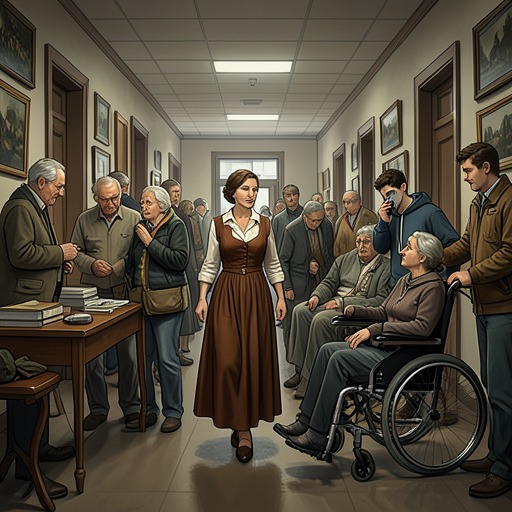
Bridget’s Mother
Bridget Jones: Mad About the BoyBridget’s Mother is an unnamed, widowed parent whose brisk advice and perfectionism can frustrate Bridget Jones, but whose own history of loss makes their conflicts more than a simple clash of temperaments. She urges her daughter to stop dwelling on widowhood and enjoy life, yet struggles to let Bridget Jones be herself. When that strain finally gives way, their shared grief over Mark Darcy and Bridget’s Father becomes visible beneath the advice and criticism.
Identity and Family History
Bridget’s Mother lives with Una at St Oswald’s House, an upscale retirement community near Kettering that its residents’ families are not permitted to call a retirement community. Its Victorian mansion, lake, Italianate garden, restaurants, coffee bar, hairdresser, gym, pool, and spa form a carefully furnished world of activities. Bridget’s Mother’s phone calls often arrive amid the scheduling demands of that world: in one, she calls about Christmas plans while Una is due for a cranio-facial appointment and Aqua-Zumba, having had her hair done beforehand. The comic mismatch between the elaborate arrangements and Bridget Jones’s bafflement makes the place feel both comfortable and faintly absurd.
Her history includes the death of Bridget’s Father, who died of lung cancer six months after diagnosis. He did, shortly before his death, hold newborn Billy Darcy. His death left Bridget’s Mother and Bridget Jones with a profound loss, although Bridget Jones observes that her mother and Una rarely show their grief openly. Una had Geoffrey, a close friend of Bridget’s parents for fifty-five years, until he died after a heart attack. Bridget Jones associates the older women’s ability to carry on cheerfully with their wartime generation, imagining it shaped by powdered eggs and whale-meat fritters. That inherited habit of endurance is both a source of resilience and a limit on how directly the women speak about pain.
Advice and the Work of Moving On
Bridget’s Mother recognizes that her daughter is bereaved, but often approaches that grief by urging action. She tells Bridget Jones not to listen to people who discourage her from moving on as a woman, insists she should find someone, and says she cannot continue feeling as she does. The advice is meant kindly, but its certainty sits uneasily beside Bridget Jones’s sense that there is no way out of her feelings at that moment. When Bridget’s Mother detects what she calls wallowing in her daughter’s voice, Bridget Jones tries to answer in a bright, positive manner; the effort only confirms to her mother that she is not convincing.
Her prescription for renewed enjoyment is practical and immediate: Bridget Jones could drive to St Oswald’s House, join her and Una, and get into the sauna. The suggestion overlooks the distance, the children, and the work of leaving them behind. A later call finds Bridget Jones hoping for a suitor, only to discover that her mother is asking whether she has decided about a cruise. These exchanges show how their priorities can pass one another: Bridget Jones is attentive to the emotional possibility of a call, while her mother has a concrete family plan to settle.
Grandmotherhood and Family Logistics
Bridget’s Mother is involved in the children’s lives, but her presence does not remove the pressure of coordinating care. During the end-of-school-year rush, Bridget Jones is trying to manage a long list of jobs, parties, pickups, and school commitments. The summer concert adds another complication: Billy Darcy is to play I’d Do Anything from Oliver! on his bassoon at Capthorpe House, and the surrounding arrangements generate a mass of messages. Bridget’s Mother takes Billy Darcy and Mabel Darcy to tea at Fortnum & Mason, a practical contribution that also brings the children into her own busy world.
Her help can come with scrutiny. After the children are home, Bridget’s Mother searches through the cupboards for a tea strainer, questions whether the phone has been left on because the children cannot behave themselves, and criticizes the flesh-pink dress Bridget Jones has worn. In another strained family gathering, the residents’ hard-hat celebration ends with Billy Darcy crying because he wanted to take part in the ceremony. Under stress, he tells Bridget Jones that everything is her fault and threatens to kill her; she, equally overwhelmed, answers in kind. Bridget’s Mother responds with shocked anger. The moment exposes the pressure surrounding childcare and family events: practical help, high expectations, and exhaustion do not always combine smoothly.
Grief, Conflict, and Reconciliation
The sharpest confrontation between mother and daughter begins with the dress and the phone, but quickly reveals a deeper wound. Bridget Jones bursts into tears and says that her mother always thinks she is doing everything wrong and tries to change her, even down to the colours she wears. Bridget’s Mother initially tells her to pull herself together and soldier on, repeating the instruction until she, too, breaks down. She apologizes, kneels in front of her daughter, and embraces her, calling her little girl. The stiff, crispy bouffant hair pressed against Bridget Jones during the embrace becomes an unexpectedly intimate detail: the mother’s familiar appearance is no longer merely a source of irritation but part of the comfort of being held.
In the embrace, Bridget’s Mother speaks of how dreadful Mark Darcy’s death was and admits how much she misses Bridget’s Father. She returns to the need to keep going, echoing the survival ethic that has shaped both women, while Bridget Jones counters that endurance can amount to papering over the cracks. Her mother also recognizes her own part in their difficulties: Bridget’s Father used to tell her to let their daughter be, but she admits that she cannot leave things alone and wants everything to be perfect. The apology does not erase the conflict; it makes its source legible, joining criticism, bereavement, and love in the same conversation.
Social Life and Narrative Role
Bridget’s Mother is not defined only by her role as a critic or caregiver. Later, as she cuddles Mabel Darcy, shares chocolate buttons, and drinks red wine, she becomes more open to the idea of Kenneth Garside as a possible suitor, though she observes that he is highly sexed. The scene places her enjoyment of company alongside the vulnerability and disorder of family life. Her husband’s death has not removed the possibility of attraction or amusement, even as the earlier pressure on Bridget Jones to find someone shows how personally she values renewed companionship.
Across these episodes, Bridget’s Mother embodies an uneasy version of soldiering on. She encourages her daughter to move forward, but the same injunction can silence grief; she offers help, but often packages it with instructions and corrections. Their reconciliation matters because it briefly suspends that pattern. Rather than perfecting Bridget Jones or fixing her sorrow, Bridget’s Mother acknowledges her own loss, admits her difficulty in letting go of control, and holds her daughter. The relationship remains imperfect, but the embrace reveals the affection that survives its frictions.