Cracked shells
Bridget Jones: Mad About the BoyCracked shells names a recurring contrast between polished appearances and private distress. Its clearest emblem is the phrase “THE SOUND OF SHELLS CRACKING,” which arrives after Bridget’s lonely, self-condemning diary entry. The image reaches beyond Bridget: Chloe’s supposed perfection gives way to heartbreak, Bridget and her mother break down together, and Nicolette’s immaculate presentation cannot protect her from betrayal. In each case, a composed exterior proves fragile; what follows is not a restoration of perfection, but a moment in which pain becomes visible to someone else.
The Image and Its Structure
The metaphor gains force from its placement. At 9.15 p.m., Bridget records that the children are asleep and that she is “very old and lonely.” She imagines that nobody will ever fancy her again, believes Mr Wallaker is having sex with Miranda, and concludes that everybody else’s life is perfect. The capitalized heading that follows turns an inward spiral into a sound-image: something that seemed intact has split. The next day, Bridget records weighing 136 pounds and being 46 pounds heavier than Miranda, giving her private comparison a numerical edge. The sequence connects the crack not to a dramatic external event alone, but to the pressure of judging herself against other people’s apparently complete lives.
The shell is therefore both protection and performance. The people in these scenes appear to have their feelings contained—by perfection, brisk advice, expensive clothes, or an immaculate picnic—but each surface gives way under a specific strain. The image does not make their difficulties identical. A romantic rejection, a mother-daughter quarrel, and the discovery of infidelity have different causes and consequences. What connects them is the sudden exposure of hurt that composure had concealed.
Perfection Gives Way
Chloe’s shell cracks during a rowing trip on the Serpentine. She has prepared an immaculate picnic hamper, complete with cutlery and china, and Graham’s announcement initially seems to her like a possible proposal. Instead, he says he has met somebody in Houston through YoungFreeAndSingle.com and is moving to Texas to live with her. The careful setting and the expectation of a declaration of commitment make the reversal especially sharp: the scene’s polish cannot soften the rejection.
Chloe interprets Graham’s explanation—that she is too perfect—as a judgment on the role she feels compelled to perform. Sobbing, she tells Bridget that she is not perfect and only pretends to be; she also fears Bridget dislikes her for seeming perfect. Bridget embraces her and denies that she thinks Chloe is perfect. Chloe’s hopeful question in response leaves the reassurance tender rather than conclusive: she wants to believe that she can be accepted without sustaining the image that has just been turned against her. The breakup thus exposes both the pain of losing Graham and Chloe’s unease about how others see her.
Bridget’s exchange with her mother makes the metaphor more reciprocal. Her mother criticizes Bridget’s practical habits, her top, and her choice of a flesh-pink dress, then urges her repeatedly to pull herself together and soldier on. Bridget bursts into tears and says that her mother sees her as rubbish, is always trying to change her, and thinks she does everything wrong—including what colours she wears. The advice meant to make Bridget cope instead becomes part of the pressure she is describing.
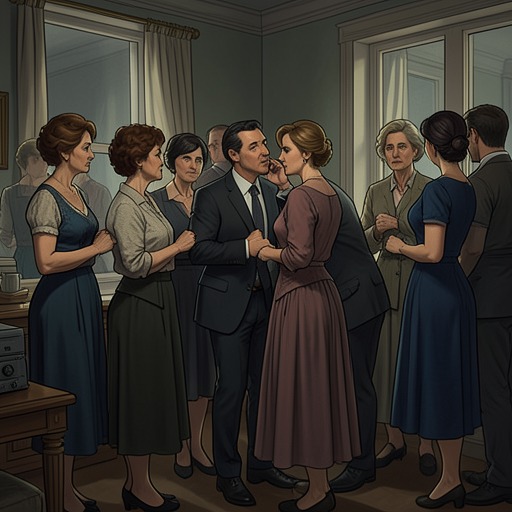
The scene changes when Bridget’s mother abruptly stops and looks at her. She apologizes, kneels awkwardly, puts her arms around Bridget, and calls her “My little girl.” Crucially, the mother then cries too. Neither woman remains securely on one side of the exchange as the composed fixer or the person who needs fixing: both are exposed, and the embrace follows their shared breakdown. The shell image helps read the scene as a crack in their familiar pattern of criticism and correction, not as proof that their differences have simply vanished.
Recognition and Shared Vulnerability
Nicolette’s episode extends the motif from intimate family and friendship scenes to the performance of social polish. Bridget sees her in a coffee queue wearing a white faux-fur jacket and sunglasses, with an enormous handbag, and expects a frosty greeting. Instead, Nicolette says the bag is Hermès and begins to shake. A receipt appears to show two handbags, but the detail that explains her distress emerges only when she tells Bridget that her partner bought the identical bag for another woman. Nicolette says the affair has been going on for eight months and that she called the other woman herself.
The bag, first displayed as a luxury object, becomes evidence of betrayal. Its matching duplicate punctures the reassurance that the purchase might have represented something exclusively hers. Bridget does not immediately understand why the receipt matters; once Nicolette explains, she responds by inviting her downstairs and awkwardly patting her shoulder. The movement from the public queue to an empty basement gives Nicolette space to show the hurt behind the composed appearance.
Bridget’s thought that, if Nicolette is having a breakdown, everybody is a mess of cracked shells makes the concept explicit. It is not a claim that everyone’s circumstances are alike; it is a recognition that outward confidence offers no reliable measure of inward security. Later, Nicolette’s furious email about the school concert—declaring that she does not care who brings the food or when anyone arrives—shows her distress spilling into an ordinary shared responsibility. Bridget responds by calling her, and Nicolette spends an evening at Bridget’s home while the children play Roblox and watch SpongeBob SquarePants. As Nicolette looks at OkCupid and curses the men there, the scene gives the cracked shell a social consequence: exposure can lead not to a cure, but to company and practical care.
What the Cracks Reveal
Across these episodes, “perfect” is less a description of a stable condition than a demanding appearance. Chloe says she pretends to be perfect; Bridget experiences her mother’s attempts to improve her as proof that she is thought to be doing everything wrong; Nicolette’s striking clothes and new handbag coexist with a hidden betrayal. Bridget, meanwhile, moves between seeing herself as irredeemably lonely and recognizing that women who seem more composed are also in trouble. The motif repeatedly unsettles the distinction between the person who is coping and the person who is falling apart.
The image also shifts the meaning of emotional disclosure. A crack is painful, and the book does not suggest that a hug, a phone call, or an evening together erases what caused it. Chloe still faces Graham’s departure; the mother-daughter exchange does not establish that criticism will never recur; Nicolette’s account leaves the affair and its consequences unresolved. Yet once the shell breaks, another person can answer the distress in front of them. Bridget comforts Chloe, her mother embraces Bridget, and Bridget makes room for Nicolette. The concept’s significance lies in that movement from apparent self-sufficiency to recognition: the break reveals vulnerability, and vulnerability makes mutual care possible.