Digital Technology and Social Media Anxiety
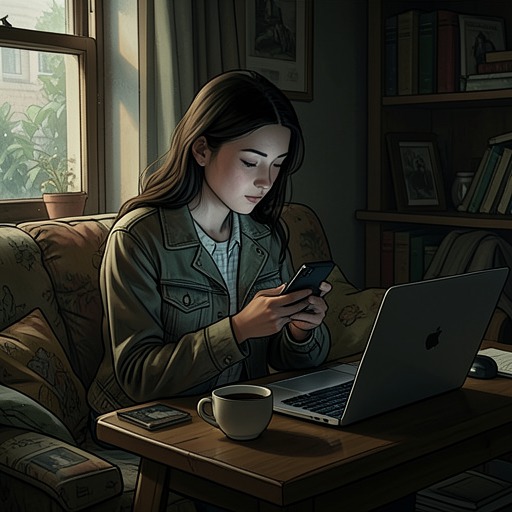
Bridget Jones: Mad About the BoyDigital Technology and Social Media Anxiety is a recurring feature of Bridget Jones’s life, where devices and platforms promise to connect people but repeatedly intensify frustration and uncertainty. Television remotes, Twitter counters, baby monitors, and text messages are not neutral background objects: each changes how Bridget experiences attention, parenting, and intimacy. The resulting comedy depends on a sharp mismatch between technology’s promise of effortless connection and the emotional labor required to use it.
Domestic Technology and Loss of Control
Bridget’s irritation first appears in her struggle to turn on the television. Faced with three remotes and ninety buttons, she experiences a routine household task as an opaque system designed for technologically confident young people. Her comic comparison of herself to a monkey with a mobile phone sits beside a more serious sense that such devices can leave people believing they alone are incapable. When she finally throws the remotes onto the sofa, the television starts by accident, revealing Talitha on air. The machine supplies the connection Bridget wanted, but only after defeating her attempts to control it.
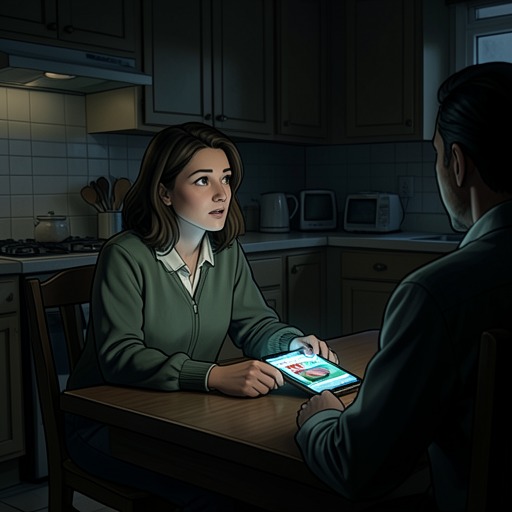
That collision between family life and malfunctioning technology becomes more consequential during a morning at home. While trying to manage the children and an Internet connection problem, Bridget’s frustration builds until she bursts into their bedroom and yells that she hates technology and wants to read the papers without interruption. She then discovers that the baby monitor is switched on. Her outburst has been transmitted to Billy, who is sobbing when she finds him downstairs. Bridget apologizes and tries to establish whether the monitor was the cause of his distress. The device meant to reassure a single parent has instead carried her anger into the children’s space, making private exasperation audible and turning technical dependence into a source of guilt.
A neighboring mother gives that frustration an outward, spectacular form. After Xbox remotes fly from an upstairs window and smash beside the dustbins, the neighbor comes outside carrying laptops, iPads, and iPods, then puts the electronics in the bin as her son and his friends protest. Her complaint is that children’s devices have made her their unpaid technician and concierge, while their attention is consumed by games. The scene does not resolve the conflict between adults and technology; it makes the household dependence visible by treating the devices as objects that can be discarded. Bridget’s immediate thought that she must befriend the woman makes the neighbor’s revolt an unexpected point of recognition.
Twitter, Visibility, and Measured Rejection
Bridget approaches Twitter with a hopeful premise: social media should mean that nobody has to feel isolated. That expectation collapses as soon as she encounters streams of fragmented conversations organized around usernames. She cannot work out how to follow what is happening, and the platform’s apparent openness offers little practical guidance. The problem is not simply learning a new interface; it is trying to enter a conversation whose participants and context already seem to exist elsewhere.
The follower count turns that confusion into a personal test. Bridget checks repeatedly and finds that she has no followers. Rather than treating the zero as a temporary feature of a new account, she fears that other users are talking to one another while ignoring her, perhaps even discussing her unpopularity. The number does not explain why nobody has followed her, but it becomes a stark, visible measure onto which she projects social rejection. Twitter promises an audience and immediately makes its absence countable.
The diary’s tallies carry the joke into bodily routine. Bridget records repeated checks alongside her weight and food consumption; in one entry she lists an extensive day of eating after noting that she still has no followers. She later reports being whitelisted by Twitter for checking her followers 150 times in one hour. The platform’s response is a striking reversal: the system notices and restricts her precisely because she has been trying so insistently to find out whether anyone notices her. Instead of an audience, she receives a limit on the act of looking for one.
Parenting and the Technology Household
These episodes place technological frustration within the uneven demands of single parenthood. The baby monitor is present because Bridget is anxious about the children’s safety, yet its continued use also leaves her vulnerable to being overheard. Her furious words, directed at the pressures around her, reach Billy before she can explain herself. The scene links technological surveillance not to an abstract debate about privacy but to a concrete domestic consequence: a child is hurt, and Bridget must repair the moment with an apology.
The neighbor’s decision to throw away the family’s devices echoes Bridget’s loss of patience while enlarging it into a confrontation over children’s dependence. Her son and his friends are still intent on finishing a game level as she rejects the role technology has assigned her. The comic force comes from the scale of the response, but the grievance is specific: the devices organize attention, demand service, and place the burden of keeping them working on adults. Bridget recognizes in this outburst a possible ally because it gives dramatic expression to a frustration she has just enacted in her own home.
Online Courtship and Textual Intimacy
Technology also opens a route into Bridget’s relationship with Roxster. His real name is Roxby McDuff; he works for an environmental charity and first encounters Bridget through Talitha, then moves from Talitha’s Twitter account to Bridget’s. Their connection begins through this chain of online visibility rather than through a planned introduction. When they meet, Roxster explains that he likes older women and asks Bridget why she is out with a younger man she met on Twitter. The platform has supplied an opening, but the conversation must still negotiate the age difference and what each person wants from it.
Their relationship develops over eleven weeks, with texting woven into a deliberately separate adult life. Because Roxster shares a home with three other young men and Bridget does not want to introduce him to her children too soon, they meet in pubs and small restaurants, go to films, and walk on Hampstead Heath. Their phones carry a running commentary on daily activities: the children’s school routine, Roxster’s problems with his boss, and what each of them is eating. The children become part of their exchanges even before they meet Roxster. Texting therefore bridges a practical separation, allowing the relationship to feel continuous without bringing him immediately into Bridget’s family home.
That continuity is not the same as certainty. After their breakup, a later message from Roxster says that he regrets the night of the curry and chicken pie, was confused and drunk, and misses Bridget. His text reopens a question that the message itself cannot settle: whether he wants to renew the relationship, and whether Bridget wants him to. When their texting resumes, Roxster explains that on the night he ended things he had been alone eating chicken korma, poppadoms, and lager, overwhelmed by the prospect of being a proper boyfriend and perhaps becoming a father figure. He also recalls Bridget seeming relieved by the breakup before her later outburst. The messages provide an account of his hesitation, but the warnings Bridget has received about mixed signals and a relationship consisting of texts and occasional sex remain part of her understanding.
The Double Edge of Connection
Across these episodes, technology alternates between failed access and intense availability. The television controls are difficult to master; Twitter makes social presence legible as a follower count; the baby monitor carries words farther than Bridget intends; and texts sustain a relationship across separate households while leaving its commitments open to interpretation. These are distinct problems, but each turns on a gap between what a device appears to offer and what it actually guarantees.
The diary form sharpens that gap. Bridget records follower totals, repeated checks, messages, and daily details, converting fluctuating social experience into numbers and logs. Such precision does not make her feel more secure: zero followers heightens her fear of exclusion, and a long-running exchange with Roxster cannot by itself answer what their relationship is becoming. Yet digital communication also has real relational force. It helps bring them together, sustains their shared commentary, and enables his apology and explanation to reach her. The book’s treatment of social technology is therefore neither simple condemnation nor uncomplicated celebration. Devices amplify connection, but they cannot guarantee that it will be understood, reciprocated, or secure.