Head-lice infestation among Bridget’s circle
Bridget Jones: Mad About the BoyHead-lice infestation among Bridget’s circle is a recurring domestic crisis in which uncertainty spreads faster than any confirmed account of who has lice. A school notice, a frightened child, and a celebrity treatment service set off checks, messages, hair-extension removal, and a costly family expedition. The episode’s comic escalation rests on a real burden: caring for children and protecting a wide social circle consumes time and money while displacing Bridget Jones’s work.
Scope and Uncertainty
The diary first records the scale of the worry through numbers rather than a clear medical inventory. On 23 April, Bridget Jones notes that she has spent 507 minutes dealing with lice instead of writing, and lists 23 people who might have been exposed through the family. The possible contacts include Tom, Jude, Jude’s recent dates, Talitha, Roxster, Arkis, Sergei, Grazina the Cleaner, Chloe, Brian the Agent, and the entire Greenlight Productions team. The suggestion that lice might travel down a phone is presented as a joke, underscoring how far the imagined chain of exposure has extended. This is a list of potential contacts, not evidence that all of them were infected.
The crisis arrives just as Bridget Jones is trying to begin official rewriting work on The Leaves in His Hair. Her first account of the day is a proud declaration that the script has become real work; shortly afterwards, the writing proves difficult, and the infestation concerns compete for her attention. The entry’s tally of zero minutes spent writing against 507 minutes spent dealing with lice gives the interruption a precise measure. The infestation is not simply an inconvenience at home: it takes over the hours she had intended to devote to her precarious screenwriting work.
The School Notice and Mabel’s Distress
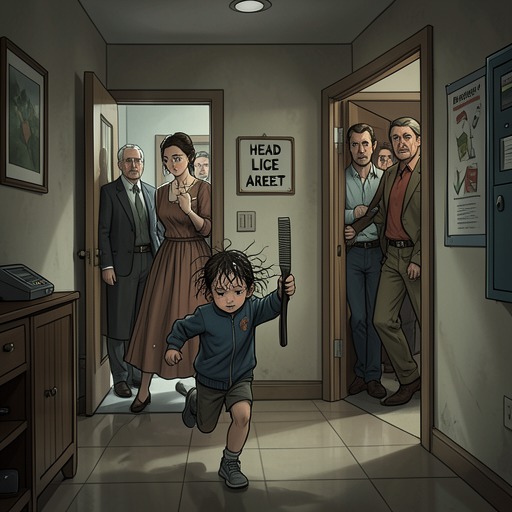
The outbreak becomes personal when Mabel comes home holding a letter for parents in the Infants Branch. It reports that a child in Briar Rose has head lice and asks families to obtain a suitable comb and products and to check their children before school. Mabel reads the notice as identifying her: she sobs that she is the child who has infected Briar Rose. Her distress gives the anonymous wording a child’s frighteningly direct meaning.
Bridget Jones comforts Mabel, explaining that the notice refers to Cosmata and that no lice were found on Mabel. She also suggests that the school may have written child when it meant several people. The reassurance does not make the episode’s uncertainty disappear; the hug itself prompts Bridget Jones to worry that they might reinfest one another. The scene links the practical task of checking hair with the emotional work of convincing a child that she is not to blame.
Treatment, Cost, and Social Spillover
Talitha’s response turns the search for treatment into another strand of the crisis. During a meeting about the screenplay, messages from Talitha provide a running account of her visit to a Celebrity Nit Nurse in Notting Hill. Talitha reports that no lice have been found yet, then says that the nurse has found lice on her and that clearing her head will cost £130. The diary preserves the uncertainty around both the diagnosis and the price: the charge seems so high that Talitha is not sure she believes the nurse.
That evening, Bridget Jones helps Talitha remove her hair extensions. Oil has to be rubbed into the glue before the extensions can be pulled out and inspected. The inspection finds many dark dots in the glue but no live insects, which the Celebrity Nit Nurse has already removed. The procedure is difficult and distressing, and the extensions will cost hundreds of pounds to replace. Bridget Jones offers to pay, taking responsibility despite being unsure that the lice were her fault. The episode thus extends beyond a search for insects: treatment affects Talitha’s appearance and brings a substantial possible expense into their friendship.
A text from Tom adds a counterpoint to the growing alarm. He reports that lice and pubic lice are not the same thing, says he appears to have neither, and notes that Arkis finds the situation funny and treats it as a bonding experience. The distinction matters because the infestation narrative has become so absorbing that even the terminology can blur. Bridget Jones also worries that material about the difference between head lice and pubic lice may have appeared on screen during the screenplay meeting, another awkward intrusion of the subject into professional life.
The Nit-Nurse Expedition and Aftermath
On 27 April, the diary records 32 lice and eggs extracted and calculates a cost of £8.59 per dead louse. The family’s expedition to the nit nurse is, in Billy’s assessment, extreme fun; the diary says that everyone enjoys it. Assistants dressed entirely in white vacuum everyone’s hair, report that they have found nothing, and then use a very hot hairdryer. The reassuring result sits beside the earlier report that the nurse had found and removed insects from Talitha, and beside the record of 32 lice and eggs extracted. The episode therefore does not resolve every account into a single neat diagnosis.
The bill changes the mood. The service costs £275, a sum that prompts Bridget Jones to compare it with a possible trip to Euro Disney and to wonder whether a mini-vacuum and a very hot hairdryer could do the job at home. The nurse says the equipment is specially designed, with a vacuum from Atlanta and a Heat Destroyer made in Rio de Janeiro. That explanation gives the treatment the air of a technical spectacle while leaving its steep cost plainly visible.
The wider diary shows why such disruptions feel cumulative. Bridget Jones’s lists already include children’s parties, pickups, work, and the coordination of other adults; she laments how complicated child-rearing has become and how much effort seems required to keep the children engaged and happy. Later, the approaching end of the school year brings plays, trips, themed days, teacher presents, and mass emails about Billy’s summer concert. Against that crowded calendar, the lice episode is a concentrated instance of a larger pressure: a small household emergency demands investigation, coordination, emotional reassurance, and money from a parent whose time is already divided among work and care.